
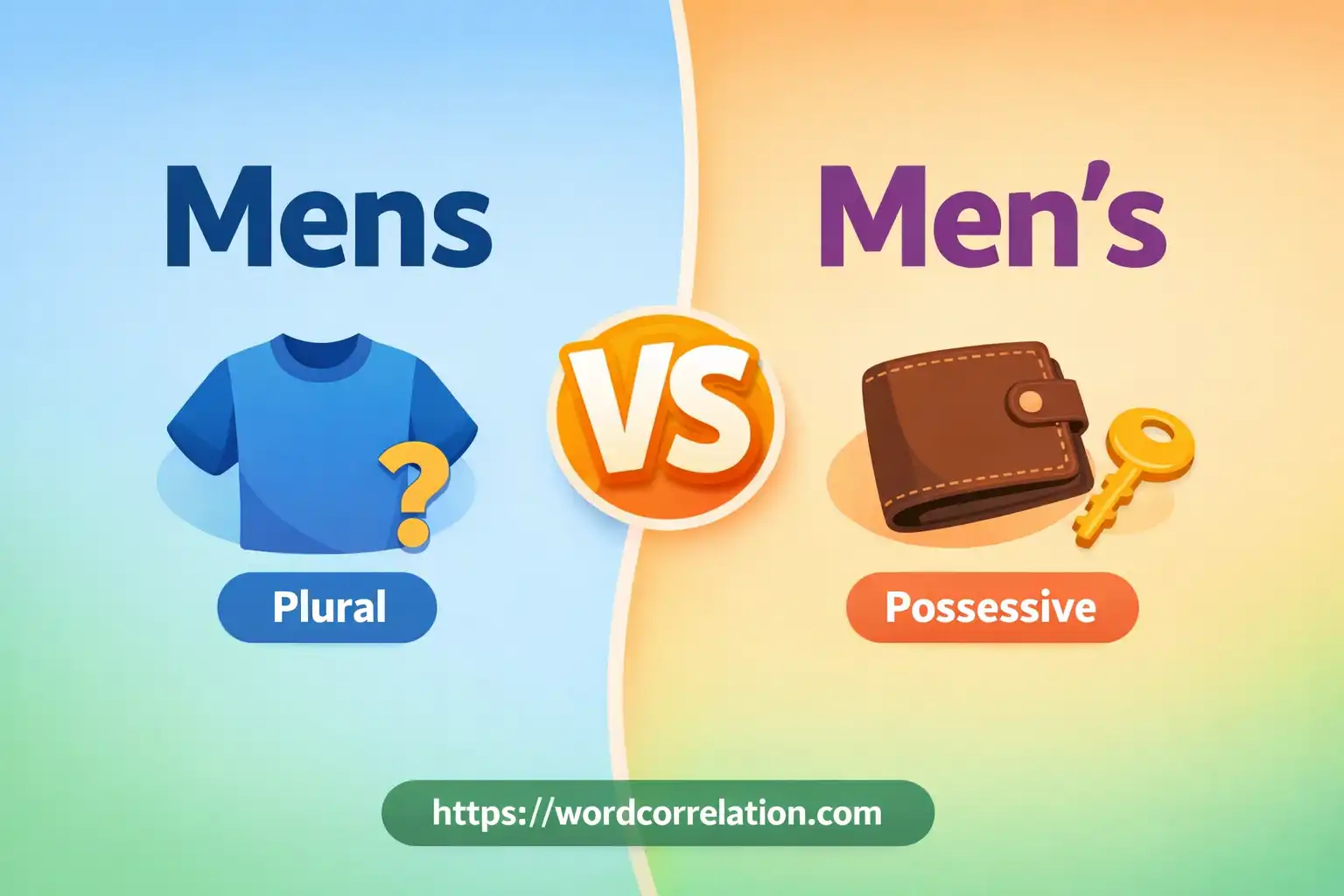
When deciding between men’s or mens, standard English grammar requires men’s with an apostrophe before the “s.” The word men is already plural (referring to more than one adult male), so adding an apostrophe followed by an “s” creates the plural possessive form. The unpunctuated spelling mens is not a standard English word on its own, though it frequently appears as an unpunctuated search shortcut, URL slug, or element of compound nouns like menswear.
Understanding how irregular plural nouns form possessives will ensure your writing remains grammatically precise across professional documents, marketing copy, and everyday communication.
Quick Answer: Men’s vs Mens at a Glance
| Term | Part of Speech | Standard Status | Primary Meaning | Correct Context / Usage | Example |
|---|---|---|---|---|---|
| Men’s | Plural Possessive Noun / Modifying Adjective | Standard English | Belonging to, designated for, or associated with men. | Apparel, facilities, sports divisions, health, and publications. | “The men’s basketball team won the regional championship.” |
| Mens | Non-standard Form | Misspelling (Except in compounds) | Lacks standard grammatical function as a standalone noun. | Unpunctuated e-commerce URLs, database tags, or compound words (menswear). | “The store catalog categorized the jackets under menswear.” |
| Men | Plural Noun | Standard English | Two or more adult male human beings. | Counting, grouping, or describing multiple male individuals. | “Three men attended the morning strategy session.” |
What Does “Men’s” Mean?
Definition and Grammatical Role
Men’s (pronounced /mɛnz/) is the plural possessive form of the irregular noun man.
In English grammar, regular nouns form plurals by adding “-s” or “-es” (e.g., dog becomes dogs), and their plural possessive form adds an apostrophe after the “-s” (e.g., dogs’ toys). However, man is an irregular noun that forms its plural by changing its internal vowel to become men.
Because men is already plural without an ending “-s,” you show possession or association by applying the standard possessive suffix ‘s.
Use men’s whenever something belongs to, is designed for, or is associated with a group of adult males.
- Pronunciation:
/mɛnz/(menz) - Part of Speech: Plural Possessive Noun / Attributive Adjective
Example Sentences for “Men’s”
- Retail & Fashion: “The department store relocated the men’s apparel section to the second floor.”
- Sports & Athletics: “She has coached the university’s men’s tennis team for over eight seasons.”
- Facilities & Architecture: “The executive suite includes a newly renovated men’s locker room.”
- Health & Wellness: “The medical journal published a special issue dedicated entirely to men’s preventative health.”
- Publications & Media: “He subscribed to a popular men’s lifestyle magazine for grooming and fitness advice.”
- Product Descriptions: “These men’s leather boots feature waterproof lining and reinforced stitching.”
- Legal & Professional: “The firm established a scholarship fund supporting men’s mental health initiatives.”
What Does “Mens” Mean?
Standard Grammar vs. Digital Conventions
As a standalone word, mens does not exist in standard English dictionaries. It is a common misspelling caused by assuming that all plural nouns end in “-s” or by omitting punctuation.
However, mens appears in two specialized digital and structural contexts:
- Compound Nouns: In words like menswear, the apostrophe is omitted by lexical convention to form a single, seamless compound word describing clothing for men.
- Digital Search & E-Commerce URLs: Search engines, database parameters, and website URLs often strip punctuation for technical simplicity (e.g.,
domain.com/mens-shoes). While acceptable in web addresses or back-end code, the apostrophe must be restored in visible, user-facing body copy.
- Pronunciation:
/mɛnz/(menz) - Status: Non-standard as an independent word; valid inside established compound words (menswear).
Contextual Usage and Corrections for “Mens”
Below are examples showing how incorrect instances of standalone mens should be corrected in formal writing:
- E-Commerce Copy Correction:
- Incorrect: “Browse our newest arrival of mens shirts.”
- Correct: “Browse our newest arrival of men’s shirts.”
- Compound Word Exception: “The fashion brand launched a sustainable menswear line this autumn.”
- Signage Correction:
- Incorrect: “The mens restroom is located near the main foyer.”
- Correct: “The men’s restroom is located near the main foyer.”
- Editorial Correction:
- Incorrect: “The league organized a mens league tournament.”
- Correct: “The league organized a men’s league tournament.”
- Database Parameter (Technical Context Only): “The filter query uses
category=mens_jacketsto fetch database records.” - Academic Writing Correction:
- Incorrect: “The study analyzed mens psychological responses to stress.”
- Correct: “The study analyzed men’s psychological responses to stress.”
- Retail Tagging Correction:
- Incorrect: “All mens outerwear marked down by twenty percent.”
- Correct: “All men’s outerwear marked down by twenty percent.”
Clarifying Related Noun Forms: Man’s, Men, Men’s, and Mans
To prevent sentence-level confusion, examine how vowel changes and apostrophes alter the meaning of this noun family:
┌─────────────────────────────────────────────────────────┐
│                    NOUN FORM TREE                       │
├──────────────┬──────────────────┬───────────────────────┤
│ Form         │ Number           │ Grammatical Role      │
├──────────────┼──────────────────┼───────────────────────┤
│ Man          │ Singular         │ Subject / Object      │
│ Man's        │ Singular         │ Singular Possessive   │
│ Men          │ Plural           │ Subject / Object      │
│ Men's        │ Plural           │ Plural Possessive     │
│ Mans (verb)  │ Singular Action  │ 3rd-Person Verb       │
└──────────────┴──────────────────┴───────────────────────┘
- Man (Singular Noun): Refers to one male adult. (“A man answered the telephone.”)
- Man’s (Singular Possessive): Belongs to one individual male. (“That man’s umbrella left behind.”)
- Men (Plural Noun): Refers to multiple male adults. (“Several men gathered in the courtyard.”)
- Men’s (Plural Possessive): Belongs to or serves multiple male adults. (“The men’s locker room updated.”)
- Mans (3rd-Person Singular Verb): Describes the action of staffing or operating something. (“She mans the reception desk every afternoon.”)
Men’s vs Mens: Key Differences
| Feature | Men’s | Mens | Men |
|---|---|---|---|
| Dictionary Status | Standard headword / form | Non-standard standalone word | Standard plural headword |
| Grammatical Function | Plural Possessive | Typographical error / URL slug | Plural Subject or Object |
| Requires Apostrophe? | Yes (before the s) | No (omitted incorrectly) | No apostrophe needed |
| Meaning | Belonging to / intended for men | N/A (or compound element) | Two or more adult males |
| Common Collocations | men’s clothing, men’s room, men’s health | menswear (as compound) | young men, group of men |
| Plural Formation Category | Irregular plural possessive | Improperly regularized plural | Irregular plural |
Why People Confuse These Words
The confusion between men’s and mens arises from three main factors in English language acquisition and digital habits:
1. Overapplication of Regular Plural Rules
In standard English, most plural nouns end in “-s” (e.g., cats, cars, desks). Writers frequently overapply this rule to irregular plurals, assuming that to make men express possession or categorization, they should simply append an “-s” without punctuation (mens).
2. Identical Pronunciation
Both men’s and the incorrect form mens are pronounced identically as /mɛnz/. Because spoken communication provides no acoustic signal for an apostrophe, writers often forget to insert the punctuation mark when translating speech to text.
3. Digital Search and E-Commerce Formatting
E-commerce navigation menus, URL structures, and search engine queries frequently drop punctuation marks for technical cleanliness. Users regularly type “mens jackets” into search bars without an apostrophe. Over time, seeing unpunctuated search terms creates false visual familiarity, causing writers to believe mens is acceptable in standard prose.
Memory Trick to Remember the Difference
Use the “Owner’s Hook” rule to instantly verify your punctuation:
The Apostrophe is an “Owner’s Hook” (‘):
- MEN = The group (more than one man).
- MEN’S = The group + the ‘s hook that hangs their belongings on the rack.
If the noun owns, holds, or designated for the group (clothing, rooms, sports teams, health), attach the hook (‘s). If you are simply counting or describing the group itself (“Five men walked in”), leave the hook off!
      [ MEN ]  +  ['s Hook]  =  [ MEN'S ]
   (The Group)   (Possession)   (For/Belonging to Men)
Example Sentences Side-by-Side
Comparing matched contexts demonstrates how choosing the correct form ensures clarity and professional presentation:
| Context | Correct Plural Possessive (men's) | Correct Plural Subject (men) | Misspelling to Avoid (mens) |
|---|---|---|---|
| Retail & Apparel | “We are shopping in the men’s department.” | “Three men requested assistance from the clerk.” | “We are shopping in the mens department.” |
| Athletics | “The men’s relay team set a national record.” | “The men trained twice daily for the event.” | “The mens relay team set a national record.” |
| Facilities | “The men’s entrance is on the west side.” | “The men entered through the front door.” | “The mens entrance is on the west side.” |
| Healthcare | “Cardiology is vital to men’s wellness.” | “Many men skip annual checkups.” | “Cardiology is vital to mens wellness.” |
| Publishing | “She edits a men’s lifestyle journal.” | “The men voiced their opinions during the interview.” | “She edits a mens lifestyle journal.” |
Common Mistakes People Make
1. Writing “Mens'” with the Apostrophe After the “S”
- Incorrect: “The mens’ locker room is closed for cleaning.”
- Correct: “The men’s locker room is closed for cleaning.”
- Why it happens: Writers confuse irregular plurals with regular plurals. Regular plurals ending in “-s” place the possessive apostrophe at the end (e.g., the teachers’ lounge). Because men is already plural without an “-s,” placing the apostrophe after the “-s” (mens’) creates a double-plural mistake.
2. Omitting the Apostrophe in Commercial Copy
- Incorrect: “Our online store offers premium mens shoes.”
- Correct: “Our online store offers premium men’s shoes.”
- Why it happens: Copywriters sometimes duplicate search engine queries directly into readable text. While search engines process unpunctuated keywords, professional prose requires standard punctuation.
3. Confusing “Man’s” (Singular) with “Men’s” (Plural)
- Incorrect: “The store expanded its man’s clothing section.”
- Correct: “The store expanded its men’s clothing section.”
- Why it happens: Both forms are possessive, but man’s indicates something belonging to a single male (a man’s hat), whereas retail sections and sports teams serve a collective group (men’s clothing).
Frequently Asked Questions
Is “mens” ever a real word in standard English?
No. Mens is not a standard standalone word in English dictionaries. The correct plural possessive noun is men’s. The only exception occurs when mens is combined without punctuation into an established compound word, such as menswear.
Why is it “men’s” and not “mens'”?
Because men is an irregular plural noun that does not end in “-s.” In English grammar, irregular plurals form possessives by adding ‘s to the end of the word (e.g., children’s, women’s, men’s). Placing an apostrophe after the “s” (mens’) is incorrect because mens is not a valid base noun.
Should I write “men’s clothing” or “mens clothing”?
You should always write men’s clothing in formal writing, editorial content, and professional copy. While “mens clothing” appears frequently in unpunctuated internet search queries, standard grammar requires the apostrophe.
Is there any difference between American and British English for this word?
No. Both American and British English follow identical rules for irregular plural possessives. Both language standards prescribe men’s for possessive or descriptive usage and classify mens as a misspelling.
What is the difference between “men’s” and “menswear”?
Men’s is a possessive noun phrase (e.g., men’s apparel or men’s shoes), requiring an apostrophe. Menswear is an accepted closed compound noun referring broadly to clothing designed for men, written as a single word without an apostrophe.
How do I know whether to use “men” or “men’s”?
Use men when you are simply referring to or counting multiple male individuals (e.g., “Five men arrived”). Use men’s when describing something that belongs to, is intended for, or is associated with men (e.g., “the men’s restroom”).
Conclusion
Choosing between men’s and mens comes down to applying standard punctuation rules for irregular plural nouns:
- Use men’s (with an apostrophe before the “s”) for all possessive contexts, department names, sports teams, and product descriptions intended for men.
- Avoid mens as an independent word in formal writing, reserving it only for established compound words like menswear or internal database search parameters.
- Use men (without an “s”) when simply referring to two or more male individuals as a subject or object.

Ibrahim Jhon is an English language editor with over ten years of experience working with writers, publishers, and international businesses. He specialises in word choice, grammar accuracy, and the differences between British and American English.