Many people stop when they write this word. They ask one simple question. Should I write realisation or realization? This confusion appears in school work, emails, blogs, and even professional reports. However, the problem is not about meaning. Instead, the problem is about spelling. Both forms look correct. Both sound the same. Therefore, writers feel unsure and slow down.
This article removes that stress. First, it explains why this confusion exists. Next, it shows how British and American English handle this word. Moreover, it gives clear rules that anyone can follow. You will also see real examples from daily life. In addition, common mistakes appear with simple fixes. As a result, you will know exactly which spelling to choose.
This guide uses very simple English. Short sentences help you read fast. Clear examples help you remember. By the end, you will never doubt this word again. Overall, this article solves one clear problem. It tells you how to write the word correctly every time.
For regional spelling differences, the word comparison hub provides quick context.
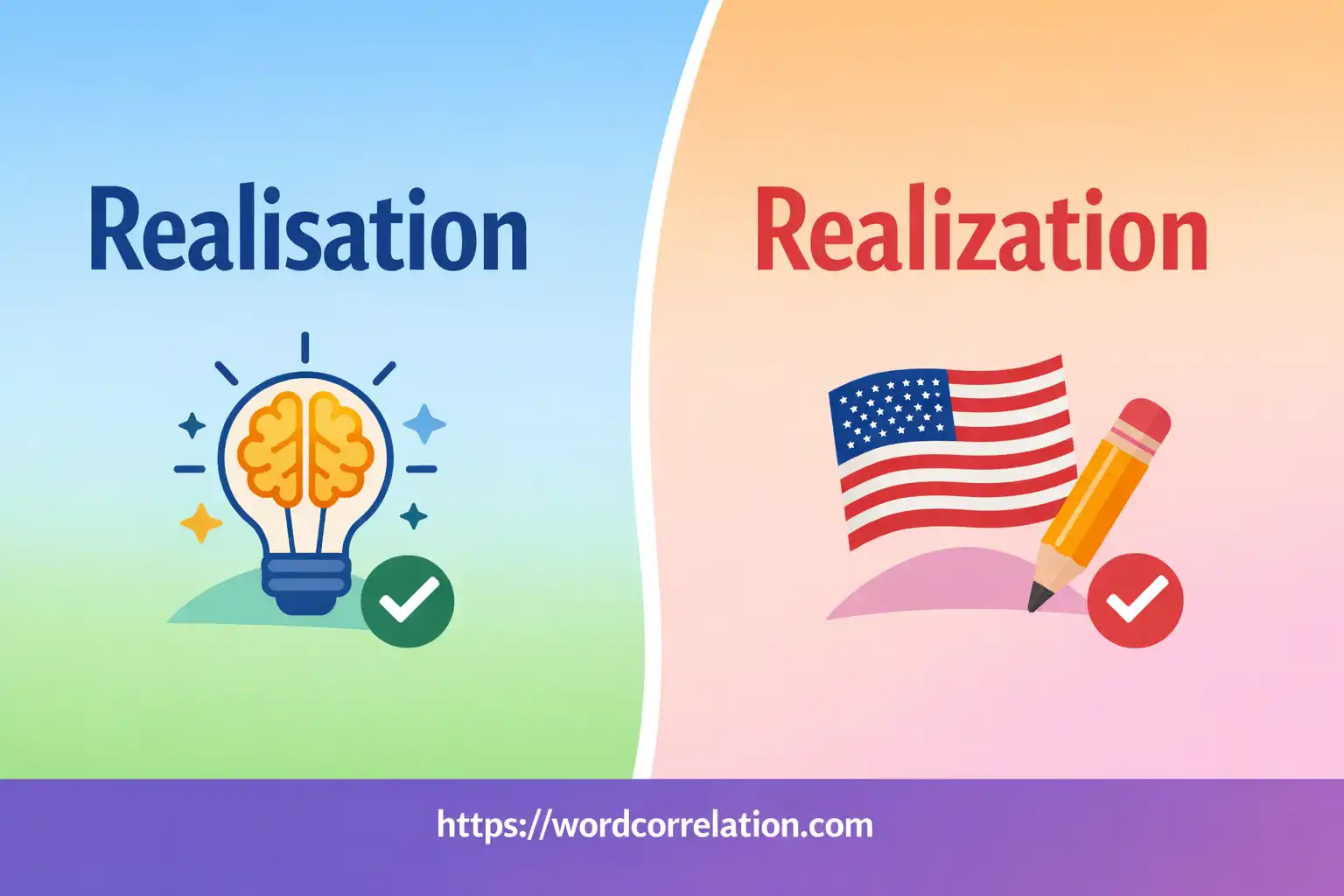
Realisation or Realization – Quick Answer
- Both words have the same meaning
- The difference is spelling, not usage
- Realization = American English
- Realisation = British English
Example:
- US: I had a realization today.
- UK: I had a realisation today.
The Origin of Realisation or Realization
The word comes from Latin. It started from the idea of “making something real.” Later, French influenced English spelling. As English spread, spelling styles changed. Therefore, two correct spellings appeared.
British English kept -ise and -isation forms. American English later simplified many words. As a result, -ize and -ization became common in the United States. However, the meaning stayed the same.
This history explains the confusion. People see both spellings online. Students read books from different countries. Meanwhile, the internet mixes all writing styles. Because of that, writers hesitate.
This is part of our UK vs US pillar for spelling style differences.
British English vs American English Spelling
British and American English follow different spelling rules. However, the meaning never changes. The difference is visual only.
In British English, words often end with -ise. In contrast, American English prefers -ize. This rule applies to many words.
Examples:
- Realisation (UK)
- Realization (US)
- Organisation vs Organization
- Visualisation vs Visualization
Quick Comparison
| Style | Spelling | Example |
| British English | Realisation | UK schools, BBC |
| American English | Realization | US colleges, CNN |
Therefore, spelling depends on location, not correctness.
Which Spelling Should You Use?
The right choice depends on your audience. First, think about who will read your writing.
For the United States
Use realization. Schools, companies, and media expect this form.
For the UK and Commonwealth
Use realisation. This fits British standards.
For global or professional writing
Choose one style and stay consistent. Many international companies prefer American English. However, British English is also acceptable.
Consistency matters more than choice. As long as you do not mix spellings, your writing stays professional. A closely related example is visualization or visualisation.
Common Mistakes with Realisation or Realization
Many errors happen because of habit or auto-correct. Below are frequent mistakes with fixes.
❌ I had a realisation in my US college essay.
✅ I had a realization in my US college essay.
❌ The report uses realization and realisation together.
✅ The report uses one spelling only.
❌ Realisation is more formal than realization.
✅ Both are equally formal.
These mistakes confuse readers. Therefore, always match spelling to audience.
Realisation or Realization in Everyday Examples
This word appears everywhere. Context does not change the spelling rule.
Emails
- I came to a realization after our meeting.
- She reached a realisation about the deadline.
News
- The realization shocked investors.
- The realisation changed public opinion.
Social Media
- That realization hit hard today.
- This realisation made me smile.
Professional Writing
- Market realization improved profits.
- Policy realisation requires planning.
Each example shows the same meaning. Only spelling changes.
Realisation or Realization – Google Trends & Usage Data
Search behavior shows clear patterns. American users search realization more. British users prefer realisation. Meanwhile, students often search both together. This shows confusion.
ESL learners also compare spellings. Writers check which version sounds correct. Professionals usually follow style guides.
Correct usage increases with education level. However, mistakes still appear online. As a result, comparison searches stay popular.
Realisation vs Realization Comparison Table
| Feature | Realisation | Realization |
| Meaning | Understanding something clearly | Understanding something clearly |
| Part of Speech | Noun | Noun |
| Context of Use | UK and Commonwealth | United States |
| Formal or Informal | Both | Both |
| Common Mistakes | Used in US writing | Used in UK writing |
| Correct Example | A sudden realisation occurred. | A sudden realization occurred. |
This table removes all doubt.
FAQs About Realisation or Realization
Is realisation the same as realization?
Yes. Meaning stays the same.
Which spelling is correct in formal writing?
Both are correct. Choose by region.
Can they be used interchangeably?
No. Avoid mixing styles in one text.
Why do people confuse them?
English has regional spelling rules.
Can grammar tools catch this mistake?
Sometimes. However, tools depend on language settings.
Is there a British vs American difference?
Yes. That difference causes the spelling change.
Conclusion
Overall, realisation and realization mean the same thing. The only difference is spelling. British English uses realisation. American English uses realization. Therefore, location decides the form.
Many writers worry because they see both versions online. However, the rule is simple. Match spelling to your audience. Stay consistent throughout your text. Avoid mixing styles in one document. You’ll spot the same pattern again in optimisation or optimization.
In short, do not overthink this word. Meaning never changes. Context stays the same. Only spelling shifts with region. Finally, remember one easy rule.
US audience = realization. UK audience = realisation.

Jonathan Swift is a writer whose work reflects sustained attention to language precision, meaning, and the practical effects of word choice. Trained in classical studies and theology, he develops a disciplined approach to writing that combines close textual analysis with a strong concern for clarity and accuracy. His essays, pamphlets, and satirical works show a consistent method: examining how words are used, misused, and reshaped to influence public understanding.
Swift’s writing demonstrates an early form of semantic analysis. He compares terms, exposes false equivalence, and highlights how subtle differences in wording alter meaning, intent, and interpretation. This analytical focus allows readers to see language not as decoration, but as a tool that shapes thought, policy, and belief.
By breaking down complex expressions into their functional parts, Swift helps readers distinguish between surface language and underlying meaning. His work remains valuable to audiences interested in word comparison, rhetoric, and the responsible use of language. Across genres, his reputation rests on careful reasoning, linguistic discipline, and a consistent commitment to helping readers read more critically and precisely.