
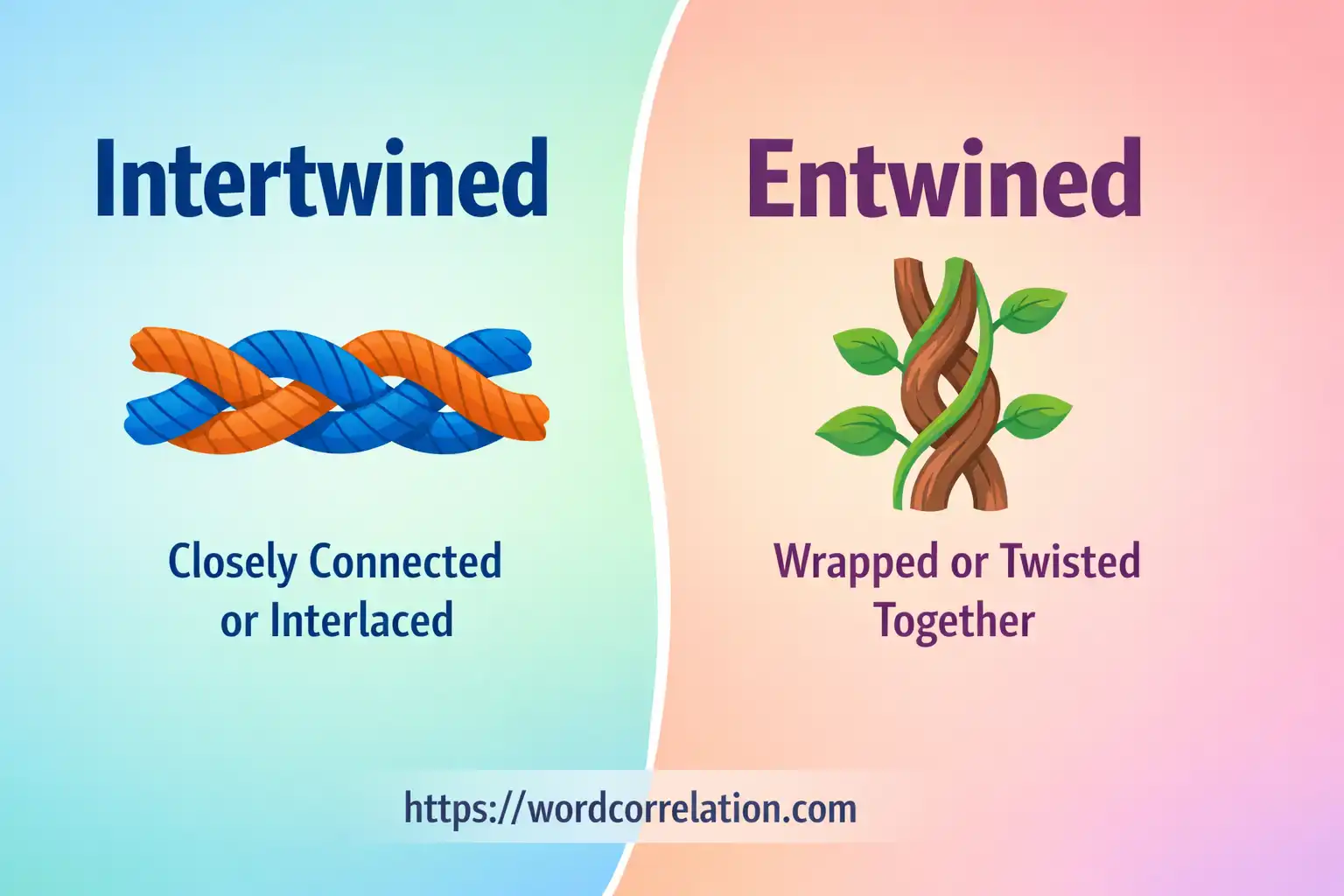
When describing two things that are woven together, you might pause and wonder whether to write intertwined or entwined. Because both words stem from the same root verb and share nearly identical core definitions, writers frequently treat them as interchangeable synonyms in everyday prose.
Intertwined describes two or more elements that mutually twist around each other, creating a complex, multi-strand connection. Entwined describes one element wrapping around another object, or two items joined in a gentle, sensory, or romantic embrace.
Here is a quick breakdown to help you pick the precise term for your exact writing context:
Quick Answer Table (At-a-Glance)
| Word | Part of Speech | Core Focus | Quick Example |
|---|---|---|---|
| Intertwined | Adjective, Verb (past) | Mutual connection between two or more equal strands | The economies of the two neighboring nations are deeply intertwined. |
| Entwined | Adjective, Verb (past) | One item wrapping around another; romantic or gentle link | Fresh ivy was entwined around the marble pillar. |
What Does “Intertwined” Mean?
Part of Speech & Pronunciation
- Part of Speech: Adjective, Verb (past tense / past participle of intertwine)
- Pronunciation:
/ˌɪn.tɚˈtwaɪnd/(pronounced in-ter-TWYND)
Definitions & Structural Contexts
The word intertwined relies on the Latin-derived prefix inter- (meaning “between” or “among”). It emphasizes a reciprocal, multi-directional linkage where both strands twist together simultaneously:
- Physical Mutual Weaving: Two or more cords, wires, or threads twisted over and under one another in a balanced pattern.
- Complex Abstract Links: Ideas, systems, historical events, or economies that are so closely integrated that separating them is nearly impossible (frequently paired as inextricably intertwined).
- Symmetric Relationship: A scenario where item A twists around item B just as much as item B twists around item A.
6 Example Sentences in Different Contexts
- Economic Context: Financial analysts reported that domestic inflation and global supply chain disruptions have become deeply intertwined.
- Political Context: The diplomatic history of both territories shows that their cultural identities are inextricably intertwined.
- Biological Context: Under the microscope, the scientist observed how the double-helix strands were intricately intertwined.
- Literary Context: The novel features three intertwined plot lines that merge during the dramatic final chapter.
- Personal History Context: Growing up in a small farming village meant that our family histories were closely intertwined.
- Abstract Philosophy Context: The essay argues that personal freedom and civic responsibility are permanently intertwined.
What Does “Entwined” Mean?
Part of Speech & Pronunciation
- Part of Speech: Adjective, Verb (past tense / past participle of entwine)
- Pronunciation:
/ɪnˈtwaɪnd/(pronounced en-TWYND)
Definitions & Structural Contexts
The word entwined uses the prefix en- (meaning “to cause to be in” or “enfold”). It focuses on the action of encircling, wrapping around, or forming an intimate, sensory connection:
- Asymmetric Physical Twining: One flexible object winding around a fixed central core (e.g., a vine wrapping around a trellised post).
- Intimate or Romantic Union: Physical closeness between people, such as holding hands or hugging.
- Poetic or Aesthetic Wrapping: Decorating or weaving elements together for visual or emotional appeal.
6 Example Sentences in Different Contexts
- Romance Context: The newlyweds sat quietly on the garden bench with their fingers lovingly entwined.
- Botanical Context: Wild honeysuckle vines had entwined around the wooden fence posts over the summer.
- Artistic Context: The sculptor crafted a bronze masterpiece depicting two figures entwined in a dance posture.
- Craft Context: She carefully entwined colorful silk ribbons into her daughter’s long hair for the festival.
- Historical Narrative Context: Local folklore remains entwined with ancient local superstitions about the forest.
- Poetic Context: The author described the evening fog as a cold ribbon entwined around the city streetlights.
Intertwined vs Entwined: Key Differences Comparison Table
| Feature | Intertwined | Entwined |
|---|---|---|
| Prefix Focus | Inter- (between, mutual, reciprocal) | En- (in, upon, enfolding) |
| Directionality | Symmetric (both strands twist around each other) | Asymmetric or Enfolding (one strand wraps on another) |
| Dominant Tone | Academic, formal, systemic, technical | Romantic, sensory, botanical, poetic |
| Common Collocation | Inextricably intertwined | Fingers entwined / Vines entwined |
| Formal Business Use | Preferred for corporate or political analysis | Less common in formal data reports |
Why People Confuse These Words
The confusion between this word pair stems from their shared root, overlapping dictionary definitions, and identical suffix:
1. The Shared Root Word (Twine)
Both words build upon the English verb twine, which originates from the Old English twin (meaning “double thread” or “twisted strand”). Because both words describe physical or figurative twisting, major dictionaries treat them as near-synonyms in general contexts.
2. Prefix Distinctions (Inter- vs En-)
While casual speech treats them identically, precise writers distinguish them using prefix logic:
- Inter- signifies mutual interaction between multiple entities. When you describe two global markets, both influence each other equally, making intertwined the natural fit.
- En- signifies enfolding or bringing into a state. When a climbing vine grows around a oak tree, the tree does not twist around the vine. Because the action is one-directional, entwined is structurally more accurate.
Memory Trick to Remember the Difference
Use this simple mental technique to pick the right spelling every single time:
INTERtwined = INTERactive & Mutual
Look at the prefix INTER:
Think "INTERnational" or "INTERactive."
Use INTERtwined when TWO or MORE things interact and twist together mutually!

ENtwined = ENfold & ENwrap
Look at the prefix EN:
Think "ENfold" or "ENwrap."
Use ENtwined when ONE thing enfolds or wraps around an object (like fingers or vines)!
Visual Mental Technique
Whether you prefer American English (visualization) or British English (visualisation), mental imagery helps lock this rule in place. Picture two ropes twisted together in a braid for intertwined, and picture a green vine wrapped around a tree trunk for entwined.
Example Sentences Side-by-Side
| Context | Using INTERTWINED Correctly | Using ENTWINED Correctly |
|---|---|---|
| Nature & Gardening | The two willow branches grew intertwined like a woven arch. | Morning glory vines entwined around the metal porch railing. |
| Human Relationships | Their business affairs became intertwined over a decade. | They walked along the shoreline with their hands entwined. |
| Writing & Media | The documentary explores how politics and media are intertwined. | The fairy tale is entwined with local romantic legends. |
| Abstract Ideas | Fate and free will are complex, intertwined philosophical concepts. | Her personal happiness was deeply entwined with her art. |
Common Mistakes People Make
1. Using “Entwined” for Equal Systemic Relationships
- Less Precise: The fiscal policies of the two countries inextricably entwined.
- More Precise: The fiscal policies of the two countries inextricably intertwined.
- Why: In academic, economic, and political analysis, connections are reciprocal. The established phrase in professional journal style guides inextricably intertwined.
2. Overusing “Intertwined” for Gentle or Physical Touches
- Less Precise: They sat on the porch with their fingers intertwined in a romantic gesture.
- More Precise: They sat on the porch with their fingers entwined in a romantic gesture.
- Why: While not strictly ungrammatical, intertwined can sound overly technical or mechanical in romantic fiction. Entwined offers a softer, more poetic cadence.
3. Assuming One Word Is Incorrect
- Mistake: Believing that entwined is an informal misspelling of intertwined.
- Fact: Both words are fully standard English verbs and adjectives with centuries of literary precedent.
Frequently Asked Questions (FAQ)
Is there any grammatical difference between intertwined and entwined?
Grammatically, both words function as past-tense verbs and participial adjectives. They follow identical syntactic rules. The difference lies in subtle semantic nuances regarding symmetry, tone, and collocation.
Can intertwined and entwined be used interchangeably?
In general, everyday conversation, yes. Most dictionaries list them as synonyms. However, in formal academic writing, intertwined is preferred for mutual systems, while entwined preferred in creative writing for physical wrapping or romantic contexts.
What does “inextricably intertwined” mean?
“Inextricably intertwined” a common idiomatic phrase meaning two or more things are so complicatedly bound together that they cannot be separated or disentangled.
How do I decide between intertwined or entwined in creative writing?
Choose entwined when you want to evoke intimacy, softness, or one object wrapping around another (e.g., serpents entwined around a staff). Choose intertwined when emphasizing complexity, multi-strand weaving, or structural knotting.
Is it “intertwined with” or “intertwined in”?
Both prepositions are correct depending on sentence structure. “Intertwined with” far more common when linking two distinct nouns (e.g., Science intertwined with technology).
Conclusion
Deciding whether to write intertwined or entwined comes down to evaluating the relationship between the objects you are describing:
- Select intertwined when describing reciprocal, complex, or systemic relationships where multiple strands twist around each other equally.
- Select entwined when describing one object wrapping around another, or when aiming for a romantic, sensory, or poetic tone.
For polished writing, audit your manuscript to ensure your word choice aligns with your intended tone—whether in corporate reporting or literary fiction.

Ibrahim Jhon is an English language editor with over ten years of experience working with writers, publishers, and international businesses. He specialises in word choice, grammar accuracy, and the differences between British and American English.