Many people search for bodies or body’s because these two forms look similar. However, they do not mean the same thing. Therefore, writers often feel unsure. Students hesitate. ESL learners get confused. Meanwhile, grammar tools sometimes fail to explain the real reason clearly.
This confusion usually happens because of the apostrophe. For example, people think an apostrophe always shows plural. In contrast, English uses apostrophes for ownership, not for making words plural. As a result, many emails, posts, and even news articles contain this mistake.
This article solves that problem step by step. First, it explains what bodies and body’s really mean. Then, it shows where people go wrong. Moreover, it gives easy rules you can remember fast. Additionally, you will see real-life examples from daily writing. Finally, you will learn one simple rule that removes doubt forever.
Grammar clarity is provided in the word comparison hub.
Bodies vs Body’s – Quick Answer
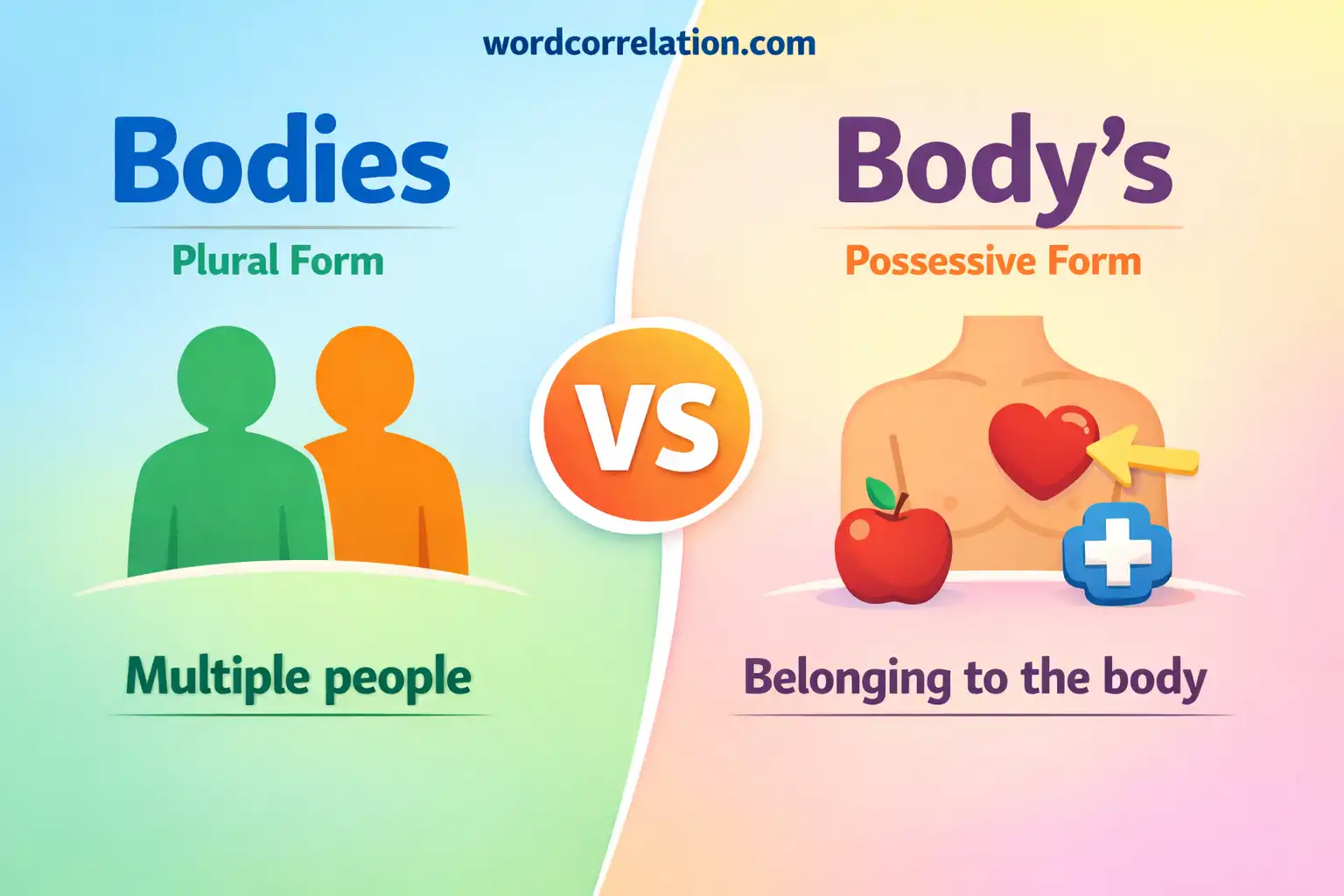
- Bodies = plural of body
Example: Many bodies were found. - Body’s = shows ownership by one body
Example: The body’s temperature was high.
Rule:
No apostrophe for plurals.
Apostrophe shows ownership only.
The Origin of Bodies vs Body’s
The word body comes from Old English bodig. It meant the physical form of a person or animal. Over time, English added plural rules. Therefore, body became bodies in plural form.
However, English also created possessive forms. As a result, writers added apostrophes to show ownership. That is how body’s appeared.
The confusion started because both forms end with s. Meanwhile, spoken English sounds similar. Therefore, learners often mix them up. In contrast, written English demands clear structure.
In short, history shows one word with two different jobs. One shows number. The other shows ownership.
If you want clear grammar simple rules, and zero confusion, this guide will help you fully.
British English vs American English Spelling
There is no spelling difference between British and American English for this case. However, usage mistakes appear worldwide.
| Feature | Bodies | Body’s |
| UK English | Plural | Singular possessive |
| US English | Plural | Singular possessive |
| Difference | None | None |
In contrast to words like colour and color, this rule stays the same everywhere. Therefore, location does not change the grammar.
Which Spelling Should You Use?
The right choice depends on meaning, not country.
For US writers
Use bodies when talking about more than one body.
Use body’s when one body owns something.
For UK or Commonwealth writers
The rule stays the same. Therefore, follow meaning, not accent.
For global or professional writing
Always check the sentence meaning first. Moreover, remove the apostrophe if you mean plural.
Quick tip:
Count the bodies. If more than one, never use an apostrophe.
Common Mistakes with Bodies vs Body’s
Many errors follow the same pattern. However, they are easy to fix.
❌ The victim’s bodies were identified.
✅ The victims’ bodies were identified.
❌ Human body’s need water.
✅ Human bodies need water.
❌ The bodies’ temperature was low.
✅ The body’s temperature was low.
Why mistakes happen:
People add apostrophes when they see s. In contrast, English grammar works differently.
Bodies vs Body’s in Everyday Examples
Emails
- The bodies were moved today.
- The body’s report is attached.
News
- Rescue teams found three bodies.
- The body’s condition shocked doctors.
Social Media
- Our bodies need rest.
- My body’s reaction surprised me.
Formal or Professional Writing
- The study examined animal bodies.
- The body’s immune response improved.
These examples show clear meaning. Therefore, context always guides the choice. A similar apostrophe issue appears in girls or girl’s.
Bodies vs Body’s – Google Trends & Usage Data
Search data shows high confusion globally. Moreover, grammar forums discuss this daily.
- Countries: US, UK, India, Philippines
- User types:
- Students
- ESL learners
- Writers
- Professionals
Correct usage appears less often than mistakes. As a result, many readers search for clarification. Therefore, learning this rule gives you an advantage in writing accuracy.
Comparison Table: Bodies vs Body’s
| Feature | Bodies | Body’s |
| Meaning | More than one body | Ownership by one body |
| Part of speech | Noun (plural) | Possessive noun |
| Context of use | Countable objects | Showing possession |
| Formal vs informal | Both | Both |
| Common mistakes | Adding apostrophe | Using for plural |
| Correct example | Healthy bodies matter. | The body’s balance changed. |
This table removes confusion instantly.
Semantic FAQs (People Also Ask)
Is bodies the same as body’s?
No. Bodies is plural. Body’s shows ownership.
Which one is correct in formal writing?
Both are correct. However, meaning decides usage.
Can they be used interchangeably?
Never. They serve different grammar roles.
Why do people confuse them?
Apostrophes confuse learners. Spoken English also hides the difference.
Can grammar tools catch this mistake?
Sometimes. However, manual checking works best.
Is there a British vs American difference?
No difference exists at all.
Conclusion
Overall, bodies vs body’s confusion comes from one small mark. However, the rule stays simple. Bodies means more than one body. Body’s shows that one body owns something. Therefore, meaning always comes first.
In short, never use an apostrophe for plurals. Moreover, always ask one question: Am I showing ownership? If the answer is no, remove the apostrophe. As a result, your writing becomes clear and professional. Get a deeper understanding with possession rules explained. The same rule applies in story’s or stories.
Finally, remember this easy rule:
Plural = no apostrophe. Possession = apostrophe.
Follow it every time. Your grammar will improve instantly.

H.G. Wells was a trained scholar and professional writer whose work reflects a rigorous approach to language, meaning, and precision. Educated in science and deeply engaged with journalism, essays, and social commentary, Wells developed a disciplined research habit that shaped both his nonfiction and analytical writing. His background in factual inquiry informed a careful use of words, where definitions, nuance, and context mattered as much as ideas themselves.
Across essays, criticism, and explanatory prose, Wells demonstrated a sustained interest in how language frames understanding. He often clarified subtle differences between related terms, helping readers grasp distinctions that affect interpretation and argument. This attention to semantics and accuracy supports readers who value clear meaning over rhetoric.
Wells’s writing serves audiences seeking reliable explanations and thoughtful comparisons rather than opinionated language. His work reflects an editorial standard built on evidence, clarity, and reader trust, offering lasting value to those who want to understand how precise word choices shape knowledge and communication.