
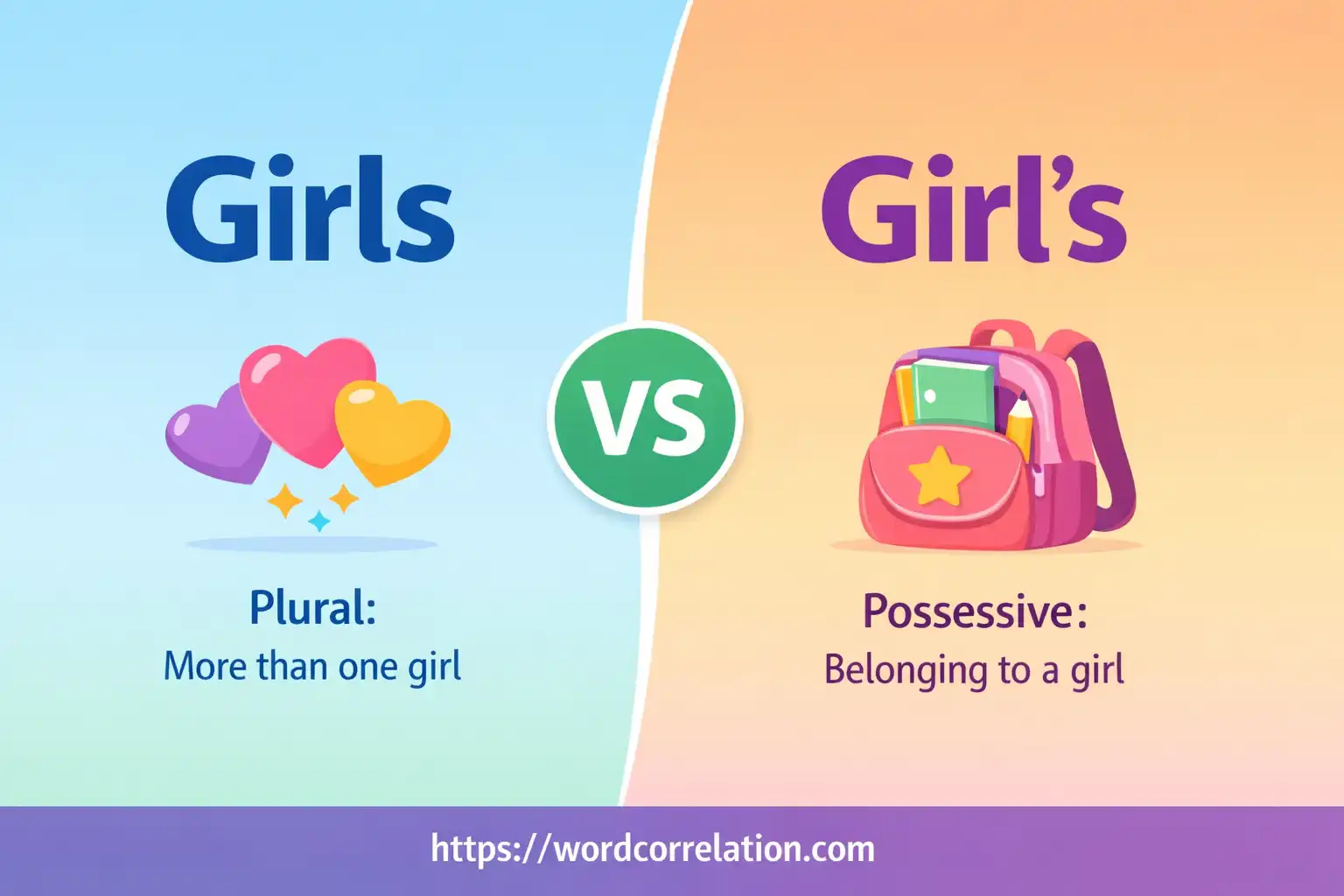
When deciding between girls’ or girl’s, the correct choice depends on how many girls you are describing and whether ownership is involved. Girl’s (with the apostrophe before the s) is the singular possessive form, indicating that something belongs to one girl. Girls’ (with the apostrophe after the s) is the plural possessive form, showing that something belongs to or is associated with two or more girls.
Understanding where to place the possessive apostrophe ensures your writing is clear, professional, and grammatically accurate.
Quick Answer: Girls’ vs. Girl’s at a Glance
| Term | Grammatical Role | Apostrophe Placement | Primary Meaning | Example Context |
|---|---|---|---|---|
| Girl’s | Singular Possessive Noun | Before the s ('s) | Belonging to or associated with one girl. | “The girl’s coat was hanging on the peg.” |
| Girls’ | Plural Possessive Noun | After the s (s') | Belonging to or designated for multiple girls. | “The girls’ basketball team won the final match.” |
| Girls | Plural Noun (Non-Possessive) | No apostrophe | Two or more girls (no ownership expressed). | “Three girls joined the science club today.” |
What Does “Girl’s” Mean?
Definition and Grammatical Role
Girl’s (pronounced /ɡɜːrlz/ — gurlz) is the singular possessive form of the noun girl.
In English punctuation, when a regular singular noun owns or is connected to an object, you add an apostrophe followed by the letter s ('s). Use girl’s whenever a single female child or young woman possesses, controls, or is directly linked to the noun that follows.
- Base Word: Girl (singular noun)
- Apostrophe Position: Before the s (
's) - Key Idea: Ownership by one single girl
Example Sentences for “Girl’s”
- Personal Belongings: “The young girl’s backpack was decorated with colorful enamel pins.”
- Physical Attributes: “The girl’s bright smile put everyone in the waiting room at ease.”
- Family Relationships: “The girl’s parents met with the school counselor to discuss her academic progress.”
- Creative Output: “The judge commended the girl’s original painting for its vibrant colors.”
- Pet Ownership: “The girl’s golden retriever puppy ran across the yard to greet her.”
- Academic Work: “The teacher handed back the girl’s essay with encouraging notes in the margins.”
- Medical Context: “The doctor checked the girl’s temperature before issuing a prescription.”
What Does “Girls'” Mean?
Definition and Grammatical Role
Girls’ (pronounced /ɡɜːrlz/ — gurlz) is the plural possessive form of the noun girl.
When a regular noun is pluralized by adding an s (forming girls), English grammar rules specify that you show possession by adding a single apostrophe after the existing s (s'). You do not add an extra s (writing “girls’s” is incorrect).
Use girls’ when describing items owned by a group of girls, or when describing spaces, groups, and events designated specifically for girls (such as a girls’ night out or a girls’ school).
- Base Word: Girls (plural noun)
- Apostrophe Position: After the s (
s') - Key Idea: Ownership or designation involving two or more girls
Example Sentences for “Girls'”
- Facilities & Shared Spaces: “The athletic department recently renovated the girls’ locker room.”
- Team Sports & Organizations: “The girls’ soccer team celebrated their championship victory with ice cream.”
- Social Events: “The old college friends organized a weekend girls’ trip to the mountains.”
- Institutional Names: “She attended a prestigious girls’ academy in central London.”
- Shared Property: “The girls’ bedroom was filled with stacked bookshelves and art supplies.”
- Group Achievements: “The principal praised the girls’ joint effort in organizing the charity fundraiser.”
- Apparel Categories: “The department store has expanded its selection in the girls’ clothing section.”
What About “Girls” (Without an Apostrophe)?
It is essential to distinguish possessive forms from the simple plural noun girls.
Girls (no apostrophe) refers simply to more than one girl. It carries no ownership or possession whatsoever.
- Correct (Plural): “The girls walked to school together.”
- Incorrect (Plural with unnecessary apostrophe): “The girl’s walked to school together.” (Greengrocer’s apostrophe error)
Example Sentences for “Girls”
- “Four girls represented the school at the national debate tournament.”
- “The girls laughed when the magician pulled a rabbit from his hat.”
- “Many young girls dream of pursuing careers in aerospace engineering.”
- “The coach gathered the girls on the field for a pre-game pep talk.”
- “Two girls volunteered to hand out programs at the theater entrance.”
Girl’s vs. Girls’: Key Differences
| Feature | Girl’s | Girls’ | Girls |
|---|---|---|---|
| Grammar Category | Singular Possessive | Plural Possessive | Plural Noun |
| Number of People | Exactly one girl | Two or more girls | Two or more girls |
| Shows Ownership? | Yes | Yes | No |
| Apostrophe Placement | Before s ('s) | After s (s') | None |
| Common Collocations | girl’s bag, girl’s voice, girl’s dream | girls’ night, girls’ school, girls’ team | girls and boys, group of girls |
Why People Confuse These Words
The confusion between girls’ or girl’s arises primarily because all three words—girl’s, girls’, and girls—are homophones. They sound identical in spoken conversation (/ɡɜːrlz/).
Because speech gives no audible clue as to where the apostrophe belongs (or whether one is present at all), writers must rely entirely on grammatical context:
┌─────────────────────────────────────────────────────────────┐
│                 APOSTROPHE DECISION MATRIX                  │
├──────────────┬──────────────────┬───────────────────────────┤
│ Target Word  │ Punctuation      │ Grammatical Function      │
├──────────────┼──────────────────┼───────────────────────────┤
│ Girl's       │ Apostrophe IN    │ ONE girl owns something   │
│              │ before the 's'   │                           │
├──────────────┼──────────────────┼───────────────────────────┤
│ Girls'       │ Apostrophe OUT   │ MULTIPLE girls own or     │
│              │ after the 's'    │ share something           │
├──────────────┼──────────────────┼───────────────────────────┤
│ Girls        │ NO apostrophe    │ Merely multiple girls     │
│              │                  │ (no ownership)            │
└──────────────┴──────────────────┴───────────────────────────┘
The Two Core Punctuation Rules
- Singular Possessive Rule: Take the singular noun (girl) and add
's$\rightarrow$ girl’s. - Plural Possessive Rule: Take the plural noun ending in s (girls) and add an apostrophe at the end $\rightarrow$ girls’.
Memory Trick to Remember the Difference
Use the “Inside vs. Outside” mnemonic rule:
INside the S = ONE Girl (Girl’s):
- The apostrophe is inside (before) the s. Think of a single girl tucked safely inside her house.
OUTside the S = SEVERAL Girls (Girls’):
- The apostrophe is outside (after) the s. Think of a group of girls playing outside together!
      [ G I R L ' S ]                   [ G I R L S ' ]
              │                                 │
   Apostrophe INSIDE the S             Apostrophe OUTSIDE the S
     = ONE single girl!                = SEVERAL girls in a group!
Example Sentences Side-by-Side
Seeing all three forms in matching contexts clarifies how apostrophe placement alters meaning:
| Context | Singular Possessive (girl's) | Plural Possessive (girls') | Simple Plural (girls) |
|---|---|---|---|
| Sports | “The girl’s tennis racket was freshly strung.” (One girl’s racket) | “The girls’ tennis team qualified for regionals.” (Team of girls) | “The girls played tennis for two hours.” (Multiple girls playing) |
| Education | “The teacher checked the girl’s homework assignment.” (One girl) | “The principal spoke at the girls’ high school.” (School for girls) | “Several girls finished their assignments early.” (Multiple girls) |
| Social Gatherings | “I attended my girl’s birthday party.” (One daughter/friend) | “We planned a fun girls’ night out.” (Group of female friends) | “The girls arrived at the party together.” (Multiple girls) |
| Clothing | “The girl’s jacket was left on the chair.” (One girl) | “The store expanded its girls’ apparel department.” (Department for girls) | “The girls wore matching winter jackets.” (Multiple girls) |
| Rooms & Facilities | “The girl’s bedroom was brightly painted.” (One girl’s room) | “The venue updated the girls’ restroom.” (Restroom for all girls) | “The girls gathered in the hallway.” (Multiple girls) |
Common Mistakes People Make
Mistake 1: Writing “Girls’s” with an Extra S
- Incorrect: “The girls’s locker room locked.”
- Correct: “The girls’ locker room locked.”
- Why it happens: People assume all possessives require an added s. However, when a plural noun already ends in s, you only add an apostrophe at the end.
2: Writing “Girl’s Night Out” Instead of “Girls’ Night Out”
- Incorrect: “We are going on a girl’s night out this weekend!”
- Correct: “We are going on a girls’ night out this weekend!”
- Why it happens: Writers forget that a “girls’ night” is an event meant for a group of female friends, making it a plural possessive (
girls').
Mistake 3: Adding Apostrophes to Simple Plural Nouns (“Greengrocer’s Apostrophe”)
- Incorrect: “The girl’s were playing soccer in the park.”
- Correct: “The girls were playing soccer in the park.”
- Why it happens: Writers mistakenly insert an apostrophe whenever a noun ends in s, even when no ownership or possession exists.
Mistake 4: Writing “Girl’s School” for an All-Girls Institution
- Incorrect: “She enrolled at a prestigious girl’s school.”
- Correct: “She enrolled at a prestigious girls’ school.”
- Why it happens: A school serves hundreds of female students, not just one. Therefore, the plural possessive girls’ required.
Frequently Asked Questions
Is it “girls’ night out” or “girl’s night out”?
The correct spelling is girls’ night out (with the apostrophe after the s). Because the event involves a group of multiple female friends, it requires the plural possessive form.
Is it “girls’ bathroom” or “girl’s bathroom”?
In public or shared spaces, it girls’ bathroom (plural possessive) because the facility intended for multiple girls. If you are referring to a private bathroom inside a single girl’s bedroom, you would say “the girl’s bathroom.”
What is the difference between girls, girl’s, and girls’?
- Girls: Plural noun (more than one girl, no possession).
- Girl’s: Singular possessive (belonging to one girl).
- Girls’: Plural possessive (belonging to or intended for multiple girls).
Is “girls’s” ever grammatically correct?
No. Standard English style guides (including Chicago Manual of Style and APA) dictate that regular plural nouns ending in s take only an apostrophe for their possessive form (girls’), never an additional s.
Is it “girls’ sports team” or “girl’s sports team”?
It is a girls’ sports team when referring to a team composed of multiple female athletes.
Conclusion
Mastering the difference between girls’ or girl’s comes down to counting your subjects:
- Use girl’s (apostrophe inside before s) when something belongs to one girl.
- Use girls’ (apostrophe outside after s) when something belongs to or designated for multiple girls.
- Use girls (no apostrophe) when simply referring to two or more girls without showing ownership.
To keep your writing polished, remember: Apostrophe inside for one girl, apostrophe outside for several girls!

Ibrahim Jhon is an English language editor with over ten years of experience working with writers, publishers, and international businesses. He specialises in word choice, grammar accuracy, and the differences between British and American English.