Many people search boys or boy’s because this small apostrophe creates big confusion. However, the mistake is very common. Students, writers, and even professionals often pause here. They ask one simple question: Which one is correct?
The problem happens because both words look almost the same. Moreover, pronunciation sounds identical. As a result, people guess instead of applying a rule. That guessing causes grammar errors in emails, exams, blogs, and social media posts.
This article solves that exact problem. It explains boys and boy’s in the easiest way possible. Additionally, it shows when to use each form. You will also learn why the confusion exists.
Furthermore, you will see real-life examples that make sense instantly. By the end, you will know one clear rule. Therefore, you will never confuse boys or boy’s again.
For grammar comparisons like this, the word comparison hub helps you choose correctly.
Boys or Boy’s – Quick Answer
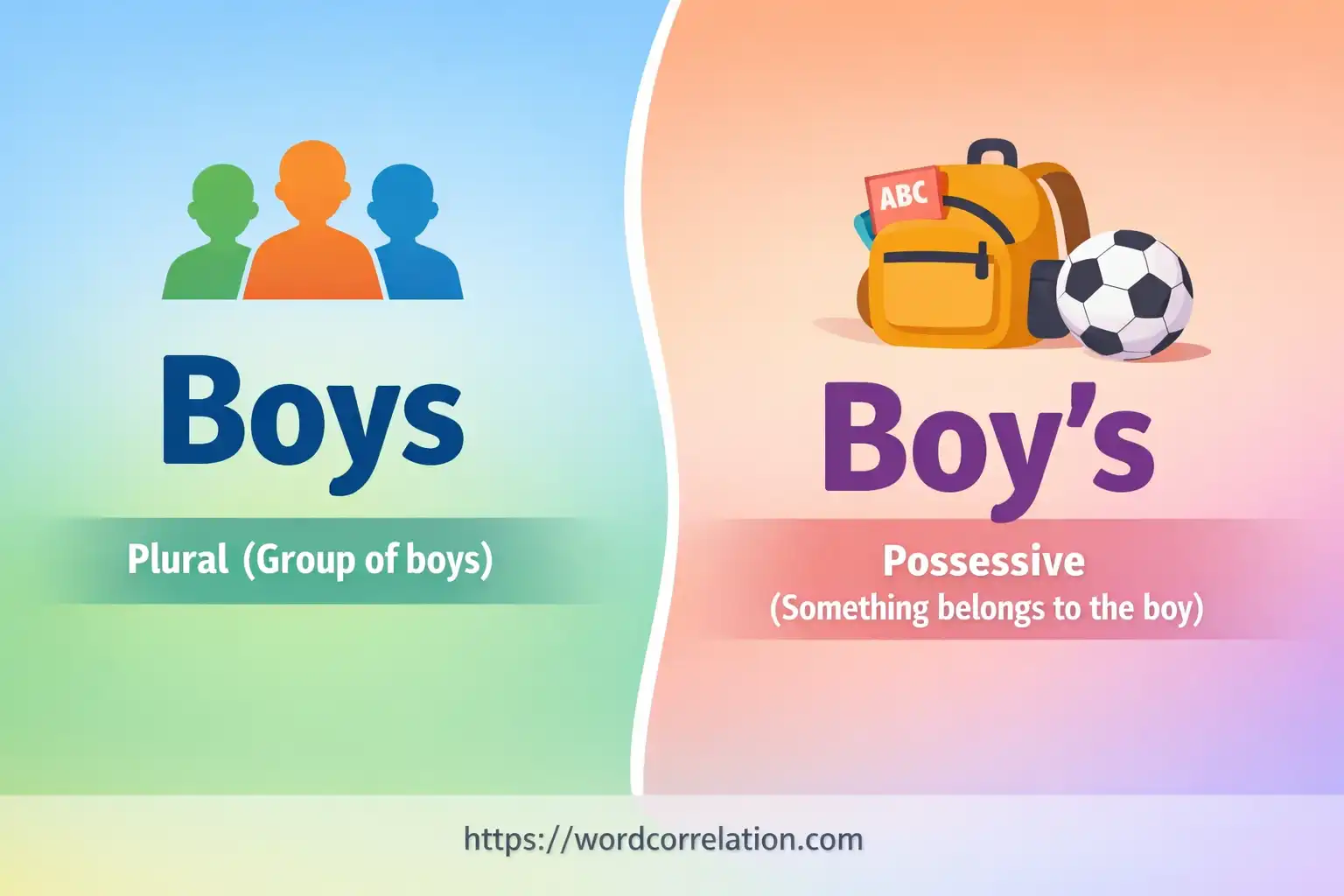
Boys means more than one boy.
Boy’s shows ownership for one boy.
- Boys are playing outside.
- The boy’s bag is on the table.
If there is no ownership, never use an apostrophe.
The Origin of Boys or Boy’s
English once used many word endings. However, modern English became simpler over time. The apostrophe appeared to show possession. Therefore, writers used it to replace missing letters.
Later, people began linking apostrophes only with ownership.
Meanwhile, plural forms stayed without apostrophes.
This difference created confusion.
This is covered in our grammar rules pillar for apostrophes and noun forms.
The problem grew because spoken English gives no visual clue.
Moreover, texting and fast writing increased errors. As a result, boys or boy’s became a top grammar question.
British English vs American English Spelling
Both British and American English follow the same rule here.
However, writing style may differ in tone.
- Boys = plural noun
- Boy’s = singular possessive noun
| Aspect | Boys | Boy’s |
| Apostrophe | No | Yes |
| Meaning | Many boys | One boy owns something |
| US English | Same rule | Same rule |
| UK English | Same rule | Same rule |
In contrast to spelling words like colour or color, this rule never changes.
Which Spelling Should You Use?
The correct choice depends on meaning.
Therefore, always ask one question first.
Are you talking about more than one boy?
If yes, use boys.
Is one boy owning something?
If yes, use boy’s.
For the US
Use the same rule in school, work, and writing.
Moreover, exams expect strict accuracy.
For the UK / Commonwealth
The rule stays identical.
Therefore, never add an apostrophe for plurals.
For Global or Professional Writing
Follow grammar rules strictly.
Additionally, proofread carefully.
Common Mistakes with Boys or Boy’s
Many errors happen due to habit.
However, learning examples fixes them fast.
❌ The boy’s are late.
✅ The boys are late.
❌ I like those boy’s shoes.
✅ I like those boys’ shoes.
❌ The boys bike is new.
✅ The boy’s bike is new.
Always connect the apostrophe with ownership, not number.
Boys or Boy’s in Everyday Examples
Emails
- The boys will attend the meeting.
- The boy’s report is complete.
News
- Local boys won the match.
- The boy’s story touched many hearts.
Social Media
- These boys are amazing!
- That boy’s talent is unreal.
Formal Writing
- The boys participated in the survey.
- The boy’s response was recorded.
Each sentence shows a clear difference.
Boys or Boy’s – Google Trends & Usage Data
Search data shows rising confusion yearly.
Moreover, students search this term the most.
ESL learners also struggle often.
Popular By Country
- USA
- UK
- India
- Pakistan
User Type
- Students
- Bloggers
- ESL learners
- Content writers
Correct usage appears less online. However, mistakes spread faster on social platforms. A similar apostrophe issue is explained in mens or men’s.
Boys vs Boy’s: Clear Comparison Table
| Feature | Boys | Boy’s |
| Meaning | More than one boy | Ownership of one boy |
| Part of Speech | Plural noun | Possessive noun |
| Context | Counting people | Showing possession |
| Formal Usage | Yes | Yes |
| Informal Usage | Yes | Yes |
| Common Mistake | Adding apostrophe | Using without ownership |
| Correct Example | Boys are running. | The boy’s hat is blue. |
This table removes confusion instantly.
Semantic FAQs – People Also Ask
Is boys the same as boy’s?
No. Boys means plural. Boy’s shows ownership.
Which one is correct in formal writing?
Both are correct, depending on meaning.
Can they be used interchangeably?
No. Meaning changes completely.
Why do people confuse them?
Because apostrophes look small but matter.
Can grammar tools catch this mistake?
Yes. However, manual checking helps more.
Is there a British vs American difference?
No. The rule is the same everywhere.
Conclusion
Overall, boys or boy’s follows one simple rule. However, many people ignore it. That mistake leads to writing errors.
Boys means more than one boy.
Boy’s shows ownership by one boy.
Therefore, always check meaning first. Additionally, look for possession. If nothing belongs to someone, skip the apostrophe. In short, apostrophes never make plurals. They only show ownership.
Finally, remember this rule: No ownership, no apostrophe. Use it once. You will never forget it again.
For the underlying concept, see plural or possessive for a clear breakdown.

Virginia Woolf is a British writer and essayist whose work centers on close reading, linguistic precision, and the careful examination of meaning. Her professional background spans fiction, literary criticism, and long-form essays, where attention to word choice and semantic nuance is central rather than decorative. Woolf approaches language as a system of relationships, treating individual words not as interchangeable units but as carriers of tone, context, and psychological weight.
Her research-based writing reflects sustained engagement with how meaning shifts across usage, rhythm, and narrative position. Through essays and critical studies, she demonstrates how subtle differences in wording shape interpretation, emotional response, and intellectual clarity. This focus aligns naturally with word comparison and semantic analysis, where accuracy matters more than flourish.
Woolf helps readers understand meaning differences by slowing language down, isolating terms, and examining how sense emerges through contrast. Her work builds trust by prioritizing clarity, textual evidence, and respect for the reader’s interpretive intelligence.