Many people stop and think when they see the words bagpack and backpack. The spellings look close. The meaning feels the same. However, only one word is correct. This confusion happens every day. Students type it in homework. Shoppers search it online. Writers use it in emails and blogs. As a result, mistakes spread fast.
Moreover, spell-check tools do not always help. Sometimes they miss the error and suggest the wrong fix. Therefore, people stay confused. This article solves that problem clearly. You will learn which word is right also see why the mistake happens. Additionally, you will understand how English rules work here.
Finally, you will know what to use in school, work, and online writing. The language stays simple. The rules stay clear. Examples stay practical. Overall, this guide removes all doubt.
For similar spelling and form checks, explore the word comparison hub.
Bagpack or Backpack – Quick Answer
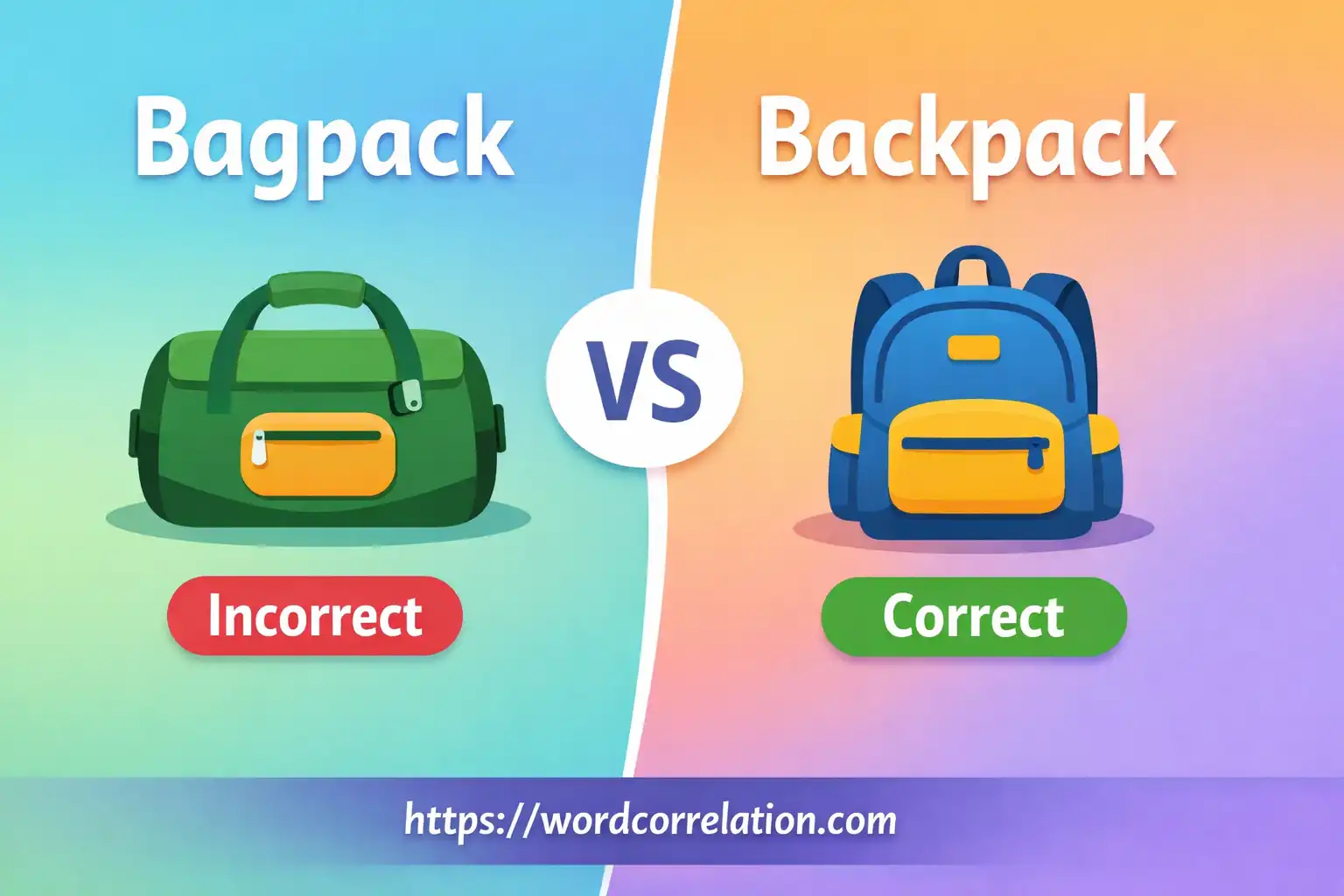
Backpack is the correct word.
Bagpack is a common spelling mistake.
- Use backpack for bags worn on the back.
- Do not use bagpack in any writing.
Example:
✅ I bought a new backpack for school.
❌ I bought a new bagpack for school.
The Origin of Bagpack or Backpack
The word backpack has a clear history. It comes from two simple words: back and pack. A pack means a bag or load. The back shows where you carry it. Therefore, backpack means a pack worn on the back.
The word appeared in English in the early 1900s. At first, hikers and soldiers used it. Later, students and travelers adopted it. As a result, the word became very common. So why does bagpack appear?
People mix words in daily speech. They know the word bag. They also know the word pack. As a result, they blend them by mistake. Moreover, some languages use a similar structure. Therefore, non-native speakers often write bagpack. However, English never accepted that form.
This belongs to our spelling errors pillar for commonly mistyped forms.
British English vs American English Spelling
English spelling changes across regions. However, this case stays simple. American English uses backpack. British English also uses backpack. Canadian English follows the same rule.
Australian English agrees as well.
In contrast, bagpack does not belong to any standard. It appears in informal writing only.
It also shows up in search queries. However, dictionaries do not accept it.
A related “wrong form vs correct form” example is handywork or handiwork..
Quick Comparison
| Aspect | Backpack | Bagpack |
| Standard English | Yes | No |
| US usage | Correct | Incorrect |
| UK usage | Correct | Incorrect |
| Dictionary listed | Yes | No |
Therefore, location does not change the answer.
Which Spelling Should You Use?
The choice depends on clarity, not style. If you write for a US audience, use backpack.
If you write for a UK or Commonwealth audience, use backpack. If you write for a global audience, still use backpack.
Moreover, professional writing needs accuracy. School work demands correct spelling.
Web content needs trust. As a result, backpack always wins. There is no case where bagpack works. Even informal text should avoid it. Therefore, choose safety and clarity every time.
Common Mistakes with Bagpack or Backpack
Many errors repeat again and again.
Seeing them helps you avoid them.
❌ I forgot my bagpack at home.
✅ I forgot my backpack at home.
❌ This bagpack is very strong.
✅ This backpack is very strong.
❌ Buy a travel bagpack online.
✅ Buy a travel backpack online.
The mistake happens because of sound.
People hear bag inside backpack.
As a result, spelling changes.
Additionally, fast typing causes errors.
Autocorrect may fail.
Therefore, careful review matters.
Bagpack or Backpack in Everyday Examples
Real examples make rules stick. Here is how correct usage looks in daily life.
Emails
“I left my backpack in the meeting room.”
News
“The student carried a heavy backpack to school.”
Social Media
“New backpack for my trip tomorrow!”
Formal Writing
“Each participant received a backpack with supplies.”
In contrast, bagpack looks unprofessional. Readers may doubt the writer’s skill. Therefore, correct spelling builds trust.
Bagpack or Backpack – Google Trends & Usage Data
Search data shows an interesting pattern. Many users type bagpack online. However, results point to backpack pages. Students search both words often. ESL learners also make the mistake. Meanwhile, professional writers rarely use bagpack. By country, the confusion appears worldwide.
India and Pakistan show higher bagpack searches. However, US and UK searches favor backpack strongly. Correct usage dominates published content. Mistakes mostly stay in comments and queries. As a result, learning the right form helps SEO and clarity. This belongs to our spelling errors pillar for commonly mistaken word forms.
Comparison Table: Bagpack vs Backpack
| Feature | Backpack | Bagpack |
| Meaning | A bag worn on the back | No accepted meaning |
| Part of speech | Noun | Incorrect form |
| Context of use | School, travel, hiking | Typing mistake |
| Formal usage | Fully accepted | Not accepted |
| Common mistake | None | Used instead of backpack |
| Correct example | She bought a backpack | ❌ She bought a bagpack |
This table removes confusion fast.
Only one word works in English.
Semantic FAQs (People Also Ask)
Is bagpack the same as backpack?
No. Only backpack is correct.
Which one is correct in formal writing?
Backpack is always correct.
Can they be used interchangeably?
No. Bagpack is incorrect.
Why do people confuse them?
Because bag and pack sound similar.
Can grammar tools catch this mistake?
Sometimes. However, not always.
Is there a British vs American difference?
No. Both use backpack.
Is bagpack accepted in any dictionary?
No. Standard dictionaries reject it.
Conclusion
Overall, the choice is simple. English accepts backpack only. The word bagpack is a spelling error. This confusion happens because of sound. It also happens due to typing habits. However, learning the rule fixes the problem fast. Another everyday misspelling to review is sugar or suger.
Use backpack in school writing.
Use backpack in professional work.
Use backpack in emails and posts.
As a result, your writing stays clear.
In short, remember one easy rule. If the bag goes on your back, write backpack. Never hange the spelling. Finally, accuracy builds trust every time.

Agatha Christie was a British writer whose work demonstrates an exceptional command of language, precision of meaning, and narrative clarity. Best known for her crime fiction, her professional background reflects decades of disciplined research, careful word choice, and structural accuracy—qualities central to research-based writing. Christie’s novels and short stories are noted not only for plot construction but for their economical use of language, where subtle differences in wording often carry decisive meaning.
Her writing shows a consistent sensitivity to semantics, ambiguity, and context, particularly in dialogue and descriptive passages, where small shifts in phrasing alter interpretation and intent. This attention to linguistic nuance helps readers distinguish between similar terms, implied meanings, and factual statements versus assumptions.
For readers seeking clarity in meaning and careful use of language, Christie’s body of work provides a reliable model of accuracy and restraint. Her enduring relevance rests on trust, consistency, and a demonstrable respect for the reader’s understanding—principles that align closely with research-driven word comparison and semantic analysis.