
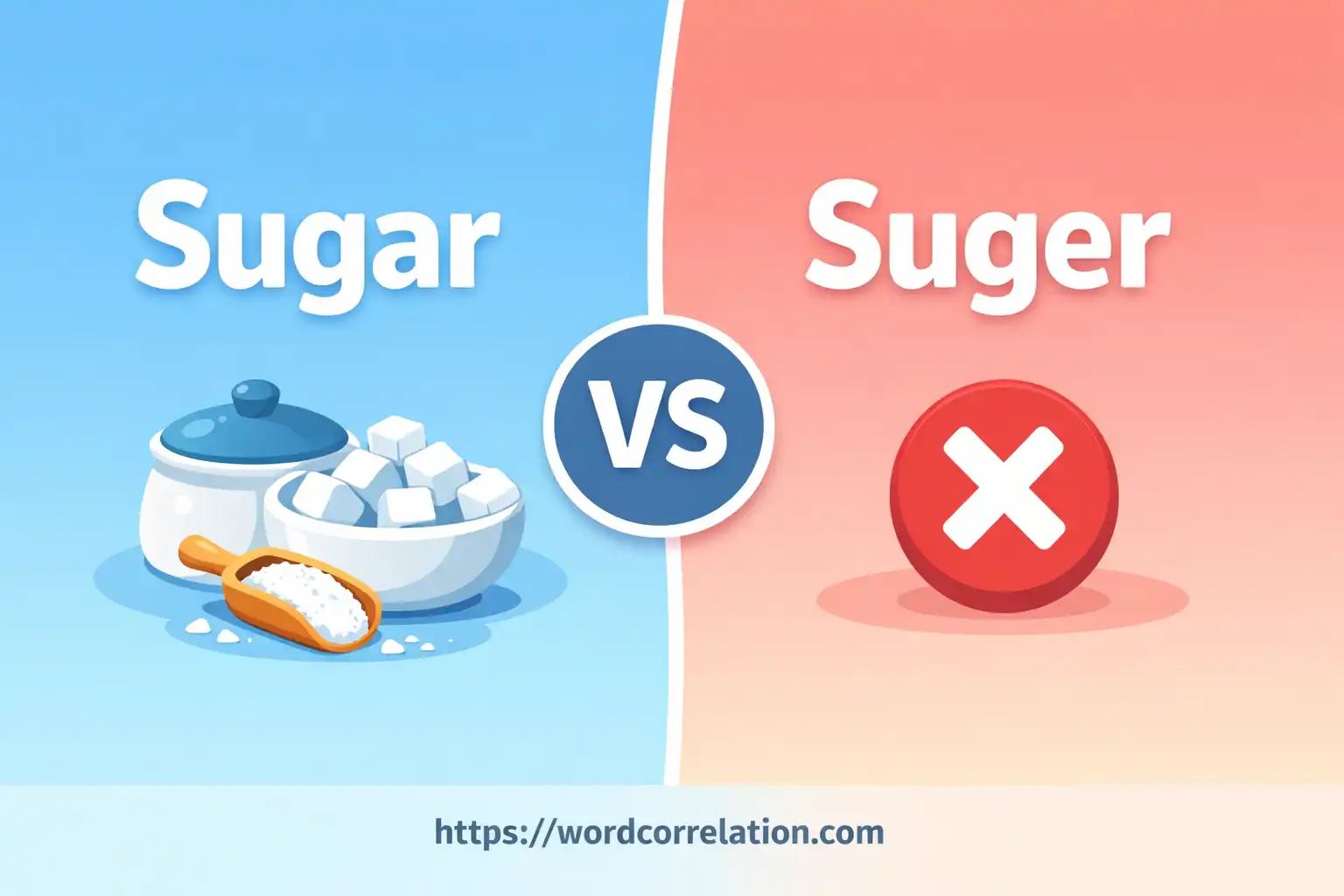
If you are typing out a grocery list, writing a recipe, or sending a friendly message and find yourself questioning whether to write sugar or suger, you are far from alone. Phonetically, both spellings sound like they could be valid English words.
The correct spelling is sugar (ending in -ar). Suger (ending in -er) is a common misspelling and is not a recognized word in standard English dictionary definitions.
Here is a quick overview to clarify the proper usage immediately:
Quick Answer Table (At-a-Glance)
| Term | Status | Definition & Part of Speech | Correct Usage Example |
|---|---|---|---|
| Sugar | Correct | Noun / Verb: A sweet crystalline substance (sucrose); a term of endearment; to sweeten. | Please pass the sugar for my morning coffee. |
| Suger | Incorrect | Non-standard misspelling (Not recognized in standard English). | Incorrect: Add two cups of suger. |
What Does Sugar Mean?
Part of Speech & Pronunciation
- Part of Speech: Noun, Verb, Interjection
- Pronunciation:
/ˈʃʊɡ.ər/(sounds like SHUH-ger)
Definitions
Sugar is a fundamental English noun, verb, and informal term of endearment. In everyday contexts, it refers to sweet carbohydrates used in baking and food production:
- Mass/Uncountable Noun (Culinary Sweetener): The sweet, crystalline substance extracted primarily from sugarcane or sugar beets, chemically known as sucrose (formula $C_{12}H_{22}O_{11}$).
- Countable Noun (Biochemistry): Any of the simple carbohydrates dissolved in water, including glucose, fructose, and lactose.
- Noun (Term of Endearment): An affectionate name used when addressing a loved one, child, or friend (e.g., “Good morning, sugar”).
- Verb (To Sweeten or Coat): To add sweetener to food or drink, or figuratively to make unpleasant news more palatable.
- Exclamation/Interjection: A mild euphemism used in place of stronger profanity when startled or annoyed (e.g., “Oh, sugar!”).
6 Example Sentences in Different Contexts
- Culinary & Baking Context: The pastry chef folded granulated sugar and softened butter together until the mixture became light and fluffy.
- Medical & Health Context: Maintaining balanced blood sugar levels requires a diet rich in complex carbohydrates and regular physical activity.
- Biochemistry Context: Fruits contain natural sugars like fructose, which supply the body with quick, accessible energy.
- Term of Endearment Context: “Don’t forget your coat before heading outside, sugar,” Grandma said with a smile.
- Action / Verb Context: He lightly sugared the fresh strawberries before serving them with whipped cream.
- Informal Exclamation Context: “Oh, sugar! I left my wallet on the kitchen counter,” she exclaimed as she reached the register.
What Does Suger Mean?
Is “Suger” a Real English Word?
In standard English dictionaries (such as Merriam-Webster, Oxford, and Cambridge), suger is classified as a spelling error when intended to mean the sweet carbohydrate.
However, “suger” does appear in two non-standard English contexts that often cause confusion online:
- Historical Proper Noun: Abbé Suger (c. 1081–1151) was a famous 12th-century French abbot, statesman, and patron of Gothic architecture.
- Foreign Language Verb: In Norwegian, suger is a present-tense verb meaning “sucks” or “absorbs.”
Unless you are writing an essay on medieval French history or translating Norwegian text, suger is an incorrect spelling for standard English writing.
Correcting “Suger” in 6 Common Error Contexts
Below are six real-world examples where suger is mistakenly typed, along with its proper correction:
- Recipe Mistake:
- Incorrect: Combine flour, butter, and brown suger in a large mixing bowl.
- Correct: Combine flour, butter, and brown sugar in a large mixing bowl.
- Health Report Mistake:
- Incorrect: The lab results showed elevated blood suger after fasting.
- Correct: The lab results showed elevated blood sugar after fasting.
- Casual Conversation Mistake:
- Incorrect: Give me some suger, honey!
- Correct: Give me some sugar, honey!
- Product Labeling Mistake:
- Incorrect: This fruit juice contains zero added sugers.
- Correct: This fruit juice contains zero added sugars.
- Coffee Order Mistake:
- Incorrect: I prefer iced tea with lemon and two sugers.
- Correct: I prefer iced tea with lemon and two sugars.
- Figurative Expression Mistake:
- Incorrect: There is no way to suger-coat the bad news.
- Correct: There is no way to sugar-coat the bad news.
Sugar vs Suger: Key Differences Comparison Table
| Feature | Sugar | Suger |
|---|---|---|
| Spelling | S-U-G-A-R (ends in -ar) | S-U-G-E-R (ends in -er) |
| Standard English Status | Valid English word | Misspelling in English |
| Pronunciation | /ˈʃʊɡ.ər/ | N/A (Phonetic error) |
| Part of Speech | Noun, Verb, Interjection | Non-standard / Foreign noun |
| Primary Meaning | Sweetener, carbohydrate, term of affection | Historical name or non-English term |
| Acceptable in Formal Writing? | Yes | No |
Why People Confuse These Words
The mix-up between sugar and suger happens primarily because of how English handles unstressed vowel sounds (known as the schwa sound, $/ə/$).
1. The Phonetic “-er” Trap
In spoken English, the ending of sugar is pronounced /ər/. In hundreds of everyday English nouns, this sound is spelled with -er (such as baker, sweetener, water, butter, and paper). Because writers are accustomed to the -er suffix for nouns, the brain defaults to typing suger.
2. Etymology and Vowel Evolution
The word sugar entered English in the Middle Ages from Old French (sucre), which derived from Medieval Latin (succarum), Arabic (sukkar), and ultimately Sanskrit (śarkarā).
During the Middle English period, the spelling varied widely—appearing as sugre, suker, and sugur. By the 16th century, standard English settled on the -ar ending, even though the pronunciation evolved to feature an initial “sh” sound (/ʃ/) and an unstressed schwa ending.
Other common words sharing this same -ar phonetic ending trap include:
- Dollar (not doller)
- Beggar (not begger)
- Cellar (not seller when referring to a basement)
- Caterpillar (not caterpiller)
Memory Trick to Remember the Difference
Never misspell this common word again by using this simple mnemonic device:
The “A R” Recipe Mnemonic
Look at the last two letters of SUGAR:
S – U – G – A – R
Remember that A Real treat needs A Recipe!
Both A Real and A Recipe start with A-R.
Therefore, SUGAR always ends with A-R!
If you write suger with an E, remind yourself that Error starts with E!
Example Sentences Side-by-Side
| Context | Incorrect Usage | Correct Usage |
|---|---|---|
| Baking | Add powdered suger to the icing. | Add powdered sugar to the icing. |
| Dietary Advice | Reduce your intake of refined suger. | Reduce your intake of refined sugar. |
| Agriculture | Farmers harvest suger cane in winter. | Farmers harvest sugar cane in winter. |
| Euphemism | Oh suger, I dropped my keys! | Oh sugar, I dropped my keys! |
Common Mistakes People Make
1. Assuming “-er” Suffix Rules Apply
People often assume that because a word describes a culinary agent (like sweetener or thickener) or a person doing an action (baker, cooker), it must end in -er. However, sugar is a root noun rather than an agent noun formed by adding a suffix.
2. Misspelling Derived Words
When creating compound words or adding suffixes, writers sometimes carry the spelling error forward:
- Incorrect: sugery, sugared, sugercoat
- Correct: sugary, sugared, sugarcoat
3. Autocorrect Over-Reliance
On mobile keyboards, typing suger fast might occasionally pass undetected if saved to a custom user dictionary by accident. Always double-check ingredient lists and professional copy for the -ar ending.
Frequently Asked Questions (FAQ)
Is “suger” ever correct in English?
No. In standard English, suger is an incorrect spelling. The correct word is always spelled sugar.
Why is sugar spelled with an “s” but pronounced like “sh”?
This phonetic shift occurred in Middle English. Words like sugar and sure originally kept the soft /s/ sound, but speakers naturally shifted to the palatalized /ʃ/ (“sh”) sound over centuries due to vowel influence.
What is the correct spelling for sugar-coated?
The correct spelling is sugar-coated (or sugarcoated). Using “suger-coated” is grammatically incorrect.
Is sugar a noun or a verb?
Sugar functions as both a noun (e.g., “Pass the sugar”) and a verb (e.g., “He sugared his oatmeal”). In informal speech, it also serves as an interjection.
How do you spell sugary?
The adjective form is spelled sugary (ending in -ary), meaning tasting of or containing sugar.
What is the chemical name for table sugar?
The chemical name for refined table sugar is sucrose, represented by the chemical formula $C_{12}H_{22}O_{11}$.
Conclusion
Mastering the choice between sugar or suger comes down to remembering one simple rule: standard English only recognizes sugar ending in -ar.
- Always write sugar (with an -ar) for sweetening food, tracking health metrics, or using terms of affection.
- Avoid suger (with an -er), as it is an incorrect phonetic misspelling in standard English writing.
To keep your writing polished, verify your spelling with quick online reference tools or review our detailed guides on tricky English spelling patterns.

Ibrahim Jhon is an English language editor with over ten years of experience working with writers, publishers, and international businesses. He specialises in word choice, grammar accuracy, and the differences between British and American English.