Many people pause when they write abstain vs refrain. Both words talk about holding back. Both suggest stopping yourself. So, they feel almost the same. But they are not always equal.
Students often mix them in essays. Professionals sometimes use the wrong one in emails. Even news headlines switch them without care. That small mistake can change tone. It can also confuse meaning.
So, what is the real difference? When should you use abstain? When is refrain better? And why does it matter in real life?
In this guide, you will learn the simple difference. You will see real examples. You will also learn one fast rule to choose the correct word every time.
Abstain vs Refrain – Quick Answer
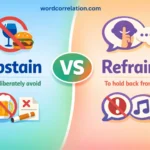
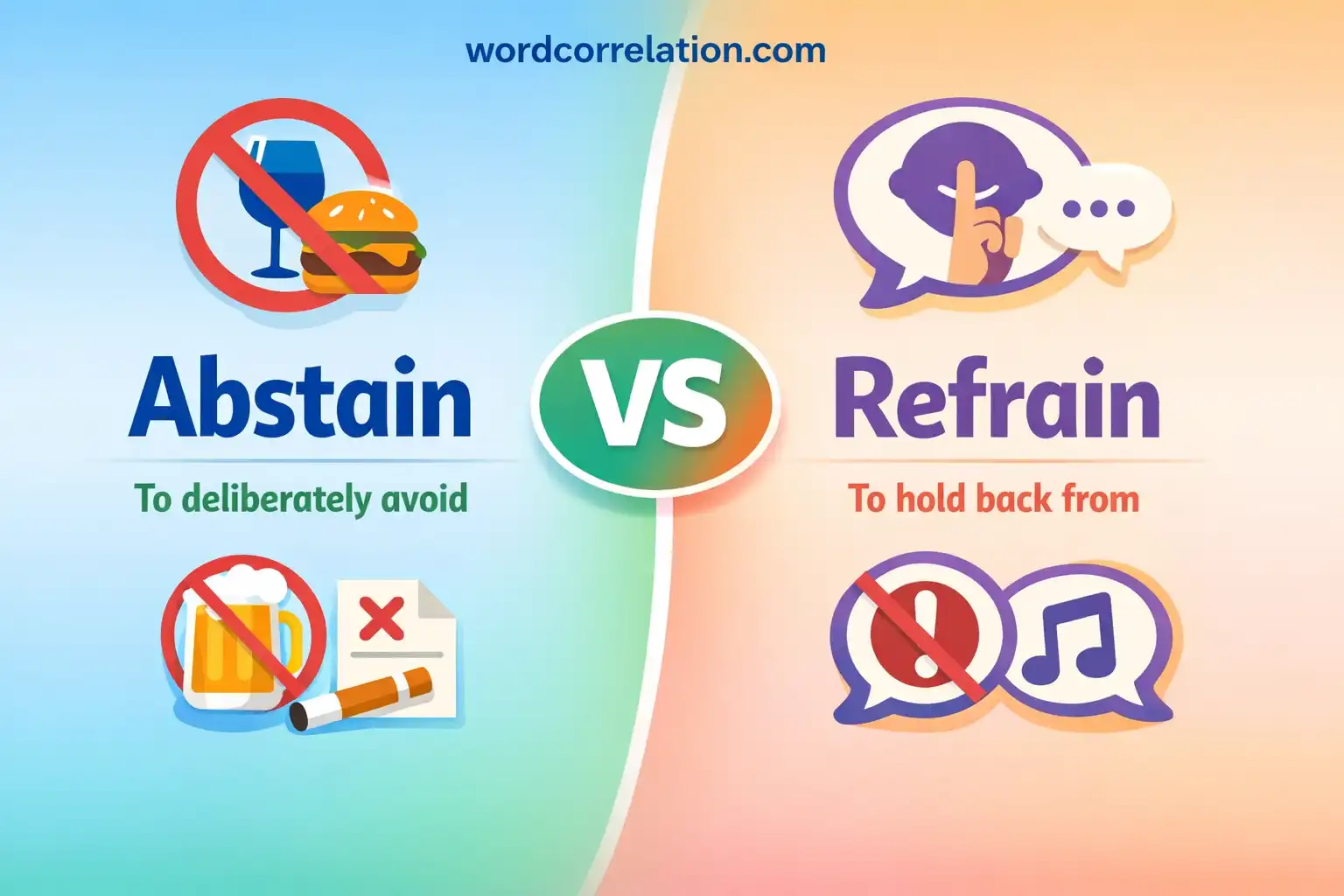
Abstain means you choose not to do something, often for moral, legal, or formal reasons.
Refrain means you hold yourself back from doing or saying something.
Examples:
- She abstained from voting.
- He refrained from commenting.
Easy rule:
Use abstain for formal decisions.
Use refrain for everyday self-control.
The Origin of Abstain vs Refrain (Simple History)
Both words come from Latin. That is one reason they sound alike.
Abstain comes from the Latin word abstinere. It means “to hold back” or “to keep away.” Over time, English used it in formal settings. For example, people abstain from alcohol. Judges abstain from decisions. Voters abstain in meetings.
Refrain comes from the Latin word refrenare. It means “to bridle” or “to check”, feels more personal. It suggests stopping yourself in a moment.
So, both words share the idea of control. However, they grew in different directions. Abstain became more formal. Refrain stayed more flexible and emotional.
That history explains today’s confusion.
British English vs American English Spelling
There is no spelling difference between British and American English.
Both use:
- Abstain
- Refrain
So, the confusion is not about spelling. It is about usage and tone.
Here is a quick comparison:
| Word | US Spelling | UK Spelling | Difference? |
| Abstain | Abstain | Abstain | No |
| Refrain | Refrain | Refrain | No |
Because spelling does not vary, focus on meaning instead.
How to Choose the Right Word Fast
Choosing between abstain and refrain is easier than you think.
US
In American English, abstain sounds formal. It often appears in politics, law, or religion.
Example:
- The senator abstained from voting.
Meanwhile, refrain appears in daily writing.
Example:
- Please refrain from using your phone.
UK / Commonwealth
Usage is very similar in British English. Abstain stays formal. Refrain feels more general.
Global or Professional Writing
In global business or academic writing:
- Use abstain for official actions.
- Use refrain for behavior control.
If you are unsure, ask yourself:
Is this about a formal decision? If yes, choose abstain.
Is this about stopping yourself in a moment? If yes, choose refrain.
Common Mistakes with Abstain vs Refrain
Writers often confuse these two words in similar sentences.
Here are common errors:
❌ He abstained from making a rude comment.
✅ He refrained from making a rude comment.
(Reason: This is personal control, not a formal action.)
❌ She refrained from voting in the election.
✅ She abstained from voting in the election.
(Reason: Voting is a formal decision.)
❌ The board refrained from the final vote.
✅ The board abstained from the final vote.
Another mistake happens in tone. Abstain can sound too heavy in casual talk.
❌ I will abstain from dessert tonight.
✅ I will refrain from dessert tonight.
In daily life, refrain sounds more natural.
Abstain vs Refrain in Everyday Examples
Let’s see how both words appear in real writing.
Emails
- Please refrain from sharing confidential data.
- I will abstain from this vote due to conflict of interest.
News
- Three members abstained from the resolution.
- The spokesperson refrained from further comments.
Social Media
- I am trying to refrain from negativity this year.
- He chose to abstain from political debate.
Professional Writing
- Directors must abstain from decisions where bias exists.
- Employees should refrain from using personal devices at work.
Notice the pattern. Abstain fits formal responsibility. Refrain fits personal control.
Abstain vs Refrain – Usage Patterns & Search Interest
People search this keyword because the meanings overlap. Both involve self-control. Both use “from.” That makes them look interchangeable.
Students and ESL learners search it often. Writers also check it while editing reports or academic papers.
Editors usually see confusion in formal writing. For example, someone may write “refrain from voting” in a legal document. That sounds less precise. In formal settings, abstain carries stronger meaning.
In everyday writing, the opposite problem appears. Someone may write “abstain from laughing.” That sounds too serious.
So, misuse affects tone. It can make writing sound stiff. Or it can weaken formal meaning.
Comparison Table: Abstain vs Refrain
| Feature | Abstain | Refrain |
| Meaning | Choose not to do something formally | Hold yourself back from doing or saying something |
| Part of Speech | Verb | Verb |
| Context of Use | Voting, religion, law, official actions | Everyday behavior, speech, reactions |
| Formal vs Informal | More formal | Neutral to slightly formal |
| Common Mistake | Used in casual talk | Used in formal decisions |
| Correct Example | She abstained from voting. | He refrained from arguing. |
This table removes the confusion quickly.
FAQs About Abstain vs Refrain
Is abstain the same as refrain?
No. Both mean holding back, but abstain is more formal. Refrain is more general.
Which one is correct in formal writing?
Use abstain for official decisions. Use refrain for behavior or speech.
Can they be used interchangeably?
Sometimes, but not always. In voting or legal matters, only abstain fits well.
Why do people confuse them?
They both mean “to hold back” and often use “from” after them.
Can grammar tools catch this mistake?
Sometimes. However, tone mistakes may pass unnoticed.
Is there a British vs American difference?
No. Spelling and meaning remain the same in both versions of English.
Conclusion
The confusion around abstain vs refrain happens because both words share one idea: control. Yet their usage differs in tone and context.
Abstain belongs to formal settings. It appears in voting, religion, and official decisions. It sounds serious and structured.
Refrain fits daily life. It describes stopping yourself from speaking, acting, or reacting. It feels more natural in conversation and writing.
Overall, the biggest mistake is using abstain in casual situations. That makes writing sound stiff. On the other hand, using refrain in legal or political contexts can weaken meaning.
Finally, remember this simple rule:
Formal decision? Use abstain.
Personal control? Use refrain.
That one line will guide you every time.

Rudyard Kipling is an English writer and poet whose work demonstrates sustained attention to language choice, precision of meaning, and the practical power of words. Born in 1865 in Bombay and educated in England, he builds his career as a journalist and editor in India before establishing himself as a major literary figure through fiction, poetry, and essays.
His professional background in research-based writing is shaped by reporting, close observation, and disciplined revision, all of which inform his exact use of vocabulary.
Kipling’s writing reflects a deep awareness of semantics and nuance, particularly in how similar words can carry different cultural, emotional, or contextual meanings. His stories and poems rely on careful word selection to convey authority, tone, and intent, making his work valuable for readers interested in language accuracy and comparison.
For audiences seeking clarity in meaning, his body of work offers concrete examples of how subtle differences in wording influence interpretation. This focus on linguistic precision supports informed reading and fosters trust in language as a tool for clear understanding.