
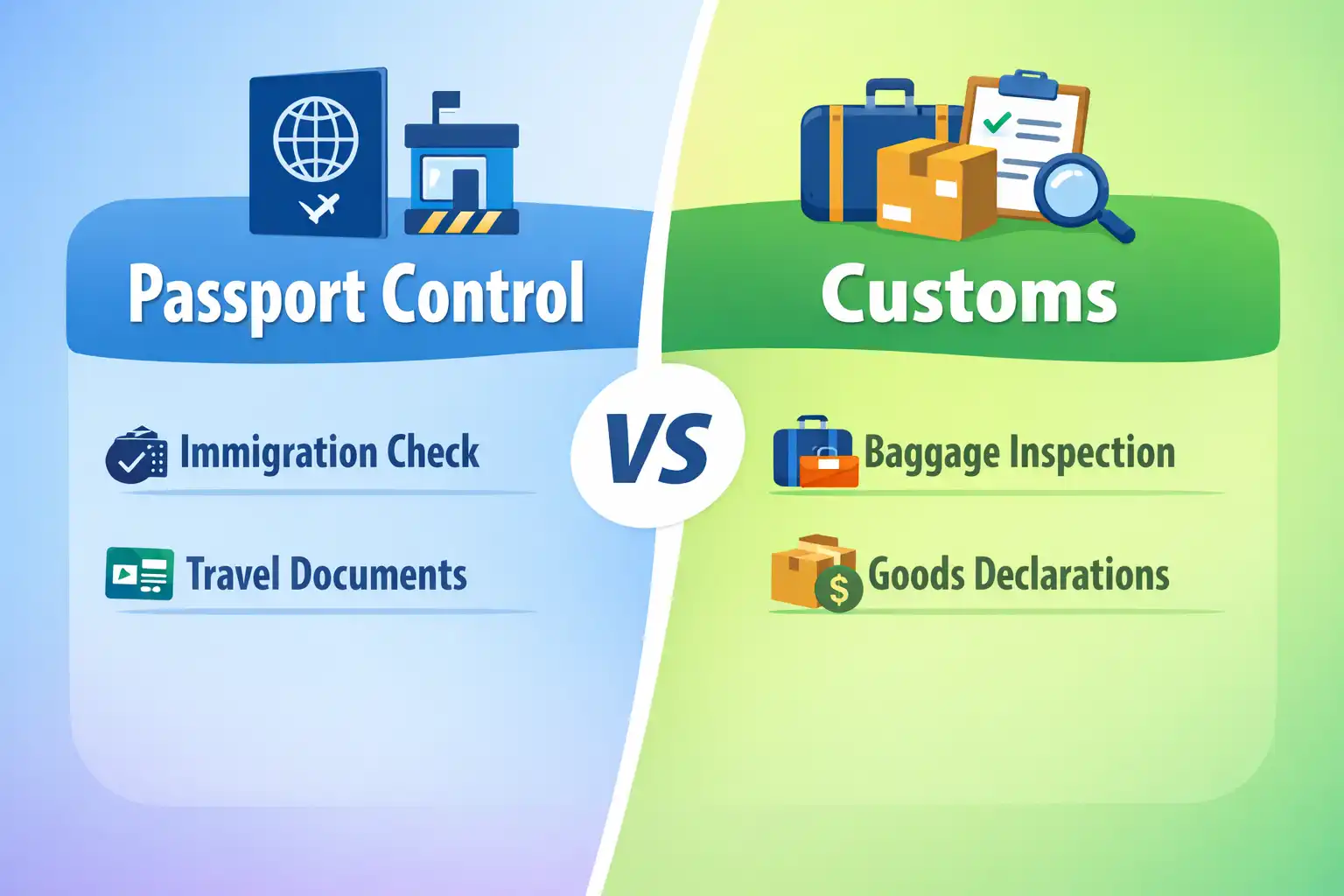
Whether you are a first-time international traveler or a seasoned globetrotter, one moment at the airport almost always creates confusion — when you face two separate checkpoints and wonder: Are passport control and customs the same thing? The short answer is no. These are two entirely different processes, run by different officers, for completely different purposes.
This guide breaks down everything you need to know about passport control vs customs — what each one checks, which comes first, how the process varies by country, and how to get through both without any issues.
What Is Passport Control?
Passport control — also known as immigration control or border control — is the checkpoint where an immigration officer verifies your identity and your legal right to enter the country. This is about you as a person, not what you are carrying.
At passport control, the officer will typically:
- Check your passport for validity, expiry date, and authenticity
- Verify your visa or entry permit, if one is required
- Scan your biometrics — fingerprints or facial recognition — at many modern airports
- Ask you a few standard questions about your visit
Common questions asked at passport control include:
- What is the purpose of your visit?
- How long will you be staying?
- Where will you be staying?
- Do you have a return or onward ticket?
This process is mandatory for every international traveler, regardless of what is in their luggage. Even if your bags are completely empty, you still must pass through passport control.
Simple definition: Passport control = Who you are and do you have the legal right to enter this country?
Where Does Passport Control Happen?
In most airports around the world, passport control takes place before you collect your checked luggage. You land, walk through the arrivals hall, and reach the immigration desks before reaching the baggage carousel.
One notable exception is the United States. When arriving in the US, you first collect your bags, then proceed through a combined passport and customs checkpoint managed by US Customs and Border Protection (CBP).
What Is Customs?
Customs is a completely separate checkpoint focused entirely on what you are carrying into the country — not who you are. Customs officers check whether the goods in your luggage are legal, within allowed limits, and properly declared.
At customs, officers are looking for:
- Restricted or prohibited items such as certain foods, plants, seeds, and meat products
- Goods that exceed duty-free allowances — alcohol, tobacco, electronics, or gifts above a set value
- Large amounts of cash or monetary instruments (typically $10,000 or equivalent must be declared)
- Commercial goods being brought in without proper documentation or duty payment
- Counterfeit products or items violating intellectual property laws
In many airports, travelers who have nothing to declare simply walk through the green lane without any interaction with a customs officer. Only those carrying declarable items, or those selected for a random inspection, go through the red lane for a full check.
Simple definition: Customs = What you are bringing into the country and is it allowed?
Where Does Customs Happen?
Customs is always located after baggage claim, because officers need to inspect what is in your checked luggage. You collect your bags first, then proceed to the customs checkpoint before exiting the airport.
Passport Control vs Customs: Side-by-Side Comparison
| Feature | Passport Control | Customs |
| Also called | Immigration / Border Control | Customs & Excise |
| Checks | Your identity & right to enter | Items you are carrying |
| When it happens | Before baggage claim (usually) | After baggage claim |
| Mandatory? | Yes — always | Yes, but green lane is a walkthrough |
| Documents needed | Passport, visa if required | Declaration form if applicable |
| Questions asked | Purpose of visit, duration of stay | What goods are you bringing in? |
| Officer type | Immigration Officer | Customs Officer |
| What triggers delay? | Visa issues, flagged travel history | Undeclared items, restricted goods, excess cash |
Which Comes First — Passport Control or Customs?
This is the most common question travelers have. The standard order at most international airports is:
- Step 1: Land at the airport and disembark
- Step 2: Passport Control — verify your identity and entry rights
- Step 3: Baggage Claim — collect your checked luggage
- Step 4: Customs — declaration check, green or red lane
- Step 5: Exit the airport
The logic is straightforward: passport control comes first because a country needs to confirm you are allowed to enter before worrying about what you brought with you. Customs comes after baggage claim because officers need to see your bags.
Exceptions: When the Order or Location Changes
United States
The US has a unique combined process. After landing, you collect your bags first, then go through a single CBP checkpoint where an officer handles both immigration and customs. Both processes happen together at one counter, which is different from most other countries.
Schengen Zone — Europe
If you fly into one Schengen country and then take a connecting flight to another Schengen country, you go through passport control at your first point of entry into the Schengen Zone. Customs is typically handled at your final destination when you collect your bags.
Pre-Clearance Airports
Several airports outside the US offer US pre-clearance facilities. This includes major airports in Ireland, Canada, the UAE, Aruba, the Bahamas, and Bermuda. At these airports, US-bound travelers complete both passport control and customs before boarding their flight — meaning when they land in the US, they arrive as domestic passengers and skip the immigration and customs queues entirely.
Connecting Domestic Flights
If you arrive on an international flight and then connect to a domestic flight within the same country, you go through both passport control and customs at your arrival airport — not at your domestic final destination.
Common Mistakes at Passport Control
Wrong queue: Most airports have separate lanes for citizens, regional passport holders (such as EU/EEA), and international visitors. Joining the wrong line wastes time and you will be redirected anyway.
Documents not ready: Have your passport, visa, hotel address, and return ticket accessible before you reach the officer. Searching through your bag while at the desk creates unnecessary delays.
Using your phone: Phone use — especially making calls — is prohibited in most passport control and customs areas. Keep your phone on silent and put it away before you reach the checkpoint.
Being vague or inconsistent: Answer questions directly and honestly. If your answers are inconsistent or evasive, officers are trained to notice and may refer you for secondary inspection.
Common Mistakes at Customs
Failing to declare items: Some travelers assume small purchases do not need to be declared. If an officer finds an undeclared item during an inspection, it can result in fines and a flag on your travel record for future trips.
Bringing prohibited food: Fresh fruits, vegetables, meat, and dairy products are restricted or banned at many borders without proper documentation. A single undeclared apple can result in a fine of several hundred dollars in countries like the US and Australia.
Not declaring large amounts of cash: Carrying $10,000 or more in cash or equivalent foreign currency across most international borders requires a declaration. Failing to declare it is treated seriously — it can be confiscated and may trigger a financial investigation.
Exceeding duty-free limits: Every country sets its own limits for how much alcohol, tobacco, and gifts you can bring in without paying import duty. Research the limits for your destination before you travel.
Tips for Smooth Passage Through Both Checkpoints
For Passport Control
- Check your passport expiry date well in advance — many countries require at least six months of validity beyond your travel dates
- Research whether your destination requires a visa and apply early if needed
- Keep hotel booking confirmation or your host’s address handy
- Have your return or onward flight details accessible
- Stay calm, be honest, and answer questions briefly and clearly
For Customs
- Fill out any customs declaration forms on the plane — most airlines distribute these during the flight
- Keep receipts for any significant purchases made abroad
- Research the customs allowances for your destination country before you travel
- When in doubt, use the red lane and declare — the consequences of undeclared goods are far worse than paying a small duty
Passport Control vs Customs — Final Verdict
Passport control and customs serve entirely different purposes at international airports. Passport control is about you as a traveler — your identity, your documents, and your legal right to enter a country. Customs is about what you are carrying — your goods, your purchases, and whether they comply with import rules.
Both checkpoints exist to protect national security and regulate what enters a country, but they operate independently, are staffed by different officers, and check completely different things.
Understanding the difference between passport control vs customs removes a major source of travel anxiety. Once you know what to expect at each checkpoint and how to prepare, international travel becomes significantly smoother — from the moment you land to the moment you walk out of the airport.

Ibrahim Jhon is an English language editor with over ten years of experience working with writers, publishers, and international businesses. He specialises in word choice, grammar accuracy, and the differences between British and American English.