Many people pause when they write any day or anyday.
They look almost the same, but they do not work the same way. Because of that, writers often feel unsure. Students hesitate. ESL learners get confused. Even fluent speakers sometimes guess.
This confusion matters because one form is correct in modern English, and the other is usually wrong. When the wrong form appears in emails, articles, or professional writing, it can look careless. It can also change how your message feels to the reader.
So, what is the real difference?
Why do people keep mixing them up?
And which one should you use today?
In this guide, you will learn the clear answer. You will also see simple examples from real life. We will explain where the confusion started, how English uses these words now, and how to choose the right form fast. By the end, you will not second-guess this again.
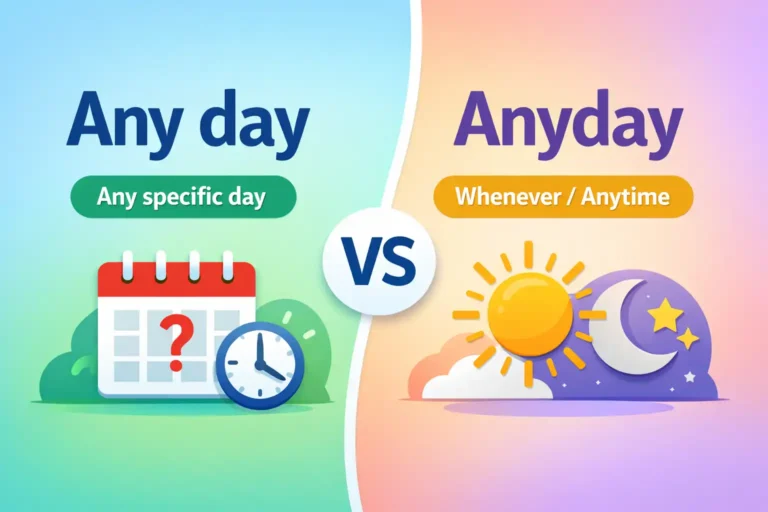
Any Day vs Anyday – Quick Answer
Any day (two words) is correct in modern English.
Anyday (one word) is usually incorrect today.
- Use any day when you mean on any day or at any time.
- Avoid anyday in formal and everyday writing.
Example:
✅ You can call me any day.
❌ You can call me anyday.
Easy rule: If you mean any time or any date, always use any day.
The Origin of Any Day vs Anyday (simple history)
Long ago, English often joined words together. At that time, anyday appeared as a single word in some writing. It was not common, but it existed. Writers used it loosely, and spelling rules were not strict.
Over time, English became more standardized. Grammar guides became clearer. Editors also preferred cleaner spacing. Because of that, any day slowly replaced anyday.
Today, modern English treats any day as a phrase, not a compound word. As a result, anyday is now considered outdated or incorrect in most contexts. You may still see it in old books or casual online posts, but it is no longer standard.
So, the confusion comes from history, not from current rules.
British English vs American English Spelling
This is where many learners expect a difference, but there is none.
Both American English and British English use any day as two words. Neither variety accepts anyday as standard today.
In contrast to words like everyday and every day, this pair does not split by region. The rule stays the same everywhere.
Examples:
| Region | Correct Form | Example |
| US | any day | You can visit any day. |
| UK | any day | This service runs any day. |
So, no matter where you write, the choice does not change.
How to Choose the Right Word Fast
Choosing the correct form is simple once you know the audience and purpose.
For US writers
Use any day in all writing. This includes emails, blogs, and professional documents. Do not use anyday.
For UK and Commonwealth writers
The same rule applies. Any day is correct. Anyday looks outdated or informal.
For global or professional writing
Always choose any day. It is clear, accepted, and safe. If spelling does not vary, focus on clarity instead of style.
Quick tip:
If you can replace the phrase with any time, then any day is the right choice.
Common Mistakes with Any Day vs Anyday
Writers often make the same errors again and again. Here are the most common ones.
❌ You can reach us anyday during office hours.
✅ You can reach us any day during office hours.
❌ This offer is valid anyday of the week.
✅ This offer is valid any day of the week.
❌ I can help you anyday you need.
✅ I can help you any day you need.
The mistake usually happens because people think it works everyday. But these two cases are different. That small space matters.
Any Day vs Anyday in Everyday Examples
Seeing a word used in real situations helps you remember it. In daily life, any day appears often, while anyday does not. Writers use any day to talk about time, availability, or choice. It fits naturally in spoken and written English. Because of this, it shows up in emails, news writing, and social posts without sounding forced.
Below are clear, real-world examples that show how any day works in context.
Email Examples
- You can contact our team any day during business hours.
- I am free to meet any day next week.
These sentences sound polite, clear, and professional. Using anyday here would look incorrect.
News & Media Examples
- The helpline is open any day, including weekends.
- Citizens can submit applications any day through the official portal.
News writing avoids informal or outdated forms, so any day is always used.
Social Media Examples
- Grateful for progress any day it comes.
- Learning something new any day feels like a win.
Even in casual writing, any day keeps the message natural and readable.
Key reminder:
If the sentence talks about time, choice, or availability, any day is the correct form.
Any Day vs Anyday – Usage Patterns & Search Interest
People search this comparison because they see both forms online. Some websites still show anyday, especially in casual posts or comments. That creates doubt.
Students and ESL learners search for it when writing assignments. Writers search for it when editing content. Professionals search it because small grammar errors can affect credibility.
One real-world problem happens in business emails. Using anyday can look careless, even if the message is friendly. That small detail can change how the reader judges the sender.
So, the safest and smartest choice is always any day.
Any Day vs Anyday – Clear Comparison Table
| Feature | Any Day | Anyday |
| Meaning | On any day / at any time | Intended same meaning |
| Part of speech | Phrase | Non-standard compound |
| Context of use | All modern writing | Rare, outdated |
| Formal vs informal | Formal and informal | Avoid both |
| Common mistake | Forgetting the space | Using one word |
| Correct example | You may come any day. | ❌ anyday |
This table removes the confusion instantly.
Semantic FAQs (People Also Ask)
Is any day the same as anyday?
No. Any day is correct today. Anyday is usually wrong.
Which one is correct in formal writing?
Any day is always correct in formal writing.
Can they be used interchangeably?
No. Only any day should be used now.
Why do people confuse them?
Because some English words combine, like everyday, but this one does not.
Can grammar tools catch this mistake?
Many tools can, but not all. Knowing the rule is safer.
Is there a British vs American difference?
No. Both use any day.
Conclusion
Overall, the confusion between any day and anyday is common, but the solution is simple. Modern English clearly prefers any day as two words. It works in casual speech, professional writing, and global English. In contrast, anyday is outdated and often seen as an error.
The most important thing to remember is this: spacing changes meaning and correctness. Even one missing space can affect how your writing looks and feels. Writers, editors, and learners all benefit from using the standard form.
So, when should you use each?
Use any day whenever you mean on any day or at any time.
Avoid anyday completely.
Finally, here is the easiest rule to keep forever:
If you can say “any time,” then write “any day.”

Daniel Morris writes about English word differences and spelling confusion. His focus is to provide clear, simple explanations with practical usage examples.