
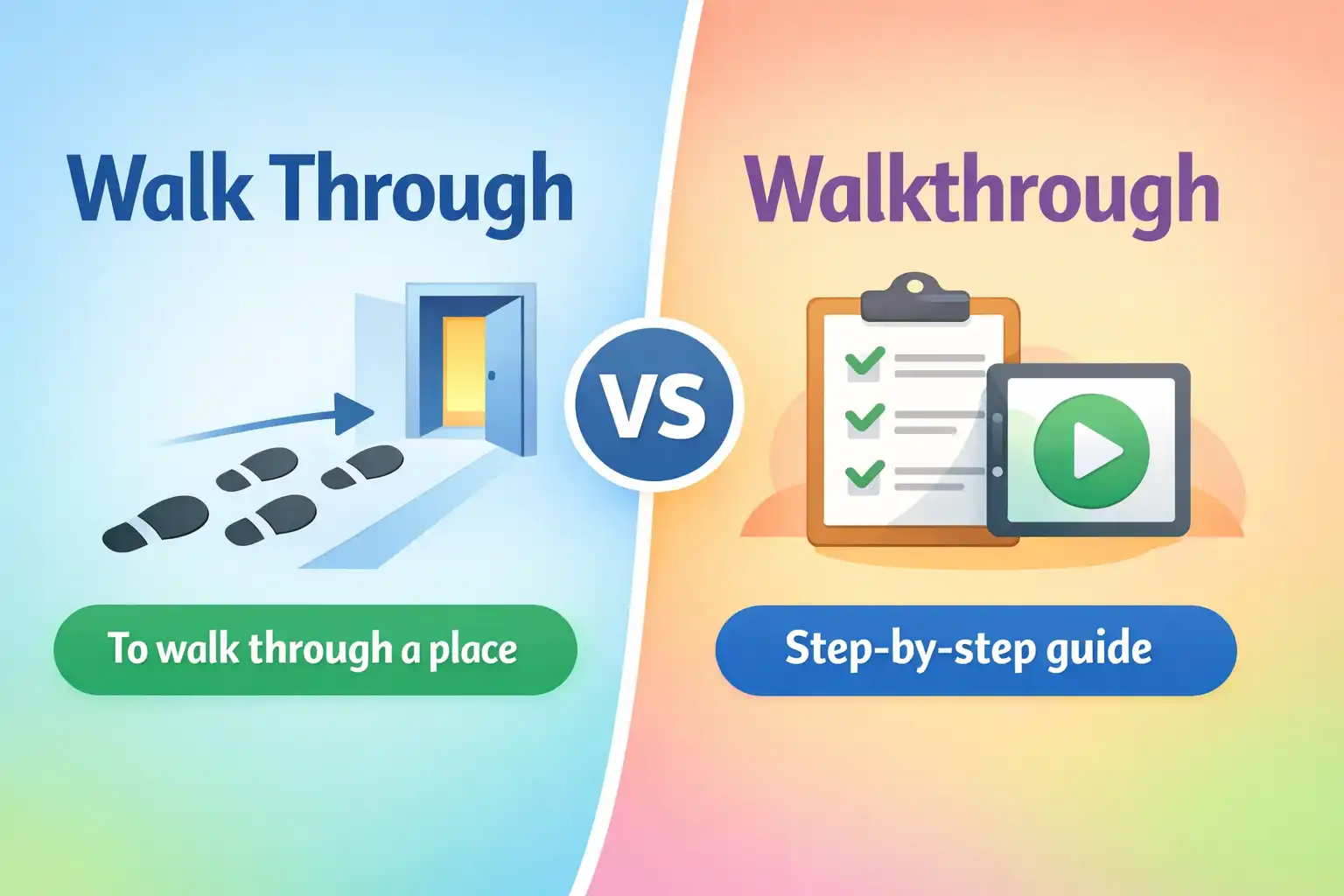
SEO Title: Walkthrough vs Walk-Through: Which Spelling Should You Use? Meta Description: Walkthrough vs walk-through: learn when to hyphenate, when to combine into one word, and how to avoid common grammar mistakes with clear examples.
When deciding between walkthrough vs walk-through, the primary factor is modern usage and style preference. Both spellings refer to a step-by-step demonstration, detailed inspection, or instructional guide. Walkthrough (one word) is the dominant spelling in software development, tech, and video games, whereas walk-through (hyphenated) is the traditional form preferred by formal print dictionaries and established publishing house styles.
Understanding when to combine, hyphenate, or separate these words ensures your writing remains clear, polished, and grammatically accurate.
Quick Answer: Walkthrough vs Walk-Through at a Glance
| Term | Part of Speech | Primary Meaning | Best Context / Usage | Example |
|---|---|---|---|---|
| Walkthrough | Noun / Adjective | A step-by-step tutorial, guide, or comprehensive demonstration. | Software, tech documentation, video games, modern digital writing. | “I published a full walkthrough for the final game level.” |
| Walk-Through | Noun / Adjective | A step-by-step inspection, rehearsal, or guided tour. | Traditional publishing, real estate, formal business reports, engineering. | “We scheduled a final walk-through before closing on the house.” |
| Walk through | Phrasal Verb | The physical or mental action of moving across space or guiding someone through steps. | Action-oriented sentences, physical movement, active instruction. | “Please walk through the process with the new team members.” |
What Does Walkthrough Mean?
Definition and Grammatical Role
Walkthrough (closed compound, single word) functions as both a noun and an adjective. It denotes an instructional overview, a detailed tutorial that leads a user through a process step-by-step, or a comprehensive review of a complex system.
Over the past two decades, digital culture—particularly software development, cybersecurity, and gaming communities—has streamlined the hyphenated form into a single, closed compound word. Major style authorities accept “walkthrough” as a standard noun in contemporary prose.
- Pronunciation:
/ˈwɔːk.θruː/(WAWK-throo) - Part of Speech: Noun, Adjective
Example Sentences for “Walkthrough”
- Software Engineering: “The lead developer provided a detailed code walkthrough to identify potential bugs before deployment.”
- Video Games: “If you get stuck on the puzzle in Chapter 4, check the online walkthrough for the solution.”
- Product Onboarding: “Our customer support team recorded a video walkthrough to help users set up their accounts.”
- Project Management: “During yesterday’s walkthrough, we discovered three steps in the workflow that needed optimization.”
- Cybersecurity: “The security auditor shared a step-by-step walkthrough explaining how the vulnerability was patched.”
- Adjective Usage: “The platform features interactive walkthrough modals that guide new visitors through key tools.”
What Does Walk-Through Mean?
Definition and Grammatical Role
Walk-Through (hyphenated compound) is the traditional spelling listed as the headword in primary reference works, including Merriam-Webster, Oxford English Dictionary, and Collins. It serves as a noun (an inspection, preliminary rehearsal, or step-by-step procedure) and an adjective describing something designed to be walked through (such as a walk-through closet or a walk-through metal detector).
While the unhyphenated single word is common online, traditional print editors and style guides prefer the hyphenated form, especially when the term acts as a compound modifier preceding a noun.
- Pronunciation:
/ˈwɔːk.θruː/(WAWK-throo) - Part of Speech: Noun, Compound Adjective
Example Sentences for “Walk-Through”
- Real Estate: “The buyer conducted a thorough final walk-through of the property to verify that repairs were complete.”
- Theater & Film: “The cast scheduled a quiet walk-through on stage to memorize blocking before full dress rehearsals began.”
- Architecture & Facilities: “The venue installed a walk-through security scanner at the main public entrance.”
- Corporate Audits: “The internal accounting team performed a financial walk-through of the payroll department.”
- Manufacturing & Safety: “OSHA inspectors conducted an unannounced walk-through of the assembly plant.”
- Interior Design: “The original blueprint includes a spacious walk-through pantry connecting the kitchen and dining room.”
The Phrasal Verb: Walk Through (Two Words)
To keep your writing grammatically accurate, never confuse the compound nouns (walkthrough / walk-through) with the phrasal verb form (walk through).
When expressing an action—whether moving physically through a doorway or verbally explaining a procedure—use two separate, unhyphenated words.
- Verb Example 1 (Physical): “You must walk through the metal detector before entering the courtroom.”
- Verb Example 2 (Instructional): “Let me walk through these budget estimates with you step-by-step.”
Rule: If you can insert an adverb or helper word between them (e.g., “walk carefully through”), it is a verb phrase, not a noun.
Walkthrough vs Walk-Through: Key Differences
| Feature | Closed Form (walkthrough) | Hyphenated Form (walk-through) | Open Form (walk through) |
|---|---|---|---|
| Primary Function | Noun / Adjective | Noun / Adjective | Phrasal Verb |
| Grammatical Role | Thing or modifier | Thing or modifier | Action / State |
| Dictionary Status | Modern variant / standard | Traditional headword | Verb entry |
| Dominant Industry | Tech, SaaS, Gaming, Digital Media | Real Estate, Law, Publishing, Architecture | General English |
| AP Style Preference | Highly common in tech contexts | Traditional compound rule | Used only as action |
| Plural Form | Walkthroughs | Walk-throughs | Walks through / Walked through |
Why People Confuse These Words
The confusion surrounding this word pair stems from the natural language evolution of compound words in English.
Compound terms generally pass through three distinct phases:
- Open Compound: Two distinct words created to express a verb action (walk through).
- Hyphenated Compound: A hyphen is added when the words join to create a single noun or descriptive adjective (walk-through).
- Closed Compound: As frequency of use rises over time, the hyphen drops out entirely, forming one solid word (walkthrough).
Because this transition is currently active in English usage, reference sources differ:
- Merriam-Webster & Oxford: Historically list walk-through as the primary noun entry, acknowledging walkthrough as a secondary variant.
- Tech & Digital Publications: Almost exclusively favor walkthrough due to its brevity and standard placement in software interface design (e.g., “User Walkthrough”).
- Chicago Manual of Style & AP Style: Chicago favors hyphenated compounds for descriptive adjectives before a noun (a walk-through tour), while modern AP style permits closed compounds when widely recognized in popular culture.
Memory Trick to Remember the Difference
Use this simple 3-step rule to instantly select the right form:
- One Word = One Guide: Walkthrough is connected as one single word when it represents one complete guide or tutorial (tech, software, gaming).
- Hyphen = Structural Bridge: Walk-through uses a hyphen as a physical bridge, making it perfect for physical or structural descriptions (a walk-through closet, a walk-through inspection).
- Two Words = Two Actions: Walk through uses two separate words when it performs a verb action—you physically walk (action) through (preposition) a space.
Example Sentences Side-by-Side
Comparing matched contexts highlights how grammar and industry expectations dictate word choice:
| Context | Closed Noun (walkthrough) | Hyphenated Noun/Adjective (walk-through) | Verb Form (walk through) |
|---|---|---|---|
| Real Estate | “The buyer completed the walkthrough.” | “The buyer completed the final walk-through.” | “The agent will walk through the house with you.” |
| Software | “Read the online walkthrough for installation.” | “Follow the step-by-step walk-through guide.” | “The developer will walk through the codebase.” |
| Theater | “The actors completed a quick walkthrough.” | “The director led a stage walk-through.” | “The cast will walk through their positions.” |
| Architecture | “The 3D walkthrough showed the design.” | “The home features a walk-through hallway.” | “Visitors can walk through the atrium.” |
Common Mistakes People Make
1. Using Two Unhyphenated Words as a Noun
- Incorrect: “I downloaded a helpful walk through for this software.”
- Correct: “I downloaded a helpful walkthrough for this software.”
- Why: “Walk through” as two words is exclusively a verb. A noun requires a single closed word or a hyphen.
2. Hyphenating the Active Verb
- Incorrect: “Please walk-through the safety procedures with the crew.”
- Correct: “Please walk through the safety procedures with the crew.”
- Why: You do not hyphenate phrasal verbs when they function as active verbs in a sentence.
3. Inconsistent House Style Within a Single Document
- Inconsistent: “Our real estate team performs a pre-closing walkthrough, followed by a final walk-through checklist.”
- Consistent: “Our real estate team performs a pre-closing walk-through, followed by a final walk-through checklist.”
- Why: Pick one style (closed or hyphenated) based on your industry or audience, and maintain consistency throughout your document.
Frequently Asked Questions
Is walkthrough one word or two?
When used as a noun meaning a guide, tutorial, or inspection, walkthrough is written as one word (or hyphenated as walk-through). It is only written as two separate words (walk through) when acting as a verb phrase.
Is walk-through hyphenated in AP Style?
AP Style generally prefers hyphenating compound modifiers before a noun (a walk-through exam). However, for digital, tech, and gaming content, the single-word form (walkthrough) is widely accepted as standard industry terminology.
What is the difference between a walkthrough and a tutorial?
While both provide instruction, a walkthrough typically covers an entire end-to-end process or comprehensive procedure (such as completing an entire software setup or game level), whereas a tutorial often focuses on teaching a single specific skill or task.
When should I use “walk through” as two words?
Use “walk through” as two separate words whenever it functions as an action verb. For example: “I will walk through the building,” or “Let me walk through the steps with you.”
Can “walk-through” be used as an adjective?
Yes. When placed directly before a noun to describe it, walk-through serves as a compound adjective (e.g., walk-through metal detector, walk-through audit, walk-through exhibit).
Which spelling is best for software and gaming guides?
For software, SaaS documentation, and gaming guides, walkthrough (one word) is the clear industry standard and the term most frequently searched by users online.
Conclusion
Choosing between walkthrough and walk-through comes down to your target audience and context:
- Choose walkthrough (one word) for software, technology, gaming, and modern digital media.
- Choose walk-through (hyphenated) for real estate, legal documents, traditional print publishing, or when functioning as a compound adjective before a noun.
- Use walk through (two words) strictly when performing an active verb phrase.

Ibrahim Jhon is an English language editor with over ten years of experience working with writers, publishers, and international businesses. He specialises in word choice, grammar accuracy, and the differences between British and American English.