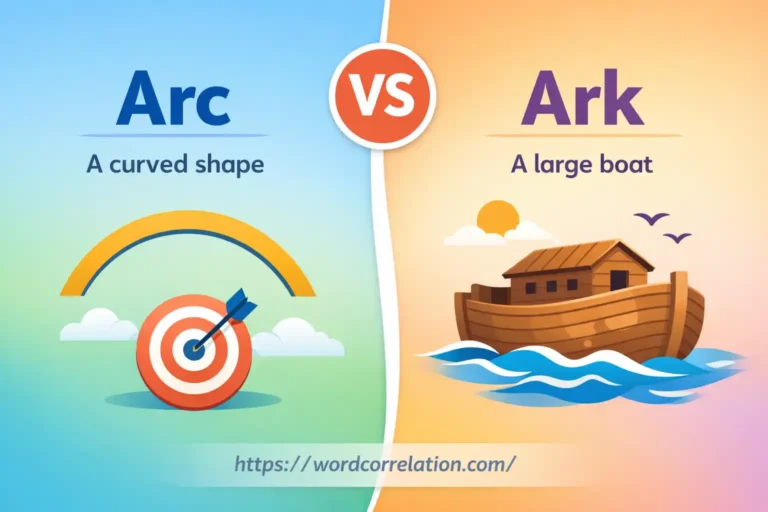
Arc and ark sound similar, but they mean different things. Arc usually means a curved shape or a path, while ark means a large boat (especially Noah’s Ark) or a sacred chest. This confusion happens in school work, blogs, emails, and even news articles. Moreover, spellcheck tools do not always help, because both words are correct English words. Therefore, one small spelling change can fully change the meaning of a sentence.
In contrast, learners want clarity. They want one clear rule. They also want easy examples. Additionally, they want to know which word fits which situation. That is exactly what this article solves. First, you will learn what each word means. Then, you will see where people make mistakes. After that, you will learn how to choose the right word every time. Finally, you will walk away with one simple rule you can always trust.
Overall, this guide uses very simple English. It avoids grammar stress. It explains everything step by step. As a result, you will never confuse arc and ark again.
Read more confusing word pairs in our Homophones & Commonly Confused Words hub.
Arc or Ark – Quick Answer
Arc and ark are not the same.
- Arc means a curve or a shaped line.
Example: The rainbow formed an arc. - Ark means a large boat or sacred chest.
Example: Noah built an ark.
Therefore, use arc for shapes. Use ark for objects.
The Origin of Arc or Ark
The word arc comes from Latin arcus. It means a bow or a curve. Because of that, modern English uses arc for curved shapes, paths, and movements. For example, science and math use arc often.
In contrast, the word ark comes from Latin arca. It means a box or chest. Later, the Bible used ark to name Noah’s ship and the Ark of the Covenant. As a result, ark gained a strong religious meaning.
The confusion exists because both words sound similar. However, their histories are very different. Therefore, their meanings never overlap. This pair fits perfectly in our word confusion pillar.
British English vs American English Spelling
There is no spelling difference between British and American English for arc or ark. However, usage differs by topic.
| Aspect | Arc | Ark |
| Spelling | Same in US & UK | Same in US & UK |
| Common use | Science, math, writing | Religion, history |
| Meaning | Curve or path | Boat or chest |
In contrast to many spelling pairs, this confusion is not regional. Instead, it is semantic. Therefore, location does not matter here.
Which Spelling Should You Use?
You should choose based on meaning, not country.
For US readers:
Use arc when talking about curves or movement. Use ark only for religious or historical objects.
For UK and Commonwealth readers:
The same rule applies. Meaning always decides.
For global or professional writing:
Always check context. If the sentence describes shape or motion, choose arc. If it describes a vessel or sacred object, choose ark.
As a result, clarity improves instantly.
Common Mistakes with Arc or Ark
Many errors happen because writers rely on sound, not meaning.
❌ The rainbow formed a beautiful ark.
✅ The rainbow formed a beautiful arc.
❌ The hero followed a long ark in the story.
✅ The hero followed a long arc in the story.
❌ Noah built an arc to save animals.
✅ Noah built an ark to save animals.
Therefore, always ask one question:
Is this a shape or an object?
Arc or Ark in Everyday Examples
Emails:
“The project shows a clear growth arc.”
News:
“The film follows the hero’s emotional arc.”
Social media:
“Love this character arc!”
Formal writing:
“The architectural arc supports the bridge.”
Religious context:
“The ark carried animals during the flood.”
As shown above, real usage makes the difference very clear.
Arc or Ark – Google Trends & Usage Data
Search data shows that arc is far more common than ark. This happens because arc appears in science, stories, and daily speech. Meanwhile, ark appears mostly in religious searches.
- Students search “story arc” often.
- Writers search “character arc” frequently.
- ESL learners search “arc vs ark” for clarity.
- Professionals use arc in reports and analysis.
However, mistakes still appear online. As a result, clear explanations remain important. Another pronunciation-based mix-up is fowl or foul.
Arc vs Ark – Simple Comparison Table
Meaning:
- Arc: A curve or path
- Ark: A large boat or sacred chest
Part of speech:
- Arc: Noun
- Ark: Noun
Context of use:
- Arc: Math, stories, shapes
- Ark: Religion, history
Formal vs informal:
- Arc: Both
- Ark: Mostly formal
Common mistakes:
- Arc: Confused with ark
- Ark: Used instead of arc
Correct example:
- Arc: “The story has a strong arc.”
- Ark: “The ark survived the flood.”
This table removes confusion instantly.
Semantic FAQs
Is arc the same as ark?
No. They sound similar but mean different things.
Which one is correct in formal writing?
Both are correct when used properly.
Can arc and ark be interchangeable?
No. Their meanings never overlap.
Why do people confuse arc and ark?
Because they sound alike when spoken.
Can grammar tools catch this mistake?
Sometimes not, because both words are valid.
Is there a British vs American difference?
No. Usage depends on meaning only.
Conclusion
Overall, arc or ark confusion is common but easy to fix. First, remember that arc relates to curves, movement, and progress. It fits stories, science, and shapes. In contrast, ark refers to a physical object, often linked to religion or history. Therefore, context always decides the correct word. Similar confusion can be seen in sole or soul.
Moreover, spelling alone cannot guide you. You must check meaning. Additionally, reading the sentence aloud can help. If it describes motion or shape, arc is correct. If it describes a vessel or sacred object, ark is correct.
In short, never choose based on sound. Always choose based on sense. Finally, keep this one rule in mind:
Shapes use arc. Objects use ark.

Daniel Morris writes about English word differences and spelling confusion. His focus is to provide clear, simple explanations with practical usage examples.