
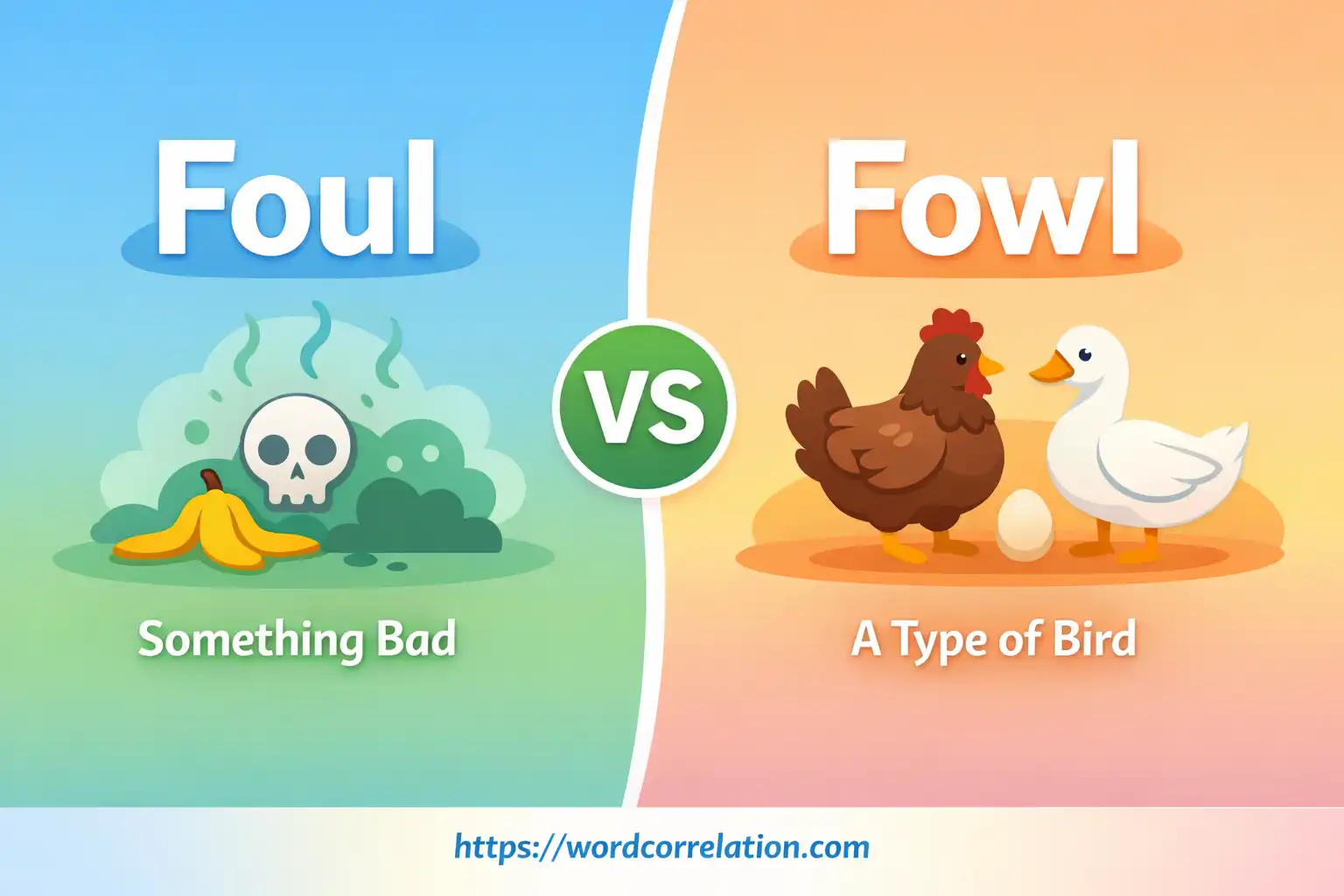
If you have ever stopped mid-sentence wondering whether to write foul or fowl, you are not alone. Because both words are pronounced identically, it is easy to swap them by mistake.
Foul means something unpleasant, dirty, unethical, or an infraction against the rules in sports. Fowl refers specifically to birds, particularly farm poultry like chickens and ducks or wild game birds.
Here is the quick breakdown to help you pick the right word immediately:
Quick Answer Table (At-a-Glance)
| Word | Part of Speech | Core Meaning | Quick Example |
|---|---|---|---|
| Foul | Adjective, Noun, Verb | Unpleasant, dirty, unethical, or a sports rule infraction | The referee called a foul after the collision. |
| Fowl | Noun | A bird, especially domestic poultry or game birds | The farmer feeds the fowl every morning. |
What Does “Foul” Mean?
Part of Speech & Pronunciation
- Part of Speech: Adjective, Noun, Verb
- Pronunciation:
/faʊl/(rhymes with towel and howl)
Definitions
The word foul almost always carries a negative or unwanted connotation. It describes something that offends the senses, violates ethics or athletic rules, or causes physical contamination:
- Adjective (Offensive or Unpleasant): Disgusting to smell, taste, or look at (e.g., a foul odor).
- Adjective (Morally Wrong or Vulgar): Unfair, dishonest, or offensive in language or behavior (e.g., foul language, foul mood).
- Adjective (Weather & Nautical): Stormy, rough, or dangerous environmental conditions (e.g., foul weather).
- Noun (Sports Rule Infraction): An illegal action or penalty in a game (e.g., a basketball foul or a foul ball in baseball).
- Verb (To Dirty or Obstruct): To clog, pollute, or commit a rule breach (e.g., to foul an engine or to foul a shooter).
6 Example Sentences in Different Contexts
- Sports Context (Noun): The referee blew the whistle and called a personal foul when the defender blocked the shooter illegally.
- Odor Context (Adjective): A foul smell drifted from the basement after the heavy rains backed up the drainage pipes.
- Ethical/Moral Context (Adjective): Spreading false rumors about a colleague is a foul tactic that damages workplace trust.
- Weather Context (Adjective): Captains ordered all fishing vessels back to the harbor due to incoming foul weather.
- Action/Verb Context (Verb): Chemical runoff can easily foul local drinking water supplies if processing plants lack strict oversight.
- Idiomatic Context (Noun phrase): Investigators suspected foul play when they discovered missing financial records in the office.
What Does “Fowl” Mean?
Part of Speech & Pronunciation
- Part of Speech: Noun (singular & plural)
- Pronunciation:
/faʊl/(rhymes with towel and owl)
Definitions
Fowl is a specialized noun used in agriculture, wildlife conservation, biology, and culinary arts to refer specifically to birds.
- Domesticated Poultry: Farm birds raised for meat, eggs, or feathers (e.g., chickens, turkeys, ducks, and geese).
- Wild & Game Birds: Birds hunted for sport or food (e.g., pheasants, quail, and wild ducks).
- Biological Taxonomy: Members of the avian orders Galliformes (landfowl) and Anseriformes (waterfowl).
Note: In traditional English, “fowl” functions as both singular and plural (e.g., “one fowl,” “a flock of fowl”), although “fowls” is also used when referring to multiple distinct species.
6 Example Sentences in Different Contexts
- Agricultural Context: The free-range homestead raises several types of domestic fowl, including ducks and Rhode Island Red chickens.
- Wildlife & Hunting Context: Duck hunters waited quietly in the coastal marsh at dawn for migratory fowl to descend.
- Culinary Context: The restaurant’s seasonal menu features roasted game fowl served with root vegetables and cranberry glaze.
- Idiomatic Context: The new corporate policy was neither fish nor fowl, satisfying neither executive management nor field staff.
- Exhibition Context: Local farmers showcased their prize-winning fowl at the county fair’s livestock competition.
- Biological Context: Waterfowl such as swans possess specialized oil glands that keep their feathers waterproof in cold ponds.
Foul vs Fowl: Key Differences Comparison Table
| Feature | Foul | Fowl |
|---|---|---|
| Primary Meaning | Dirty, unpleasant, unethical, or a sports rule infraction | A bird (poultry, waterfowl, or game bird) |
| Part of Speech | Adjective, Noun, Verb | Noun only |
| Etymology / Root | Old English fūl (rotten, dirty, corrupt) | Old English fugol (bird) |
| Typical Contexts | Sports, weather, bad smells, morality, legal reports | Agriculture, cooking, wildlife, biology |
| Key Associations | Foul mood, foul smell, foul play, personal foul | Waterfowl, wild fowl, barnyard fowl, game fowl |
| Antonym / Opposite | Fair, clean, pleasant, fresh | N/A (concrete physical noun) |
Why People Confuse These Words
The mix-up between foul and fowl happens because they are homophones—words that share identical pronunciations (/faʊl/) despite having completely different spellings, origins, and meanings.
- Origin of Foul: Derives from the Old English fūl, meaning rotten, corrupt, or dirty. It has maintained its association with unpleasantness for over a thousand years.
- Origin of Fowl: Traces back to the Old English fugol (related to the German Vogel), which originally meant “bird” in general. Over time, “bird” became the broader term, while “fowl” narrowed to describe poultry and hunted game birds.
Because we speak and hear language before writing it, our minds often default to the more common spelling (foul) when writing quickly.
Memory Tricks to Remember the Difference
Never confuse these two words again with these visual visual memory aids:
Trick 1: The “OWL” Hidden Inside FOWL
Look closely at the word FOWL:
F-O-W-L contains the word OWL.
An owl is a bird—so fowl always refers to birds!
Trick 2: “W” for Wings vs. “U” for Unpleasant
- FOWL has a W $\rightarrow$ Wings, Wild birds, Waterfowl.
- FOUL has a U $\rightarrow$ Unpleasant, Unfair, Ungodly smell.
Example Sentences Side-by-Side
| Context | Using FOUL Correctly | Using FOWL Correctly |
|---|---|---|
| On the Farm | The barn produced a foul odor after the sewer line broke. | The farmer gathered fresh eggs from his barnyard fowl. |
| In Nature | Foul weather forced the expedition team to pitch camp early. | Migratory fowl nested along the edge of the sanctuary. |
| In Conversation | He apologized for using foul language during the debate. | They discussed the logistics of raising domestic fowl. |
| In Sports / Hunting | The umpire called a foul ball down the left field line. | Hunting wild fowl requires a licensed seasonal permit. |
Common Mistakes People Make
1. Writing “Fowl Play” Instead of “Foul Play”
- Incorrect: Detectives suspected fowl play after inspecting the office.
- Correct: Detectives suspected foul play after inspecting the office.
- Why: “Foul play” is an established idiom for criminal or unethical activity. Unless actual birds were involved in a crime, always use foul.
2. Writing “Waterfoul” Instead of “Waterfowl”
- Incorrect: Ducks and geese belong to the waterfoul species.
- Correct: Ducks and geese belong to the waterfowl species.
- Why: Ducks are birds with Wings, making them waterfowl.
3. Writing “Fowl Mood” or “Fowl Weather”
- Incorrect: The manager is in a fowl mood today.
- Correct: The manager is in a foul mood today.
- Why: Moods and weather are Unpleasant, so they require foul.
Frequently Asked Questions (FAQ)
What is the main difference between foul and fowl?
Foul describes something dirty, unpleasant, unethical, or a penalty in sports. Fowl is a noun referring to birds, such as poultry, ducks, or game birds.
Is it “foul play” or “fowl play”?
The correct spelling is foul play. It refers to illegal, violent, or dishonest behavior.
Is poultry considered fowl?
Yes. Domesticated poultry (chickens, turkeys, ducks, geese) is the primary category of fowl raised for agricultural purposes.
How can I remember how to spell fowl for birds?
Remember that fowl contains the word owl (a type of bird) and starts its second syllable with W for wings.
Is a turkey considered a fowl?
Yes, turkeys are classified as landfowl (Galliformes) and are considered domestic or game fowl.
Can foul be used as a verb?
Yes. Foul can act as a verb meaning to pollute, clog, or commit a penalty in sports (e.g., “Oil spills foul the water”). Fowl is strictly a noun and cannot be used as a verb.
Conclusion
Understanding the difference between foul or fowl comes down to recognizing whether you are describing an unpleasant quality or a feathered animal:
- Use foul (with a U) when describing something dirty, unpleasant, unfair, or a sports violation.
- Use fowl (with a W) whenever referring to birds, poultry, or waterfowl.

Ibrahim Jhon is an English language editor with over ten years of experience working with writers, publishers, and international businesses. He specialises in word choice, grammar accuracy, and the differences between British and American English.