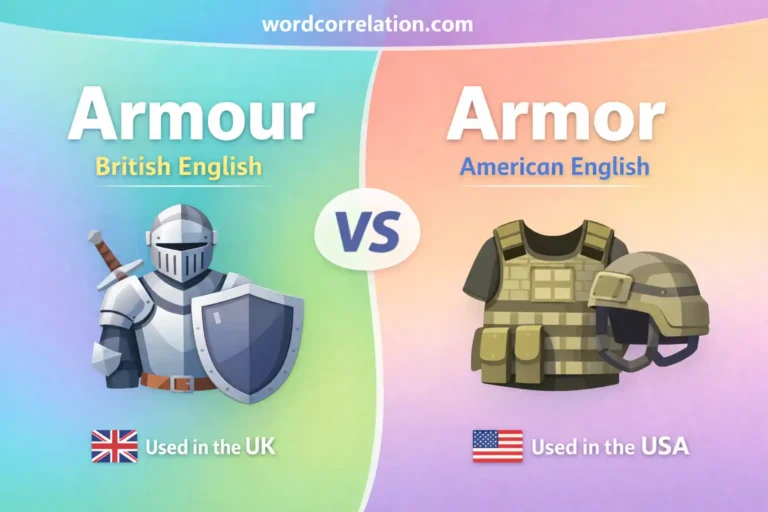
When you hear the words “armour” and “armor,” do you find yourself confused about when to use each one? Many English learners, as well as native speakers, often mix these two terms up, and it’s understandable! Both words refer to protective gear used in battle, but they have different spellings and are used in different places.
If you’ve ever wondered which one to use and why, you’re in the right place. In this article, we’ll clear up the confusion once and for all. You’ll learn where each word comes from, why people often confuse them, and how to use them correctly in your writing.
By the end of this article, you’ll be able to confidently use “armour” or “armor” in the right context, whether you’re writing emails, social media posts, or academic papers.
Armour vs Armor – Quick Answer
- Armour: Used in British English, refers to protective gear or a military vehicle.
- Armor: Used in American English, has the same meaning as “armour.”
Easy Decision Rule:
- Use armour in British English.
- Use armor in American English.
The Origin of Armour vs Armor
Both “armour” and “armor” come from the same root, derived from the Latin word “armatura,” meaning “equipment” or “arms.” The spelling difference began to appear during the early stages of the English language, as British English and American English started to develop their own rules for spelling.
- Armour (with a “u”) is the traditional spelling in British English.
- Armor (without the “u”) is the preferred spelling in American English.
Why is This Confusion Still Present?
This confusion mainly arises because the two versions of English—British and American—have evolved differently, especially in spelling. The reason people still mix them up today is that the words themselves are used interchangeably in both varieties of English, even though one is more common in each region.
British English vs American English Spelling
When it comes to British vs American English, “armour” is the traditional British spelling, while “armor” is the American version. Here’s a quick comparison:
| Feature | Armour (UK) | Armor (US) |
| Meaning | Protective covering | Protective covering |
| Part of Speech | Noun | Noun |
| Context of Use | Used in the UK and Commonwealth countries | Used in the US |
| Formal Usage | Yes | Yes |
| Common Mistakes | Confused for armor in US contexts | Confused for armour in UK contexts |
| Correct Example | “The knight wore his armour proudly.” | “The knight wore his armor proudly.” |
Which Spelling Should You Use?
It all depends on where you’re writing or who your audience is. Here’s a simple guide:
- For US audiences: Use “armor.”
- For UK and Commonwealth audiences: Use “armour.”
- Global or Professional Writing: If your audience is international, it’s best to use the spelling appropriate to your region. However, be mindful of consistency in your usage.
Common Mistakes with Armour vs Armor
Writers often make the mistake of using the wrong spelling based on their audience’s location. For example:
- Incorrect: “The tank was equipped with advanced armour for its protection.” (This might confuse American readers.)
- Correct: “The tank was equipped with advanced armor for its protection.” (This is the correct form for US readers.)
Let’s look at some other examples:
- Incorrect: “The soldiers were wearing armor during the battle.” (This would be incorrect for UK audiences.)
- Correct: “The soldiers were wearing armour during the battle.” (This would be the right spelling for UK audiences.)
Armour vs Armor in Everyday Examples
Now, let’s look at some real-life examples where you might use these words in different contexts.
Emails
- Armour (UK): “Please ensure the team is equipped with the right armour before the field operation.”
- Armor (US): “Make sure the soldiers have the best armor before they head out.”
News
- Armour (UK): “The military is testing a new type of armour for their vehicles.”
- Armor (US): “The government has approved new funding to enhance the durability of military armor.”
Social Media
- Armour (UK): “Check out this beautiful historical armour from the 16th century!”
- Armor (US): “Looking for the strongest armor? Check out these new designs!”
Formal or Professional Writing
- Armour (UK): “The knight’s armour was crafted with precision and care.”
- Armor (US): “The soldiers’ armor was tested for durability in extreme conditions.”
Armour vs Armor – Usage Patterns & Search Interest
This term is highly searched by both students and ESL learners because people often confuse British and American spellings. Many writers, especially those in the Commonwealth, search for the correct form to use in formal writing. Likewise, American writers look up the alternative spelling when writing for international audiences.
One scenario where confusion can arise is when writing professional documents that will be read by both US and UK audiences. For instance, if you are writing a report that will be shared with both British and American companies, you might want to be consistent with your spelling to avoid confusion.
Comparison Table
| Feature | Armour (UK) | Armor (US) |
| Meaning | Protective covering | Protective covering |
| Part of Speech | Noun | Noun |
| Context of Use | UK, Commonwealth | US |
| Formal Usage | Yes | Yes |
| Informal Usage | Yes | Yes |
| Common Mistakes | Confused with armor in US | Confused with armour in UK |
| Correct Example | “The knight wore his armour.” | “The knight wore his armor.” |
Semantic FAQs
Is Armour the Same as Armor?
Yes, “armour” and “armor” mean the same thing, but they are used in different regions—”armour” is used in the UK, while “armor” is used in the US.
Which One is Correct in Formal Writing?
Both “armour” and “armor” are correct in formal writing, as long as you stick to the appropriate spelling for the region you’re addressing.
Can Armour and Armor Be Used Interchangeably?
Yes, but only when referring to the same audience. If you’re writing for an American audience, use “armor,” and for a British audience, use “armour.”
Why Do People Confuse Armour and Armor?
The confusion arises because of the different spellings in British and American English. Many English learners mix them up when they are unsure of their audience.
Can Grammar Tools Catch This Mistake?
Yes, most grammar tools can catch this mistake, but they may not be able to tell you which version to use based on your audience.
Conclusion
In summary, “armour” and “armor” are the same word, but with regional spelling differences. The key takeaway is:
- Use “armour” for British English and Commonwealth countries.
- Use “armor” for American English.
One mistake to avoid is mixing the two spellings in the same document, especially if your audience is region-specific. If you ever find yourself unsure, remember this simple rule: when writing for Americans, drop the “u” and use “armor.” For British audiences, keep it as “armour.” Stay consistent with your spelling, and you’ll avoid any confusion.

Daniel Morris writes about English word differences and spelling confusion. His focus is to provide clear, simple explanations with practical usage examples.