You write a sentence about a church event. Then you pause. Should you write baptized or baptised? Both look correct. Both sound the same. Yet spellcheck may mark one as wrong. This small doubt slows many writers, students, and ESL learners every day.
The confusion happens because English has two main spelling systems. One comes from American English. The other comes from British English. So the word changes form, but the meaning stays the same. Many people do not know this. As a result, they mix the spellings in one document, which looks unprofessional and confusing.
In this guide, you will learn why two spellings exist, when to use each one, and how to avoid the most common mistake writers make with these words.
Baptized vs Baptised – Quick Answer
- Both words mean the same thing.
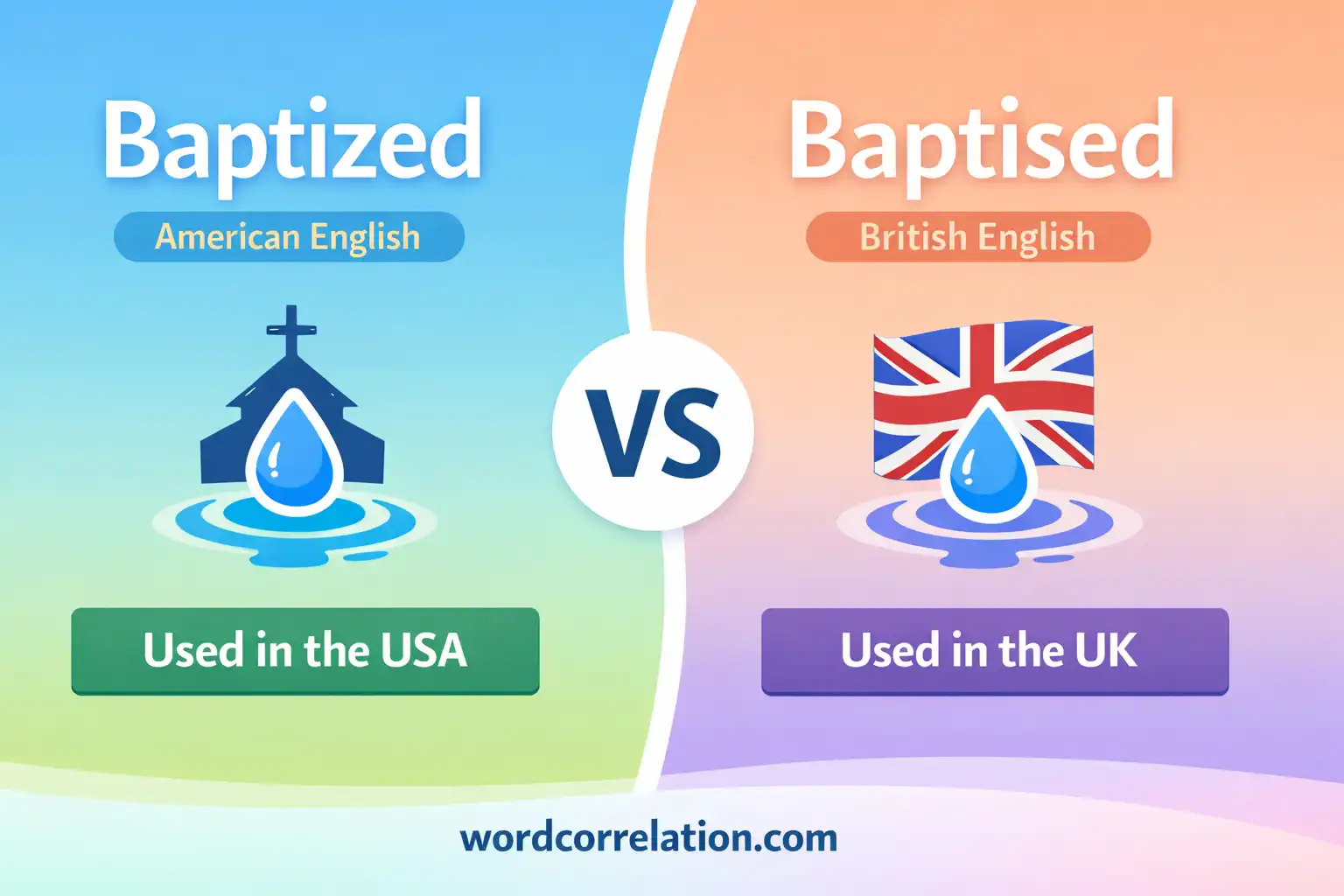
- Baptized is American English.
- Baptised is British English.
- Use the spelling that matches your audience.
Easy rule:
Write for the country you write to.
Example:
- US church website → baptized
- UK church newsletter → baptised
The Origin of Baptized vs Baptised
The word comes from the Greek word baptizein, which means to dip in water. Later, Latin and Old French carried the word into English.
For many years, English had no fixed spelling rules. Writers spelled words by sound. Then two spelling systems formed over time:
- British English kept older French-style endings like -ise
- American English simplified many words to -ize
This is why we now see pairs like:
- organize / organise
- realize / realise
- baptize / baptise
So the confusion today does not come from meaning. It comes from history and spelling style.
British English vs American English Spelling
This difference follows a clear pattern in English.
| American English | British English |
| baptized | baptised |
| organize | organise |
| realize | realise |
| recognize | recognise |
In American English, -ize is standard.
In British English, -ise is common and preferred.
However, both forms are accepted in many dictionaries. The key is consistency.
Which Spelling Should You Use?
The answer depends on who will read your writing.
Use “baptized” if:
- Your audience is in the United States
- You write for American websites or publishers
- You follow American spelling rules
Use “baptised” if:
- Your audience is in the UK, Australia, Canada, or other Commonwealth countries
- You write for British publications
- You follow British spelling style
For global or professional writing:
Pick one style and stay consistent. Do not mix both in the same article or document.
Common Mistakes with Baptized vs Baptised
Writers often make small but noticeable errors.
❌ The child was baptised at a New York church.
✅ The child was baptized at a New York church.
❌ Our London parish baptized five members.
✅ Our London parish baptised five members.
The biggest mistake is mixing styles, not choosing the wrong one.
Baptized vs Baptised in Everyday Examples
You will see these words in many places.
Emails
- “My son was baptized last Sunday.” (US)
- “My son was baptised last Sunday.” (UK)
News
- “The baby was baptized in a private ceremony.”
- “The baby was baptised in a small chapel.”
Social Media
- “Feeling blessed to be baptized today.”
- “Proud to be baptised this morning.”
Formal Writing
- Church records
- Religious history articles
- Event programs
The context does not change the spelling. Only the audience does.
Baptized vs Baptised – Usage Patterns & Search Interest
Many students and ESL learners search this term because spellcheck marks one form as wrong. Writers also worry when grammar tools suggest a change.
Editors often see documents where both spellings appear together. This makes the text look careless.
A common real-world problem happens in international teams. One writer uses American spelling. Another uses British spelling. The final document looks inconsistent.
This article solves that problem with one simple idea: match the spelling to the audience.
Comparison Table: Baptized vs Baptised
| Feature | Baptized | Baptised |
| Meaning | Same | Same |
| Part of speech | Verb (past tense) | Verb (past tense) |
| English style | American | British |
| Context of use | US writing | UK/Commonwealth writing |
| Formal vs informal | Both | Both |
| Common mistake | Mixed with baptised | Mixed with baptized |
| Correct example | She was baptized in Texas. | She was baptised in London. |
This table shows there is no meaning difference, only spelling style.
FAQs
Is baptized the same as baptised?
Yes. The meaning is identical. Only the spelling differs.
Which one is correct in formal writing?
Both are correct. Choose the one that matches your English style.
Can they be used interchangeably?
No. Do not mix them in the same document.
Why do people confuse them?
Because both appear in dictionaries and sound the same.
Can grammar tools catch this mistake?
Yes. Tools follow either US or UK settings and may flag the other.
Is there a British vs American difference?
Yes. American uses baptized. British uses baptised.
Does pronunciation change?
No. Both are pronounced the same way.
Conclusion
The difference between baptized and baptised is simple once you see the pattern. The meaning never changes. The pronunciation stays the same. Only the spelling style shifts between American and British English.
Writers often worry they are using the wrong word. In truth, they worry about the wrong thing. The real problem is mixing both spellings in the same text. This small error makes writing look unprofessional, even when the content is correct.
Overall, the solution is easy. First, know your audience. Then, choose the spelling style that matches it. Finally, stay consistent from start to finish.
Easy rule to remember:
American audience → baptized
British audience → baptised

Jonathan Swift is a writer whose work reflects sustained attention to language precision, meaning, and the practical effects of word choice. Trained in classical studies and theology, he develops a disciplined approach to writing that combines close textual analysis with a strong concern for clarity and accuracy. His essays, pamphlets, and satirical works show a consistent method: examining how words are used, misused, and reshaped to influence public understanding.
Swift’s writing demonstrates an early form of semantic analysis. He compares terms, exposes false equivalence, and highlights how subtle differences in wording alter meaning, intent, and interpretation. This analytical focus allows readers to see language not as decoration, but as a tool that shapes thought, policy, and belief.
By breaking down complex expressions into their functional parts, Swift helps readers distinguish between surface language and underlying meaning. His work remains valuable to audiences interested in word comparison, rhetoric, and the responsible use of language. Across genres, his reputation rests on careful reasoning, linguistic discipline, and a consistent commitment to helping readers read more critically and precisely.