You write a sentence. Then you pause.
Should it be borders or boarders?
Many people stop here. The words look almost the same. They sound the same when spoken. So writers often mix them up in emails, essays, news posts, and even school work.
This small spelling mistake can change the whole meaning of a sentence. One word talks about edges of places. The other talks about people who rent a room. That is a big difference.
Because of this, students, ESL learners, and even native speakers search for borders vs boarders to clear the confusion once and for all. In this guide, you will learn the exact meaning of both words, where people make mistakes, and one simple rule that makes the choice easy every time.
Borders vs Boarders – Quick Answer
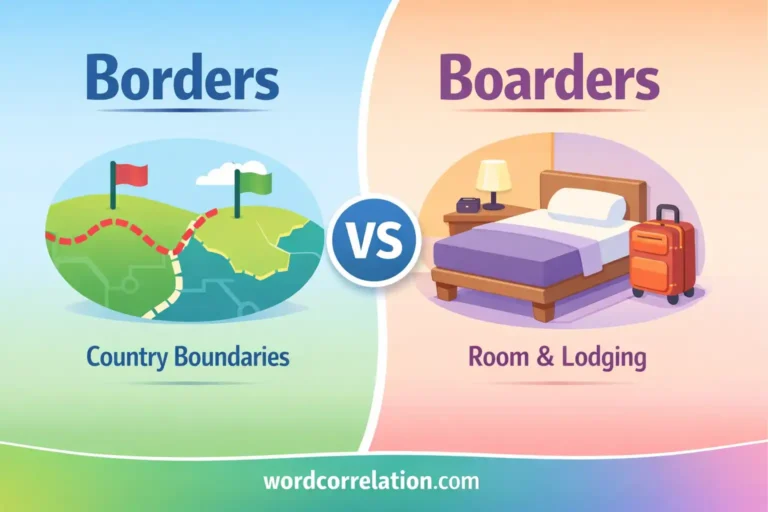
- Borders = edges, limits, or boundaries of a place
- Boarders = people who live somewhere and pay for meals or rooms
Examples:
- The river forms the borders of the country.
- The house has three student boarders.
Easy rule:
If you talk about a place, use borders.
If you talk about people staying, use boarders.
The Origin of Borders vs Boarders
The confusion starts because both words sound the same.
Borders comes from an old French word bord, which means edge or side. Over time, English used it to talk about the edge of land, countries, or areas.
Boarders comes from the word board, which once meant table. Long ago, if someone paid to sit at your table and eat, they were called a boarder. Later, it also meant someone who rents a room and meals in a house.
So, the words have very different stories. But today, they sound alike. That is why writers often confuse them.
British English vs American English Spelling
There is no spelling difference between British and American English for these words.
Both countries use:
| Word | Meaning | Example |
| Borders | Edges or boundaries | Canada shares borders with the USA |
| Boarders | People renting rooms/meals | The hostel has many boarders |
So, the issue is not about region. It is about meaning.
Which Spelling Should You Use?
You choose based on what you are talking about.
- Writing about countries, cities, areas → borders
- Writing about tenants, renters, students staying in a house → boarders
This rule works in the US, UK, Canada, Australia, and everywhere else.
In professional and academic writing, this mistake stands out quickly. So choosing the right word matters.
Common Mistakes with Borders vs Boarders
Writers often swap these words in sentences like these:
❌ The school has strict borders for students staying in the dorm.
✅ The school has strict boarders staying in the dorm.
❌ Many borders live in this paying guest house.
✅ Many boarders live in this paying guest house.
The mistake happens because people think about the sound, not the meaning.
Borders vs Boarders in Everyday Examples
Here is how the words appear in real writing.
Emails
- Please check the property borders before buying the land.
- We currently have two boarders in the guest rooms.
News
- The army protects the country’s borders.
- The old house was full of student boarders.
Social Media
- Traveling across state borders is easy now.
- My aunt rents rooms to college boarders.
Professional Writing
- The map clearly marks the national borders.
- The landlord provides meals for all boarders.
Borders vs Boarders – Usage Patterns & Search Interest
Many learners search this term because spell-check tools often miss the error. Both words are correct English words. So grammar tools do not always warn you.
Students, bloggers, and ESL writers face this problem most. Editors also see this mistake in travel articles and housing descriptions.
One real problem happens in property writing. If someone writes “the house has wide borders,” it sounds like land edges, not people living there. That can confuse readers.
Comparison Table: Borders vs Boarders
| Feature | Borders | Boarders |
| Meaning | Edges, limits, boundaries | People renting rooms/meals |
| Part of speech | Noun (plural) | Noun (plural) |
| Context of use | Geography, land, areas | Housing, lodging, tenants |
| Formal vs informal | Used in both | Used in both |
| Common mistake | Used for people | Used for places |
| Correct example | The fence marks the borders | The home has three boarders |
This table removes the confusion fast.
FAQs: Borders vs Boarders
Is borders the same as boarders?
No. Borders are edges. Boarders are people staying in a place.
Which one is correct in formal writing?
Both are correct. You must choose based on meaning.
Can they be used interchangeably?
No. The meanings are completely different.
Why do people confuse them?
They sound the same when spoken.
Can grammar tools catch this mistake?
Not always, because both words are valid.
Is there a British vs American difference?
No. The spelling and meaning stay the same.
How can I remember the difference?
Boarders have an “a” like “stay.” Borders have an “o” like “outline.”
Conclusion
At first, borders vs boarders looks like a small spelling problem. But the meanings sit far apart. One word talks about the edge of land, countries, or spaces. The other word talks about people who live somewhere and pay for food or rooms.
Writers often make this mistake because the words sound alike. Also, spell check does not help much here. So the error can slip into emails, essays, and articles without notice.
Overall, the fix is simple. Think about what you are describing. If it is a place or boundary, choose borders. If it is a person staying in a home, choose boarders.
Final rule to remember:
Places have borders. People are boarders.

Daniel Morris writes about English word differences and spelling confusion. His focus is to provide clear, simple explanations with practical usage examples.