Many learners search for effect vs influence because both words seem similar. Both talk about change. Both appear in news, essays, and daily speech. So people often mix them up.
The confusion usually happens when someone wants to describe how something changes another thing. Should you say something had an effect or had an influence? Many writers guess. Sometimes the guess is wrong.
This mistake matters because the two words do not always mean the same thing. One usually shows a result. The other often shows power to shape a result over time. Editors notice this difference quickly.
This guide explains the full meaning in very simple language. You will learn how each word works, why people confuse them, and how to choose the correct one in real writing. By the end, the difference between effect vs influence will feel clear and easy.
Effect vs Influence – Quick Answer
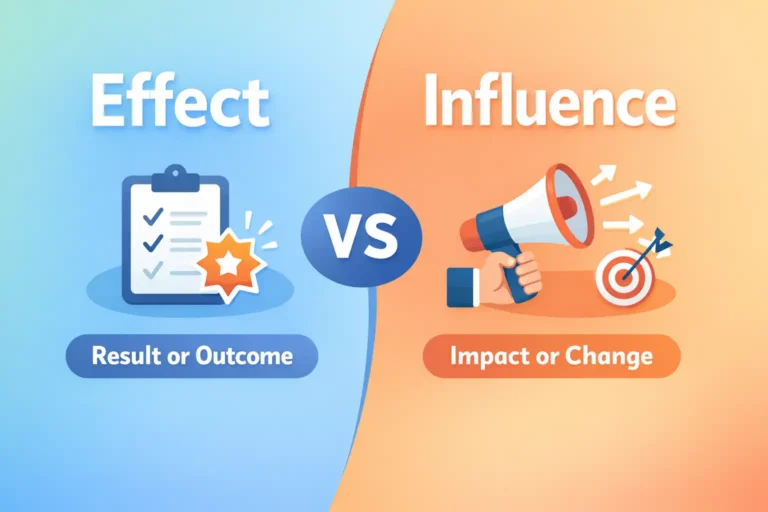
Effect means the result of a change.
Influence means the power to shape or guide change.
Meaning of Effect
- A result or outcome
- Something that happens because of a cause
Examples
- The medicine had a quick effect.
- The new rule had little effect.
Meaning of Influence
- The ability to shape decisions or behavior
- Often happens slowly or indirectly
Examples
- Parents have strong influence on children.
- Social media can influence opinions.
Easy rule
Use effect for a result.
Use influence for power that shapes a result.
The Origin of Effect vs Influence
Understanding word history helps explain why these words feel similar today.
The word effect comes from the Latin word effectus. It means result, completion, or outcome. In early English writing, the word described something that happened after a cause.
For example, philosophers often discussed cause and effect. A cause creates something. The effect is the result.
The word influence has a different origin. It comes from the Latin word influentia, which means flowing into. In early history, people believed stars could “flow” power into human lives. That idea later changed into the modern meaning: the power to shape thoughts or actions.
Because both words involve change, people often confuse them today. However, the difference still matters.
Effect shows what happened.
Influence shows what shaped what happened.
This small difference creates a big meaning change in real writing.
British vs American English Spelling
There is no spelling difference between British English and American English for these two words.
Both regions write the words the same way.
Effect → same spelling in US and UK
Influence → same spelling in US and UK
However, usage can vary slightly in tone.
In American and British writing, effect often appears in academic or scientific discussions about results. Meanwhile, influence appears more often in social topics such as culture, politics, or leadership.
Example comparison:
US news
“The policy had little effect on prices.”
UK news
“The policy had little effect on prices.”
Global writing
“Online creators have strong influence on young users.”
The spelling stays the same everywhere.
How to Choose the Right Word Fast
Choosing between effect vs influence becomes easy when you focus on the type of change.
If you describe a result, use effect.
If you describe power that shapes a result, use influence.
For US writers
Academic writing often uses effect when discussing results in research or policy.
For UK or Commonwealth writers
The same rule applies. However, social commentary often prefers influence when discussing culture or media.
For global professional writing
Use effect when talking about measurable results. Use influence when discussing persuasion, leadership, or gradual impact.
Quick thinking trick:
Result → Effect
Power shaping result → Influence
This simple rule works in most situations.
Common Mistakes with Effect vs Influence
Writers often confuse these words because they both describe change. Still, they are not interchangeable.
Here are common mistakes.
❌ The teacher had a strong effect on my career.
✅ The teacher had a strong influence on my career.
Explanation: A teacher shapes decisions over time. That is influence.
❌ Social media influenced a big effect on voters.
✅ Social media had a big effect on voters.
Explanation: Here we describe the result, not the shaping power.
❌ His speech effected many people.
✅ His speech influenced many people.
Explanation: The verb effect has a different meaning (to bring about). Most writers actually mean influence.
Editors often see this mistake in essays and news writing. So learning the difference helps your writing look clearer and more professional.
Effect vs Influence in Real Life Examples
These words appear in many types of writing. Seeing real examples helps you understand the difference.
Emails
“The new schedule had a positive effect on team productivity.”
“The manager’s leadership had a strong influence on team culture.”
News Writing
“The tax change had little effect on housing prices.”
“The celebrity’s comments influenced public opinion.”
Social Media
“This book had a big effect on how I see success.”
“Travel bloggers influence where many people choose to go.”
Professional Writing
“The training program had a measurable effect on employee performance.”
“Mentors often influence career decisions.”
Notice the pattern.
Effect shows the result.
Influence shows the force shaping that result.
Effect vs Influence – Word Usage Patterns and Search Trends
Search interest for effect vs influence often comes from students, ESL learners, and professional writers.
Students ask about this difference when writing essays. Teachers often mark mistakes when these words are swapped incorrectly.
ESL learners search for the phrase because both words translate into similar meanings in many languages. That makes the difference harder to see.
Professional writers also check this comparison because accuracy matters in journalism and business writing.
A common real-world confusion happens in leadership discussions.
Example scenario:
A manager changes company culture.
Some writers say:
“The manager had a big effect on the culture.”
However, the better phrase is:
“The manager had a big influence on the culture.”
Culture grows slowly. It is shaped over time. So influence fits better than effect.
Understanding this nuance helps writers communicate more clearly.
Effect vs Influence Comparison Table
Feature | Effect | Influence
Meaning | Result of a change | Power to shape change
Part of Speech | Noun (mostly) | Noun and verb
Context of Use | Results, outcomes, measurable change | Leadership, persuasion, social impact
Formal vs Informal | Common in academic writing | Common in social and professional topics
Common Mistake | Used instead of influence when describing people shaping behavior | Used instead of effect when describing outcomes
Correct Example | “The policy had a strong effect on prices.” | “Her advice influenced my decision.”
This table shows the key difference quickly: effect = result, influence = shaping power.
FAQs About Effect vs Influence
Is effect the same as influence?
No. Effect means the result of something. Influence means the power that shapes the result.
Which word is correct in formal writing?
Both words appear in formal writing. Use effect for results and influence for shaping behavior or decisions.
Can effect and influence be used interchangeably?
Sometimes they appear similar, but they are not fully interchangeable. The meaning changes depending on whether you describe a result or a shaping force.
Why do people confuse effect and influence?
Both words describe change. Also, many languages translate them into similar words. This makes the difference harder to see.
Can grammar tools detect this mistake?
Sometimes they can. However, tools often miss context mistakes. Human understanding usually works better.
Is there a British vs American difference?
No. Both British and American English use effect and influence with the same spelling and meaning.
Conclusion
The difference between effect vs influence becomes simple when you focus on what type of change you describe.
Effect shows the result of something that already happened. You use it when discussing outcomes, results, or measurable changes.
Influence, on the other hand, describes the power that shapes those results. It often involves people, ideas, leadership, or culture that slowly guide decisions.
Writers often confuse these words because both involve change. However, the meaning becomes clear when you look at the role each word plays.
Use effect when you want to show what happened.
Use influence when you want to show what shaped what happened.
Overall, remembering one small rule can prevent most mistakes.
Result = Effect
Shaping power = Influence
Once this rule becomes natural, the confusion between effect vs influence disappears.

Daniel Morris writes about English word differences and spelling confusion. His focus is to provide clear, simple explanations with practical usage examples.