
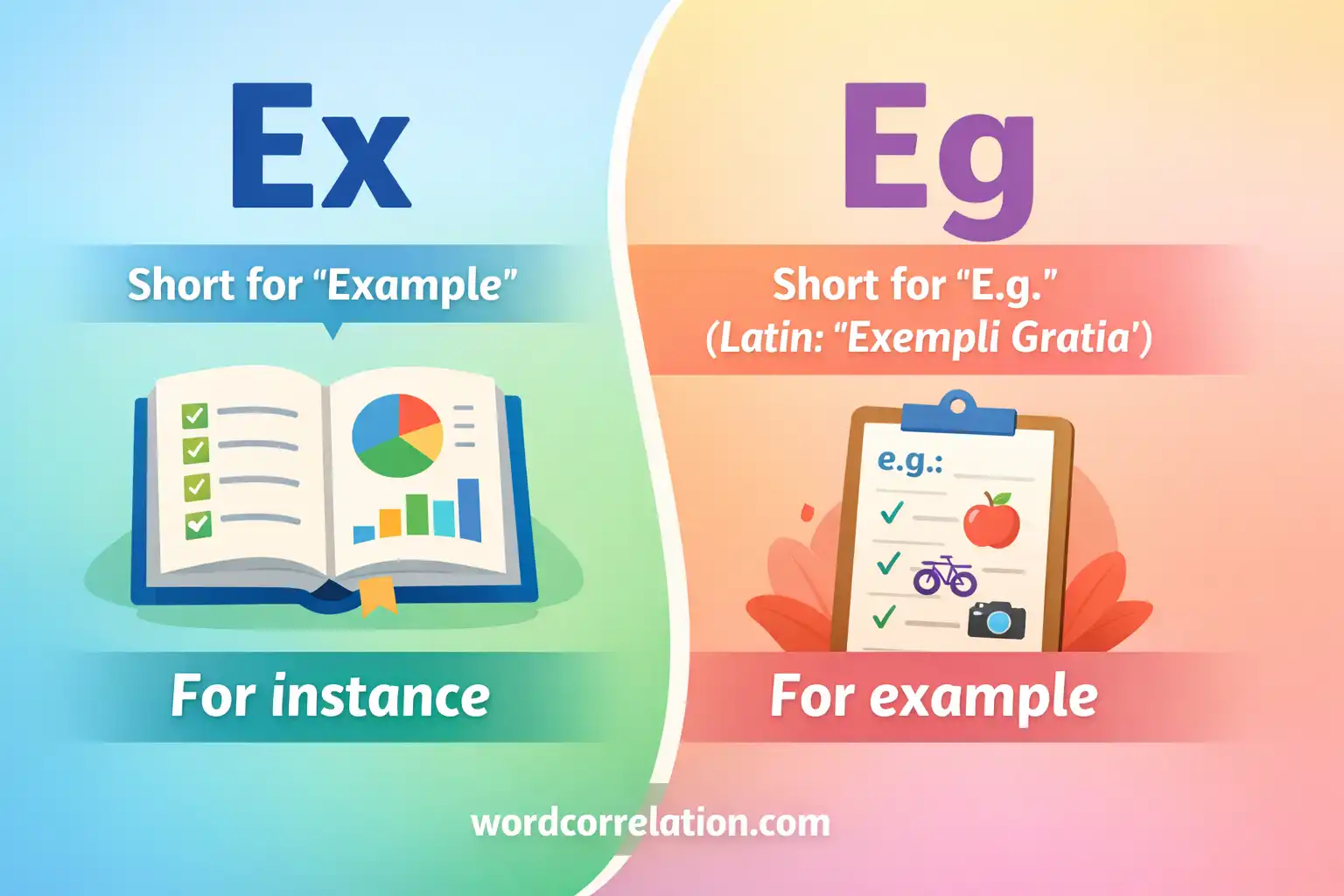
Learn ex or eg with clear rules, examples, and fixes that stop mistakes and improve writing fast. Many writers stop when they see ex or eg. The letters look small. However, the confusion feels big. Students pause. Professionals hesitate. ESL learners guess. As a result, mistakes appear in emails, essays, and posts.
This problem happens because both forms look similar. Moreover, both often appear inside brackets. Meanwhile, many people never learn the rule at school. Therefore, they rely on memory, not meaning. In contrast, grammar needs logic, not guessing.
This article solves that problem clearly. First, it explains what ex and eg really mean. Then, it shows where each one works best. Additionally, it highlights common mistakes and easy fixes. For example, you will see how to use them in real sentences. Finally, you will learn one simple rule that ends confusion forever.
If you write in English, this guide helps you. Overall, it saves time. Moreover, it builds confidence. Most importantly, it stops avoidable errors.
Abbreviation usage is explained in the word comparison hub.
Ex or Eg – Quick Answer
Ex and eg are not the same.
- eg means for example.
Example: I like fruit (eg, apples). - ex means former or out of.
Example: She met her ex boss.
Use eg for examples. Use ex for former things or origins.
The Origin of Ex or Eg
Both terms come from Latin. However, their meanings differ. Eg comes from exempli gratia. It means “for the sake of example.” Therefore, writers use it to list samples.
Ex comes from ex. It means “out of” or “from.” Later, English used it for “former.” As a result, we say ex-wife or ex-student.
The confusion started because both look short. Moreover, both appear in brackets. Meanwhile, many style guides skip the explanation. Therefore, users mix them up.
This pair fits under our meaning usage pillar.
British English vs American English Spelling
There is no spelling difference. However, usage habits vary slightly.
| Aspect | British English | American English |
| eg usage | Common | Common |
| ex usage | Common | Common |
| Periods | Rare | Sometimes used |
| Brackets | Preferred | Preferred |
In contrast to spelling debates, this rule stays global. Therefore, meaning matters more than location.
Which Spelling Should You Use?
Choose based on purpose, not country.
- US writers: Use eg for examples. Use ex for former roles.
- UK / Commonwealth: Follow the same rule. Style stays consistent.
- Global or professional writing: Prefer eg in examples. Avoid ex unless you mean “former.”
Overall, clarity wins. Therefore, pick the form that matches meaning.
Common Mistakes with Ex or Eg
Many errors repeat daily. However, each one has an easy fix.
- ❌ I enjoy sports, ex football.
✅ I enjoy sports, eg football.
Explanation: You listed an example. - ❌ She met her eg manager.
✅ She met her ex manager.
Explanation: You meant former. - ❌ Use colors ex red and blue.
✅ Use colors, eg red and blue.
Explanation: Again, examples need eg.
Therefore, always ask one question. Are you giving examples or talking about the past?
Ex or Eg in Everyday Examples
Emails
Please bring documents (eg, ID and forms).
News
The actor spoke about his ex partner.
Social Media
I love desserts, eg, cake and ice cream.
Formal Writing
Several methods (eg, surveys) were tested.
Meanwhile, ex stays rare in formal lists. It mainly describes people or roles.
Ex or Eg – Google Trends & Usage Data
Search data shows clear patterns.
- Countries: High searches in India, UK, US.
- User types: Students and ESL learners search most.
- Professionals: Search less but still make mistakes.
- Correct usage: Low compared to search volume.
- Common mistakes: Using ex instead of eg.
As a result, this topic stays relevant. Moreover, tools still miss context errors. Another form-based distinction is proof or prove.
Ex or Eg Comparison Table
| Feature | eg | ex |
| Meaning | For example | Former / out of |
| Part of speech | Abbreviation | Prefix / adjective |
| Context | Lists, samples | Past roles, relationships |
| Formal vs informal | Formal-friendly | Neutral |
| Common mistakes | Used as “former” | Used for examples |
| Correct example | Fruits (eg, apples) | My ex teacher |
This table removes doubt instantly.
Semantic FAQs (People Also Ask)
Is ex the same as eg?
No. Each has a different meaning.
Which one is correct in formal writing?
Use eg for examples. Use ex only for former roles.
Can they be used interchangeably?
Never. Meaning changes completely.
Why do people confuse them?
They look similar and appear in brackets.
Can grammar tools catch this mistake?
Sometimes. However, context still matters.
Is there a British vs American difference?
No. Usage stays the same worldwide.
Conclusion
Overall, ex or eg confusion comes from habit, not logic. However, one clear rule fixes everything. Use eg when you give examples. Use ex when you talk about the past. That is it. Contextual choice also appears in unselect or deselect.
Many writers guess because no one explains the difference simply. Therefore, mistakes spread. Moreover, readers get confused. As a result, writing loses clarity. In contrast, correct usage builds trust.
Remember this easy test. Can you replace the word with “for example”? If yes, choose eg. If not, think about “former.” Then use ex. Finally, avoid mixing them in lists. In short, meaning decides the form. Practice a few sentences. Check context every time. Finally, keep the rule close. One choice improves every piece of writing.

Ibrahim Jhon is an English language editor with over ten years of experience working with writers, publishers, and international businesses. He specialises in word choice, grammar accuracy, and the differences between British and American English.