When you’re talking about whether something can happen, you might use the words “feasible” and “possible.” These two words seem similar, but they have different meanings. Understanding the difference can help you express your ideas more clearly in everyday conversations and writing.
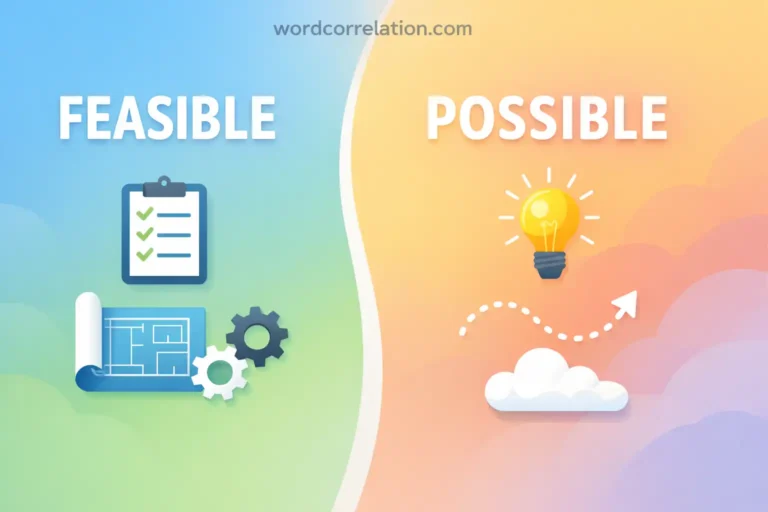
“Possible” means something can happen in general, but it doesn’t necessarily mean it’s easy or likely to happen. On the other hand, “feasible” means that something is not only possible but also realistic. It means that with the right resources, it can actually be done. Knowing when to use each word is important, especially when you are writing emails, reports, or even social media posts.
In this article, we’ll break down the meanings of “feasible” and “possible,” show you when to use each word, and explain why people often mix them up. By the end, you’ll feel confident in choosing the right word for any situation.
Feasible vs Possible – Quick Answer
- Possible means something can happen, but it doesn’t necessarily mean it’s practical or achievable.
- Example: It’s possible to win the lottery.
- Feasible means something is both possible and practical, with all resources or conditions in place to make it happen.
- Example: It’s feasible to start a business if you have enough funding and a good plan.
Decision Rule: Use “possible” for things that can happen in theory, and “feasible” when referring to things that are both possible and realistic to accomplish.
The Origin of Feasible vs Possible
The words “feasible” and “possible” have their roots in Latin, but they developed different meanings over time.
- Possible comes from the Latin word “possibilis,” meaning “that can be done.”
- Feasible comes from the Latin “facere,” meaning “to do.” It evolved to mean something that can be done realistically or practically, often with the necessary resources.
Both words have similar meanings, but “feasible” implies a greater degree of practicality and preparation than “possible.”
Reason for Confusion Today
The confusion between “feasible” and “possible” arises because both words imply that something can happen, but with different levels of likelihood and practicality. “Possible” focuses on whether something can happen at all, while “feasible” considers whether it can happen realistically under certain circumstances.
People often mix these words up in contexts where practical consideration is important, such as in business, project planning, or problem-solving.
British English vs American English Spelling
There is no difference between the spelling of “feasible” and “possible” in British and American English. Both terms are used in the same way in both varieties of English, with no regional spelling variations.
Which Spelling Should You Use?
Since both words are spelled the same in both British and American English, there is no need to worry about spelling differences. Focus on using the correct word based on the context.
Common Mistakes with Feasible vs Possible
Here are some common mistakes people make with “feasible” and “possible”:
- ❌ “It’s not feasible to do this job because it’s possible.”
- ✅ “It’s not possible to do this job because it’s not feasible.”
- ❌ “Starting a business is possible, but it’s not feasible without proper funding.”
- ✅ “Starting a business is possible, but it’s not practical without proper funding.”
Writers often confuse “feasible” with “possible” when they focus only on whether something can happen without considering the practical elements involved.
Feasible vs Possible in Everyday Examples
- Emails:
Possible: “It’s possible to finish the report by tomorrow.”
Feasible: “It’s feasible to finish the report by tomorrow if we work overtime.” - News:
Possible: “It is possible for the economy to recover soon.”
Feasible: “It’s feasible for the economy to recover soon, but only with significant policy changes.” - Social Media:
Possible: “It’s possible to go viral with the right content.”
Feasible: “It’s feasible to go viral with the right content and consistent engagement.” - Formal Writing:
Possible: “A peaceful resolution to the conflict is possible.”
Feasible: “A peaceful resolution to the conflict is feasible if both parties agree to negotiate.”
Feasible vs Possible – Usage Patterns & Search Interest
Both words are popular in various contexts, from everyday conversation to academic writing. However, the search interest in “feasible vs possible” often comes from people looking to refine their vocabulary and improve their communication skills.
Students, ESL learners, and professionals who focus on planning or projects commonly search for this distinction. Misusing the two words can lead to confusion, especially in fields like project management or business planning, where the practical ability to do something is as important as the mere possibility of it happening.
Comparison Table
| Aspect | Feasible | Possible |
| Meaning | Something that can happen realistically with the right resources | Something that can happen, but not necessarily practically achievable |
| Part of Speech | Adjective | Adjective |
| Context of Use | Used in business, project planning, and realistic scenarios | Used in general discussions, theoretical or hypothetical situations |
| Formal vs Informal | Formal and professional | Used in both formal and informal contexts |
| Common Mistakes | Misused in casual contexts where possibility is being discussed | Used in place of “feasible” when practical elements are involved |
| Correct Example | “Starting the project this year is feasible with the funding we have.” | “Starting the project this year is possible, but we need more resources.” |
FAQs
- Is “feasible” the same as “possible”?
- No. “Possible” means it can happen, but “feasible” means it is practically achievable with the right conditions.
- Which one is correct in formal writing?
- Both are correct, but “feasible” is often used in professional and business contexts where practicality is considered.
- Can they be used interchangeably?
- Not exactly. “Possible” refers to something that could happen, while “feasible” refers to something that can realistically happen with the proper resources.
- Why do people confuse them?
- People often confuse the two because both suggest something can occur, but “feasible” adds the condition of practicality, which “possible” does not.
- Can grammar tools catch this mistake?
- Grammar tools might not always distinguish between “feasible” and “possible,” as both words are grammatically correct. However, context is key.
- Is there a British vs American difference?
- No. Both words are spelled and used the same in British and American English.
Conclusion
In short, “possible” refers to something that can happen, while “feasible” emphasizes whether something is both possible and realistic with available resources. The key mistake to avoid is using “possible” when you mean “feasible,” especially in contexts that require practicality.
Easy Rule to Remember: Use “possible” for theoretical events and “feasible” when you’re talking about something that can realistically be achieved.

Daniel Morris writes about English word differences and spelling confusion. His focus is to provide clear, simple explanations with practical usage examples.