Many people search foul or fowl because these two words sound exactly the same. However, their meanings are very different. As a result, writers, students, and ESL learners often mix them up. This mistake can change the meaning of a sentence completely. Therefore, confusion happens in emails, exams, news writing, and even social media posts.
At the same time, spellcheck tools do not always catch this error. Both words are real English words. Because of that, the responsibility falls on the writer. Moreover, beginners often feel unsure which word fits a sentence. In contrast, native speakers usually rely on context without thinking about rules.
This article solves that problem clearly. You will learn what foul or fowl really means, where the confusion started, and how to choose the correct word every time. Additionally, you will see simple examples, common mistakes, and one easy rule to remember. Overall, this guide is written in very simple English, so anyone can understand and use it with confidence.
If you’re learning confusing English words, visit our homophones and commonly confused words hub for more guides.
Foul or Fowl – Quick Answer
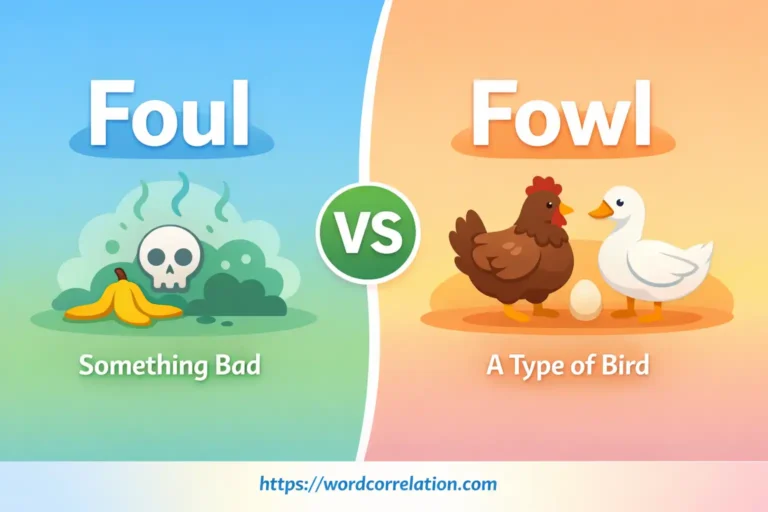
- Foul means bad, unfair, or against the rules.
- Fowl means a bird, such as a chicken or duck.
For example:
- The player made a foul during the game.
- The farmer keeps fowl on his land.
The Origin of Foul or Fowl
The confusion between foul or fowl comes from history. Long ago, English spelling was not fixed. People wrote words as they sounded. Therefore, many words that sounded alike stayed different in meaning.
The word foul comes from Old English and meant dirty or ugly. Over time, it also came to mean unfair or wrong. Meanwhile, fowl also comes from Old English and referred to birds. However, pronunciation slowly changed. As a result, both words began to sound the same.
Because of this shared sound, modern English learners struggle. In contrast, the meanings stayed separate. One word describes behavior or quality. The other names an animal. Understanding this history helps explain why the mistake still happens today.
This is a perfect example for our word confusion pillar on easily mixed terms.
British English vs American English Spelling
Many learners think foul or fowl is a British vs American spelling issue. However, that idea is incorrect. Both spellings are used the same way in all English-speaking countries.
British English and American English follow identical rules here. Therefore, location does not change the meaning.
Here is a simple comparison:
| Aspect | Foul | Fowl |
| Meaning | Bad or against rules | A bird |
| UK usage | Same | Same |
| US usage | Same | Same |
In contrast to words like color and colour, foul or fowl never change spelling by region.
Which Spelling Should You Use?
Choosing between foul or fowl depends on meaning, not country. Therefore, always focus on what you want to say.
For US writers, use foul for sports, smells, or unfair actions. Use fowl when writing about birds or farming.
For UK and Commonwealth writers, the same rule applies. Nothing changes.
For global or professional writing, clarity matters most. As a result, double-check meaning before publishing.
If the sentence talks about rules, behavior, or quality, choose foul. In contrast, if the sentence talks about animals with feathers, choose fowl.
Common Mistakes with Foul or Fowl
Many mistakes happen because people write fast. However, slowing down helps avoid errors.
❌ The referee called a fowl play.
✅ The referee called a foul play.
❌ We saw a foul walking near the lake.
✅ We saw a fowl walking near the lake.
❌ The meat smelled fowl.
✅ The meat smelled foul.
These errors confuse readers. Therefore, always match the word to the meaning, not the sound.
Foul or Fowl in Everyday Examples
You may see foul or fowl in many daily situations. Understanding context makes usage easy.
Emails:
- “The tone of your message felt foul.”
- “The farm raises local fowl.”
News:
- “The player received a foul for pushing.”
- “Bird flu affects domestic fowl.”
Social media:
- “That comment was foul, please delete it.”
- “Look at this cute fowl in my yard.”
Formal writing:
- “Unethical conduct is considered foul behavior.”
- “The study focuses on disease in farm fowl.”
Why People Search “Foul or Fowl”
People often search “foul or fowl” because the words sound identical but have unrelated meanings.
Students search it while studying grammar. Writers search it during editing. ESL learners search it for exams and daily use. Meanwhile, professionals search it when proofreading.
Most incorrect uses happen in casual writing. In contrast, formal writing usually gets it right. As a result, education and repetition improve accuracy over time. Another sound-alike pair worth reading is pail or pale.
Comparison Table: Foul vs Fowl
| Feature | Foul | Fowl |
| Meaning | Bad, unfair, wrong | Bird or poultry |
| Part of speech | Adjective, noun, verb | Noun |
| Context of use | Sports, behavior, smell | Farming, animals |
| Formal or informal | Both | Both |
| Common mistake | Used for birds | Used for bad actions |
| Correct example | “That was a foul move.” | “The fowl laid eggs.” |
Semantic FAQs (People Also Ask)
Is foul the same as fowl?
No. They sound the same but mean different things.
Which one is correct in formal writing?
Both are correct when used in the right context.
Can they be used interchangeably?
No. Each word has a fixed meaning.
Why do people confuse them?
Because they are pronounced the same.
Can grammar tools catch this mistake?
Not always, because both are real words.
Is there a British vs American difference?
No. Usage is the same everywhere.
Conclusion
Overall, foul or fowl is a classic example of sound-based confusion in English. However, the solution is simple. One word relates to bad actions, unfair play, or unpleasant things. The other word names birds. Therefore, meaning should guide your choice every time.
Many writers make this mistake because both words sound identical. As a result, careful reading becomes important. Moreover, context always gives the answer. If rules, behavior, or smell appear in the sentence, foul is correct. In contrast, if feathers, farms, or animals appear, fowl fits perfectly.
In short, never choose by sound. Always choose by meaning. Finally, remember this easy rule: bad things are foul, birds are fowl. You’ll see the same type of confusion in peeked or peaked as well.

Daniel Morris writes about English word differences and spelling confusion. His focus is to provide clear, simple explanations with practical usage examples.