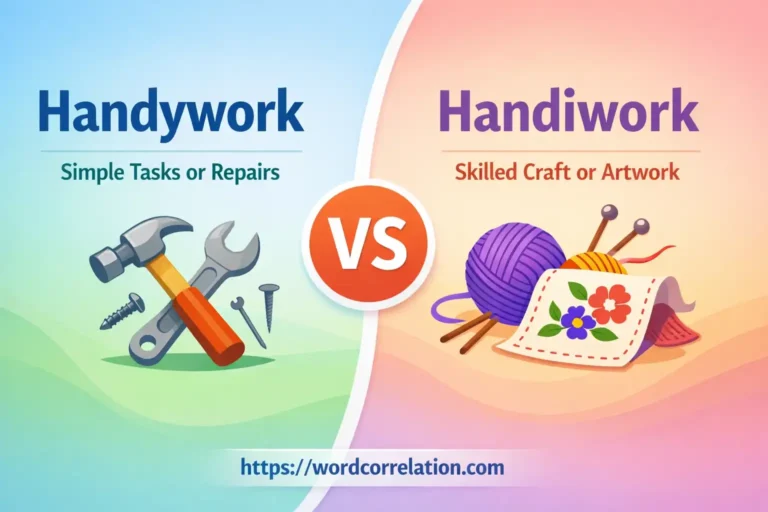
Many people stop and think when they see the words handywork and handiwork. At first glance, they look the same. However, a small spelling change can cause big confusion. Therefore, users often search this keyword to check which word is correct. Moreover, students, writers, and ESL learners worry about using the wrong spelling in exams or professional work. As a result, mistakes appear in blogs, emails, and even news articles.
In contrast, dictionaries often give short answers that do not fully help beginners. Meanwhile, grammar tools sometimes fail to explain why one word works better than the other. Consequently, readers feel unsure and keep searching again. This article solves that exact problem. It explains the difference in very simple English. Additionally, it shows real examples from daily life. Furthermore, it guides you based on your country and writing goal.
Overall, by the end, you will clearly know which spelling to use, when to use it, and why confusion happens. Finally, you will leave with one easy rule that you can always remember.
For spelling and form checks like this, start with the word comparison hub.
Handywork or Handiwork – Quick Answer
Handiwork is the correct and standard word.
Handywork is rare and usually incorrect.
- Handiwork means things made by hand.
- For example: The vase is fine handiwork.
- Use handiwork in all formal and daily writing.
The Origin of Handywork or Handiwork
The word handiwork comes from Old English. Long ago, people used the word handgeweorc. This word meant “work done by the hands.” Over time, the spelling slowly changed. However, the meaning stayed the same.
Meanwhile, handywork appeared later as a spelling variation. Some writers assumed it came from the word handy. Therefore, they thought handywork meant “useful work.” In contrast, language experts did not accept this form. As a result, handiwork became the standard spelling.
Moreover, English often keeps older spellings even when pronunciation changes. Consequently, the “i” in handiwork stayed. Overall, history explains why only one spelling survived as correct.
This belongs to our spelling errors pillar for commonly mistyped forms.
British English vs American English Spelling
Many learners think this is a US vs UK issue. However, that idea is incorrect. Both British English and American English use handiwork.
In contrast, handywork does not belong to any standard system. Therefore, it is not accepted in exams, books, or professional writing.
| English Type | Correct Spelling | Incorrect Form |
| American | Handiwork | Handywork |
| British | Handiwork | Handywork |
| Australian | Handiwork | Handywork |
Overall, spelling rules are simple here. Use handiwork everywhere.
Which Spelling Should You Use?
Your audience matters. However, the answer stays the same.
For US readers, always choose handiwork.
For UK and Commonwealth readers, again use handiwork.
For global or professional writing, handiwork is the only safe choice.
Additionally, academic writing demands standard spelling. Therefore, teachers and editors expect handiwork. Moreover, search engines also favor correct forms. As a result, using handiwork helps SEO and clarity.
Common Mistakes with Handywork or Handiwork
Writers make a few common errors. Fortunately, they are easy to fix.
❌ This painting shows great handywork.
✅ This painting shows great handiwork.
❌ She sells handmade handywork items.
✅ She sells handmade handiwork items.
❌ Handywork requires skill and patience.
✅ Handiwork requires skill and patience.
Usually, people confuse handy with handiwork. However, handy means useful, not handmade. Therefore, mixing them creates errors.
Handywork or Handiwork in Everyday Examples
In emails, correct spelling builds trust.
Your embroidery is beautiful handiwork.
On social media, clarity still matters.
Local artists sell their handiwork today.
In news writing, editors expect accuracy.
The museum displays ancient handiwork.
For formal or professional writing, mistakes look careless.
The report highlights traditional handiwork skills.
Overall, handiwork fits all situations.
Another form mistake example is bagpack or backpack.
Handywork or Handiwork – Google Trends & Usage Data
Search data shows strong interest in this keyword. Many users search it to confirm spelling. Therefore, confusion clearly exists.
By country, searches appear mostly in English-speaking regions.
By user type, students and ESL learners search the most.
Moreover, writers and bloggers also check this word before publishing.
Correct usage appears far more often than the wrong one. However, mistakes still show up in informal posts. As a result, users want clear guidance. This article fills that gap.
Handywork or Handiwork Comparison Table
| Aspect | Handiwork | Handywork |
| Meaning | Work made by hand | Often unclear |
| Part of speech | Noun | Rare noun |
| Context of use | Art, craft, skill | Informal mistakes |
| Formal usage | Yes | No |
| Common mistakes | Misspelling | Wrong assumption |
| Correct example | Fine handiwork | ❌ Not advised |
This table removes confusion instantly.
Semantic FAQs (People Also Ask)
Is handiwork the same as handywork?
No. Handiwork is correct. Handywork is not standard.
Which one is correct in formal writing?
Always use handiwork.
Can they be used interchangeably?
No. Only handiwork works.
Why do people confuse them?
Because handy is a common word.
Can grammar tools catch this mistake?
Sometimes. However, not always.
Is there a British vs American difference?
No. Both use handiwork.
Conclusion
Overall, the confusion between handywork and handiwork is very common. However, the solution is simple. Handiwork is the correct word. It means work made by hand. In contrast, handywork is a rare and incorrect form. Therefore, using it can hurt clarity and credibility.
Moreover, both British and American English follow the same rule. Consequently, you do not need to change spelling for different audiences. Additionally, professional writing, exams, and SEO all require standard usage. As a result, choosing handiwork is always the safe option.
In short, remember one easy rule. If you talk about handmade skill or craft, use handiwork. Finally, ignore handywork completely. That single habit will keep your writing clear, correct, and confident. You may also compare excelerate or accelerate for a similar error pattern.

Daniel Morris writes about English word differences and spelling confusion. His focus is to provide clear, simple explanations with practical usage examples.