When we hear the words “implausible” and “impossible,” they may seem almost identical. Both describe something that is hard to believe, yet there is a key difference that many people often miss. If you’ve ever been confused about these two words, you’re not alone. Many writers, students, and ESL learners struggle with when and how to use them correctly. This article is here to clear that confusion once and for all. We’ll explore the meanings of both words, highlight common mistakes, and provide clear examples of how to use them in everyday language.
In this article, you will learn:
- The exact meanings and differences between “implausible” and “impossible.”
- How these words are often confused in writing and speaking.
- A simple guide on when to use each word, with real-world examples.
By the end, you’ll be able to confidently choose the right word in your writing and conversations, improving both your clarity and communication skills.
Implausible vs Impossible – Quick Answer
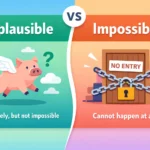
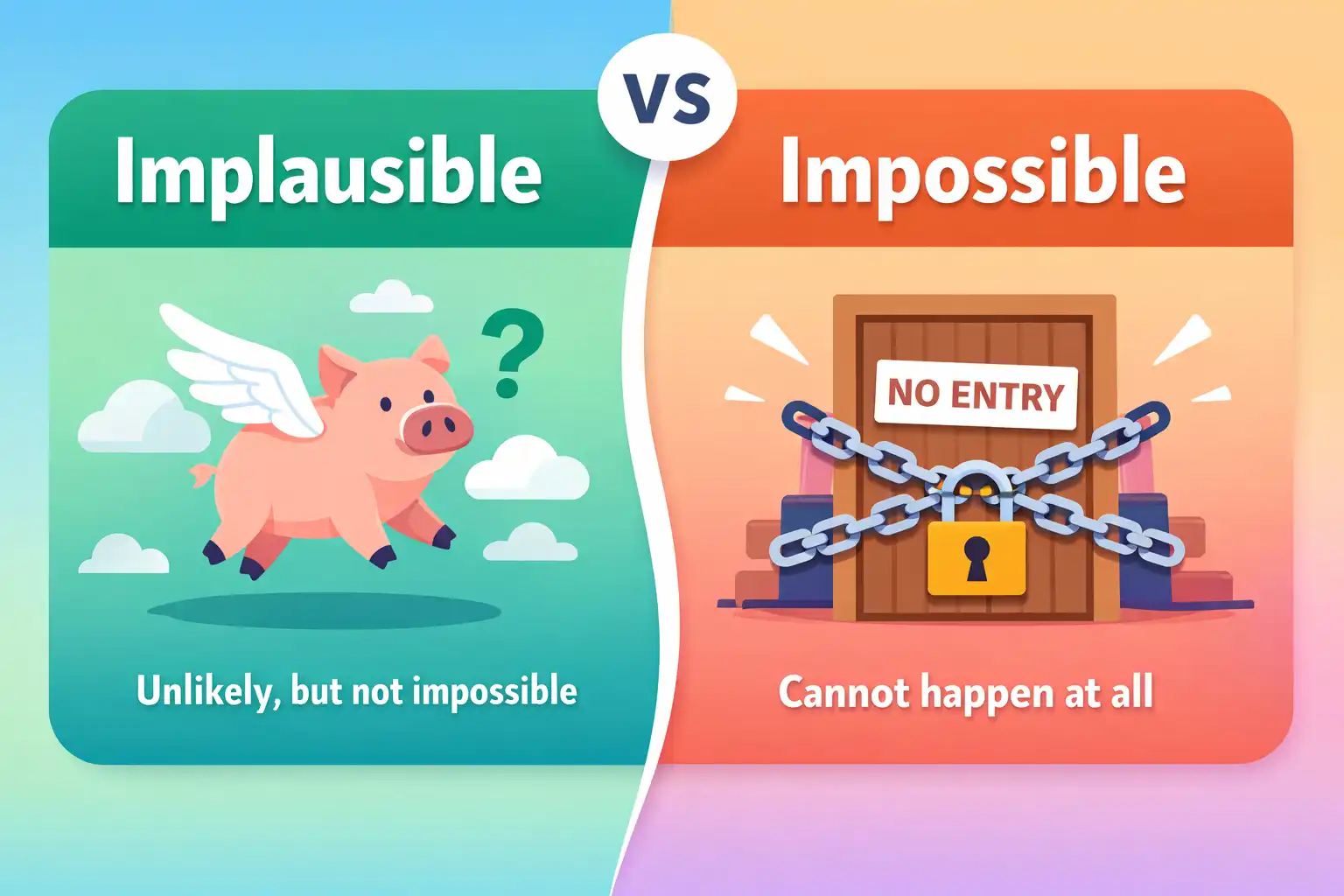
- Implausible means something that is unlikely or difficult to believe, but it could still happen.
- Impossible means something that is totally unachievable or cannot happen under any circumstances.
Example:
- It is implausible that a human could run a marathon in under two hours, but it’s not impossible. (It could happen with the right conditions or advancements.)
Quick Rule: Use “implausible” for things that are hard to believe but may still be possible, and use “impossible” for things that can never happen.
Etymology Implausible vs Impossible:Origins (Etymology)
The word implausible comes from the Latin root “plaudere,” meaning “to applaud.” It evolved over time to describe something that is difficult to accept or believe. If something is implausible, it doesn’t quite have the evidence or reasoning to be accepted as likely or probable, but it isn’t strictly impossible. The key idea here is unlikeliness.
The History of “Impossible”
On the other hand, impossible comes from the Latin word “im-” (not) and “possibilis” (able to be done). Something that is impossible, by definition, cannot be done—no matter how much we wish it to be true or how much evidence there might be. The key here is infeasibility or zero chance.
Reason for Confusion Today
Many people mistakenly treat implausible and impossible as synonyms, especially when speaking casually. However, using the wrong word can create confusion, especially in more formal or professional contexts. For example, someone might describe an improbable event as “impossible” when it’s only unlikely, not beyond the realm of possibility.
This confusion often arises because both words deal with likelihood, but at different extremes of the spectrum. Understanding this subtle difference is important for clear and accurate communication.
British English vs American English Spelling: Usage Differences + Tone (Formal vs Casual)
When it comes to implausible and impossible, there are no significant spelling differences between British and American English. The words are spelled the same in both dialects. However, how these words are used can differ slightly in tone and context, especially in formal versus casual writing.
In British English, these words may be used with more formal nuance, often in discussions related to science, policy, or ethics. In American English, the tone might lean more casual, especially when expressing opinions or in fictional contexts. Even though the spelling remains unchanged, understanding these subtle differences in usage based on tone is crucial, particularly in professional or academic writing.
Here’s a small example:
- British English (Formal): “The idea of time travel, though implausible, is a popular topic in modern science fiction.”
- American English (Casual): “It seems impossible to imagine how time travel could work in real life.”
Both sentences use the same words, but the tone in British English is slightly more formal and speculative, while the American version presents the concept in a more direct and casual way.
| Feature | British English Usage | American English Usage |
| Tone | Formal, often in scientific or philosophical discussions | Casual, more common in everyday speech and fiction |
| Usage Context | Applied in both casual and formal contexts with a slightly more reserved tone | Used more freely in informal contexts, especially in fiction or casual conversation |
| Spelling | No difference | No difference |
How to Choose the Right Word Fast
For US Audiences:
In American writing, you may often encounter “implausible” in scenarios where things are unlikely but not entirely out of the question. “Impossible” should be reserved for situations that are entirely unachievable.
For UK/Global Audiences:
The difference between “implausible” and “impossible” follows the same logic in British and Commonwealth English. The distinction is important in both formal and casual contexts, such as debates, discussions, or storytelling.
For Professional Writing:
If you are writing in a professional context—whether for a company, an academic paper, or a report—be sure to use impossible only when you are referring to something that cannot happen, and implausible when something is just highly unlikely.
Common Mistakes with Implausible vs Impossible
One of the most common mistakes people make is using impossible when they actually mean implausible. Here’s how the two differ:
- Incorrect: “It is impossible that they will find a cure for cancer in the next 10 years.”
- Correct: “It is implausible that they will find a cure for cancer in the next 10 years.”
In this case, it’s implausible because while a cure may be unlikely in such a short time frame, it’s not beyond the realm of possibility.
Here’s another example:
- Incorrect: “It’s impossible to train a dog to do math.”
- Correct: “It’s implausible to train a dog to do math.”
While teaching a dog math might be highly unlikely (implausible), it’s not impossible—it just requires the right conditions, like technological advancements or experiments in the future.
Implausible vs Impossible in Everyday Examples
In Emails
- Implausible: “It seems implausible that we’ll finish the project in one week.”
(Unlikely but possible.) - Impossible: “It’s impossible to finish the project in one day.”
(Totally unachievable.)
News
- Implausible: “The idea of cloning a human being is currently implausible, though it may not be impossible in the future.”
(It could happen, but it’s not likely at the moment.) - Impossible: “It is impossible to travel faster than the speed of light.”
(Based on current scientific knowledge, this is unachievable.)
Social Media
- Implausible: “It’s implausible that this viral trend will continue for more than a year.”
- Impossible: “It’s impossible to predict exactly what will go viral.”
(Here, you’re talking about an event that cannot be predicted with absolute certainty.)
Implausible vs Impossible – Usage Patterns & Search Interest
Both implausible and impossible are frequently searched terms, particularly by students, ESL learners, and writers who seek to clarify the difference between these similar-sounding words. The confusion between the two often stems from the fact that both describe things that seem unlikely but at different levels of certainty.
While search interest for these words fluctuates based on specific needs in writing and communication, data on search trends shows that users commonly search for “implausible vs impossible” when they are unsure which word to use in their writing, especially in formal or academic contexts. For instance, people might search for these terms when trying to describe scenarios in news articles, essays, or professional documents, where accuracy is important.
However, while there isn’t specific, detailed data to directly cite here, it is clear that both words are often confused in academic writing, where precise language is crucial. Writers typically use “implausible” to describe things that are unlikely but possible, and “impossible” when referring to something that is completely out of reach or unattainable.
Comparison Table
| Feature | Implausible | Impossible |
| Meaning | Unlikely but possible | Cannot happen at all |
| Part of Speech | Adjective | Adjective |
| Context | Speculative, hypothetical scenarios | Scientific, logical, or factual limits |
| Formal Usage | Used in formal and informal writing | Mostly formal or serious discussions |
| Common Mistakes | Used in place of “impossible” when it’s unlikely | Used when something is not beyond reason |
| Correct Example | “The idea seems implausible.” | “Traveling faster than light is impossible.” |
Semantic FAQs (People Also Ask)
1. Is “implausible” the same as “impossible”?
No, “implausible” means something is unlikely, but it could still happen. “Impossible” means it can never happen.
2. Which one is correct in formal writing?
Both are correct, but they should be used in different contexts. “Implausible” is for something unlikely, while “impossible” is for something unachievable.
3. Can they be used interchangeably?
No, they cannot. Use “implausible” for something that’s possible but unlikely, and “impossible” for something that can’t happen at all.
4. Why do people confuse them?
People confuse them because both words relate to likelihood, but they are at opposite ends of the spectrum.
5. Can grammar tools catch this mistake?
Yes, grammar tools may catch the misuse, but understanding the meaning and context is still the most reliable way to choose the right word.
Conclusion
To sum up, “implausible” refers to something that is highly unlikely but still possible, while “impossible” refers to something that cannot happen under any circumstances. Understanding the difference between these two words can prevent confusion and help you express yourself more clearly, whether you’re writing an email, creating content, or having a conversation.
Quick Tip: Use “implausible” when you’re talking about something that might happen but seems unlikely, and “impossible” when something cannot happen, no matter what.

Jonathan Swift is a writer whose work reflects sustained attention to language precision, meaning, and the practical effects of word choice. Trained in classical studies and theology, he develops a disciplined approach to writing that combines close textual analysis with a strong concern for clarity and accuracy. His essays, pamphlets, and satirical works show a consistent method: examining how words are used, misused, and reshaped to influence public understanding.
Swift’s writing demonstrates an early form of semantic analysis. He compares terms, exposes false equivalence, and highlights how subtle differences in wording alter meaning, intent, and interpretation. This analytical focus allows readers to see language not as decoration, but as a tool that shapes thought, policy, and belief.
By breaking down complex expressions into their functional parts, Swift helps readers distinguish between surface language and underlying meaning. His work remains valuable to audiences interested in word comparison, rhetoric, and the responsible use of language. Across genres, his reputation rests on careful reasoning, linguistic discipline, and a consistent commitment to helping readers read more critically and precisely.