You read a news post that says, “The house had a rat infection.” It sounds wrong. Then you see, “The child had a lice infestation.” That feels right. But why? Many people mix up infection and infestation because both words talk about harmful living things. Both suggest trouble in the body or in a place. So the mix-up happens often in writing, in school work, and even in media.
This confusion matters. When you use the wrong word, the meaning changes. A doctor, a teacher, or a reader may misunderstand you. Also, grammar tools may not catch this mistake because both words are correct English. This article clears the confusion in a very simple way. You will learn what each word really means, where people misuse them, and how to choose the right one every time.
Infection vs Infestation – Quick Answer
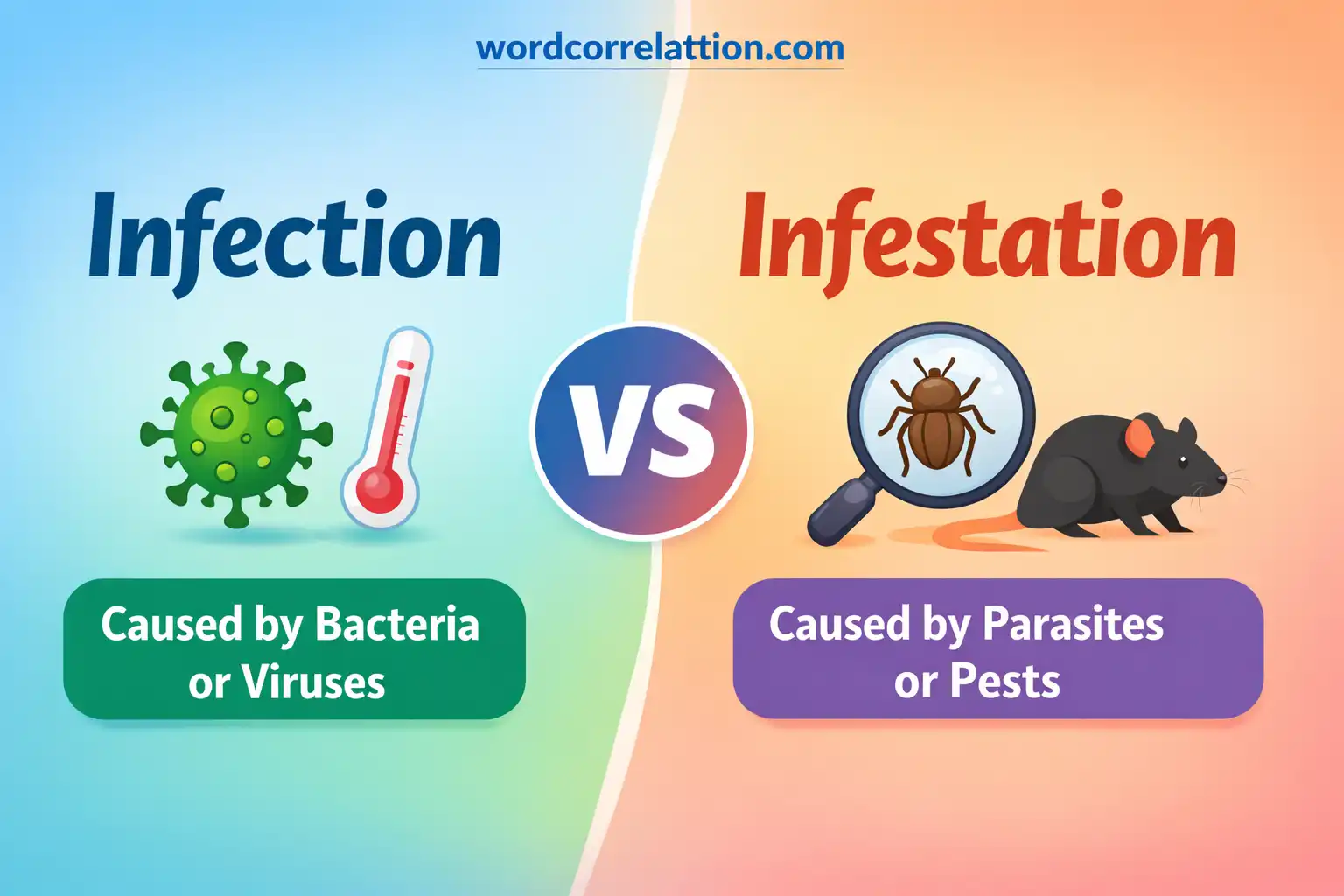
- Infection happens inside the body from germs like bacteria or viruses.
- Infestation happens on the body or in a place from visible pests like lice or rats.
- A cut can get an infection.
- A house can have a rat infestation.
Easy rule: Germs infect. Pests infest.
The Origin of Infection vs Infestation
Both words come from Latin. That is one reason they look and sound similar.
Infection comes from a Latin word meaning to stain or taint. Over time, it came to mean harm caused by tiny organisms inside the body.
Infestation comes from a Latin word meaning to attack or trouble. This word moved toward pests and creatures that invade spaces.
Because both words talk about harm and invasion, writers often mix them up today. The confusion grows because both can relate to health, homes, and living things.
British English vs American English Spelling
There is no spelling difference between British and American English for these words.
| Word | American English | British English |
| Infection | Infection | Infection |
| Infestation | Infestation | Infestation |
However, the confusion is about usage, not spelling.
Which Spelling Should You Use?
Since spelling does not change:
- Use the same spelling in the US, UK, and everywhere.
- Focus on choosing the correct meaning, not the spelling.
- In global or professional writing, clarity of usage matters most.
Common Mistakes with Infection vs Infestation
Writers often switch these words by mistake.
❌ The hotel had a bedbug infection.
✅ The hotel had a bedbug infestation.
❌ He got a mosquito infection on his arm.
✅ He got a mosquito bite that caused an infection.
The mistake happens because people think both words mean “something harmful living somewhere.” But the location is the key difference.
Infection vs Infestation in Everyday Examples
Emails
“The wound shows signs of infection.”
“The apartment has a cockroach infestation.”
News
“Doctors treated the infection quickly.”
“City workers handled the rat infestation.”
Social Media
“Clean the cut to avoid infection.”
“We called pest control for the termite infestation.”
Professional Writing
“The patient developed a bacterial infection.”
“The warehouse suffered a rodent infestation.”
You can see that infection talks about germs inside, while infestation talks about pests outside.
Infection vs Infestation – Usage Patterns & Search Interest
Many students, ESL learners, and writers search this comparison because grammar checkers do not warn them. Both words are correct, so the tool stays silent.
Editors usually see this mistake in essays, blog posts, and reports about health or hygiene. A common real-world problem happens in news writing. A wrong word can make a serious report sound careless or unprofessional.
For example, saying “rat infection in the building” sounds medically wrong and confusing. Readers may stop and question the credibility of the writer.
Comparison Table
| Feature | Infection | Infestation |
| Meaning | Germs invade the body | Pests invade a place or surface |
| Part of Speech | Noun | Noun |
| Context of Use | Medical, health | Pests, environment |
| Formal vs Informal | Common in formal health writing | Common in pest control, reports |
| Common Mistake | Used for pests | Used for germs |
| Correct Example | She has a throat infection | The house has a ant infestation |
This table removes the confusion quickly. The difference is about germs vs pests and inside vs outside.
FAQs About Infection vs Infestation
Is infection the same as infestation?
No. Infection is from germs inside the body. Infestation is from pests outside.
Can they be used interchangeably?
No. Switching them changes the meaning.
Which one is correct in formal writing?
Both are correct, but only in the right context.
Why do people confuse them?
They sound similar and both describe harm.
Can grammar tools catch this mistake?
Usually not, because both words are valid.
Is there a British vs American difference?
No. The spelling and meaning stay the same.
What is the easy way to remember?
Germs infect. Pests infest.
Conclusion
The confusion between infection and infestation happens because both words describe harmful invasion. They sound alike, come from similar roots, and often appear in health or hygiene topics. But the key difference is simple and clear once you see it.
Infection deals with germs like bacteria and viruses that enter the body. Infestation deals with visible pests like lice, rats, or termites that invade spaces or surfaces. This small difference changes the whole meaning of a sentence.
Overall, many writers make this mistake because they focus on the idea of harm, not the type of invader. In short, always think about what is causing the problem. Finally, remember this easy rule: Germs infect. Pests infest.

Virginia Woolf is a British writer and essayist whose work centers on close reading, linguistic precision, and the careful examination of meaning. Her professional background spans fiction, literary criticism, and long-form essays, where attention to word choice and semantic nuance is central rather than decorative. Woolf approaches language as a system of relationships, treating individual words not as interchangeable units but as carriers of tone, context, and psychological weight.
Her research-based writing reflects sustained engagement with how meaning shifts across usage, rhythm, and narrative position. Through essays and critical studies, she demonstrates how subtle differences in wording shape interpretation, emotional response, and intellectual clarity. This focus aligns naturally with word comparison and semantic analysis, where accuracy matters more than flourish.
Woolf helps readers understand meaning differences by slowing language down, isolating terms, and examining how sense emerges through contrast. Her work builds trust by prioritizing clarity, textual evidence, and respect for the reader’s interpretive intelligence.