Words can look calm on paper but cause real trouble in writing. Invoke and provoke are two such words. They sound close. They even share letters. So many learners, writers, and even editors mix them up without noticing.
You may see someone write, “He invoked a fight,” or “She provoked God for help.” Both sentences feel odd. But why? The mistake happens because both words deal with causing something to happen. Yet the way they cause it is very different.
This confusion matters in emails, essays, news writing, and social media posts. One word sounds respectful. The other can sound aggressive. One fits formal writing. The other often carries emotion.
In this guide, you will learn the clear difference, the origin, the correct usage, common mistakes, and an easy rule to remember. So next time, you will choose the right word without thinking twice.
Invoke vs Provoke – Quick Answer
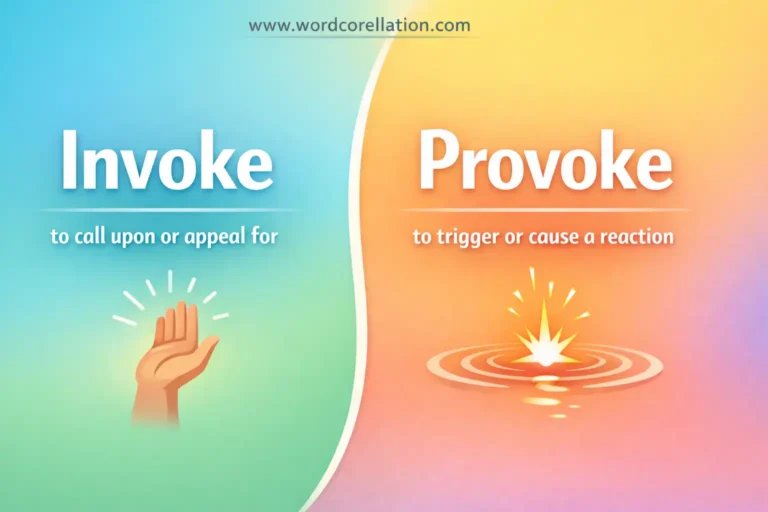
- Invoke means to call upon something for help, support, or effect.
- Provoke means to cause a reaction, often anger or action.
Examples:
- She invoked her legal rights.
- He provoked the dog by shouting.
Easy rule:
👉 Invoke = call for | Provoke = stir up
The Origin of Invoke vs Provoke
Both words come from Latin, and this is where the confusion begins.
- Invoke comes from invocare → “to call upon.”
- Provoke comes from provocare → “to call forth” or “challenge.”
At first, both meant “to call.” However, over time, their meanings moved in different directions.
Invoke kept the polite and formal idea of asking for help or support.
Provoke moved toward causing a reaction, often emotional or angry.
Writers often confuse them today because they still share the idea of “causing something.” But the tone and purpose are not the same.
British English vs American English Spelling
Good news here.
There is no spelling difference between British and American English for these words.
| Word | US Spelling | UK Spelling |
| Invoke | Invoke | Invoke |
| Provoke | Provoke | Provoke |
However, usage tone can differ slightly in formal writing, especially in legal or academic texts.
Which Spelling Should You Use?
Since spelling does not change, the focus is on correct usage.
- US writing: Often uses invoke in legal, political, and formal texts.
- UK/Commonwealth: Same pattern, especially in law and religion.
- Global writing: Use based on meaning, not region.
So, your choice depends on what you want to express, not where you write.
Common Mistakes with Invoke vs Provoke
Writers often switch these words because both suggest “causing” something.
❌ He invoked the crowd to anger.
✅ He provoked the crowd to anger.
❌ She provoked her right to speak.
✅ She invoked her right to speak.
The key difference is respectful request vs emotional reaction.
Invoke vs Provoke in Everyday Examples
Emails
- “I would like to invoke the refund policy.”
- “Your tone may provoke a negative reply.”
News
- “The senator invoked constitutional rights.”
- “The statement provoked public anger.”
Social Media
- “Do not post things that provoke people.”
- “She invoked her faith during hard times.”
Professional Writing
- Legal, academic, and formal texts often use invoke.
- Opinion pieces and reports often use provoke.
Invoke vs Provoke – Usage Patterns & Search Interest
Many students, ESL learners, and writers search this comparison because grammar tools do not always catch the mistake. Both words fit grammatically in a sentence. But only one fits the meaning.
Editors usually see this error in essays, legal writing, and news articles.
A real problem happens when someone writes:
“The lawyer provoked the law.”
This sounds strange and even funny. The correct word is invoked because the lawyer called upon the law, not angered it.
Comparison Table: Invoke vs Provoke
| Feature | Invoke | Provoke |
| Meaning | Call upon for help or support | Cause a reaction or emotion |
| Part of Speech | Verb | Verb |
| Context | Legal, religious, formal | Emotional, social, conflict |
| Tone | Respectful, formal | Emotional, sometimes negative |
| Common Mistake | Used when reaction is meant | Used when request is meant |
| Correct Example | She invoked her rights | He provoked a fight |
This table removes the confusion quickly.
FAQs About Invoke vs Provoke
Is invoke the same as provoke?
No. Invoke means to call for help. Provoke means to cause a reaction.
Which one is correct in formal writing?
Invoke is common in formal and legal writing.
Can they be used interchangeably?
No. They change the meaning of the sentence.
Why do people confuse them?
They look similar and both suggest causing something.
Can grammar tools catch this mistake?
Often no, because both words fit grammatically.
Is there a British vs American difference?
No spelling or usage difference.
Which word sounds more aggressive?
Provoke sounds more aggressive.
Conclusion
These two words may look alike, but they live in different worlds of meaning.
Invoke is calm, respectful, and formal. It asks for support, help, or authority. You often see it in law, religion, and serious writing.
Provoke is emotional and active. It pushes someone or something to react. It often appears in social situations, conflicts, and strong opinions.
The most common mistake happens when writers think both words simply mean “cause.” That is not true. One calls for. The other stirs up.
Final rule to remember:
👉 If you are asking for help or authority, use invoke.
👉 If you are causing a reaction, use provoke.
Keep this rule in mind, and you will never confuse them again.

Daniel Morris writes about English word differences and spelling confusion. His focus is to provide clear, simple explanations with practical usage examples.