Many people mix up met and meet because they look alike and sound close. Also, both words talk about people coming together. But they do not mean the same thing in time. One talks about the past, and the other talks about the present or future. So, mistakes happen in emails, school work, and even job messages.
This confusion matters because the wrong word can change your meaning. For example, “Nice to meet you yesterday” sounds wrong to a native speaker. Readers may feel unsure about your grammar.
In this guide, you will learn the simple difference, when to use each word, and how to avoid common errors. By the end, you will choose the right word fast and with confidence.
Met vs Meet – Quick Answer
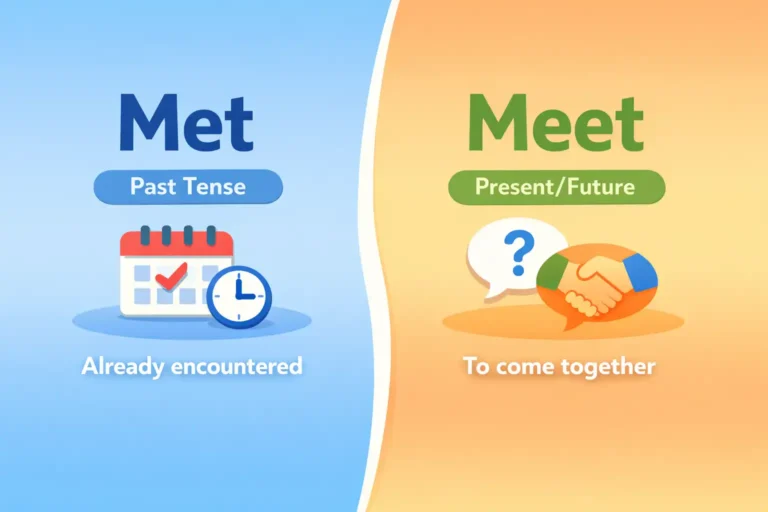
- Meet = present or future action
- Met = past action (already happened)
Examples:
- I meet my teacher every Monday.
- I met my teacher yesterday.
Easy rule: If the action is finished, use met. If not finished, use meet.
Origin of ‘Meet’ and Why It Becomes ‘Met’ (Brief Etymology)
The word meet comes from Old English mētan, which means “to come together.” Over time, English grammar created past forms for verbs. So, met became the past tense and past participle of meet.
Today, confusion happens because English verbs often change form. Some verbs add -ed, but others change completely. For example:
- go → went
- see → saw
- meet → met
Writers often confuse these forms, especially ESL learners, because the spelling changes fully instead of adding a simple ending.
British English vs American English Spelling
There is no spelling difference between British and American English for met and meet. Both regions use the same forms because this is a verb tense change, not a spelling variation.
However, usage rules remain the same everywhere.
| Form | British English | American English | Example |
| meet | Same | Same | I meet clients daily. |
| met | Same | Same | I met her last week. |
So, learners only need to focus on time, not location.
How to Choose the Right Word Fast
Choosing between met and meet becomes easy when you check the time of the action.
US:
Professional writing follows standard tense rules. Use met for past events and meet for present schedules or future plans.
UK / Commonwealth:
The same tense rules apply. There is no regional difference.
Global or professional writing:
Business emails, reports, and academic writing all follow the same grammar pattern. Always match the verb with the time reference.
Quick thinking method:
- Yesterday, last week, before → met
- Today, usually, tomorrow → meet
Common Mistakes with Met vs Meet
Many errors happen because people forget to match the verb with time words.
❌ I meet him yesterday.
✅ I met him yesterday.
❌ Nice to met you.
✅ Nice to meet you.
❌ We have meet before.
✅ We have met before.
Short explanation:
- After have / has / had, use met, not meet.
- After to, use meet (infinitive form).
Editors usually see these mistakes in student writing and informal emails.
Met vs Meet in Everyday Examples
Understanding real-life use helps memory.
Emails:
- I would like to meet you tomorrow.
- It was great to meet you.
- I met your manager last week.
News:
- The president will meet world leaders today.
- The leaders met to discuss climate change.
Social Media:
- Finally got to meet my favorite actor!
- I met her at a concert.
Formal or Professional Writing:
- Our team will meet the deadline.
- The committee met on Monday.
These examples show how time controls word choice.
When to Use Met vs Meet in Real Sentences (Contexts)
People search for this keyword because both words look simple but cause grammar stress. Students, ESL learners, and job seekers often check the difference before writing messages.
Grammar tools sometimes catch the error, but not always. For example, “Nice to met you” may slip through casual writing tools. That is why understanding the rules matters.
A real-world confusion can happen during job interviews. Saying “Nice to met you” may create a poor impression. So, correct tense use supports clear communication and confidence.
Overall, interest stays steady because English learners continue to grow worldwide.
Comparison Table: Met vs Meet
| Feature | Meet | Met |
| Meaning | To come together (present/future) | Came together (past) |
| Part of Speech | Verb (base form) | Verb (past tense & past participle) |
| Context of Use | Present habits, future plans, infinitive form | Finished actions, past events |
| Formal vs Informal | Used in all levels | Used in all levels |
| Common Mistakes | Using for past time | Using after “to” |
| Correct Example | I will meet her today. | I met her yesterday. |
This table removes confusion quickly because it links the word directly to time.
Semantic FAQs (People Also Ask)
Is met the same as meet?
No. Meet is present or future. Met is past.
Which one is correct in formal writing?
Both are correct when used with the right tense.
Can they be used interchangeably?
No. Time determines which word you use.
Why do people confuse them?
They look similar and come from the same verb root.
Can grammar tools catch this mistake?
Sometimes, tools may miss context errors.
Is there a British vs American difference?
No. Both forms are the same worldwide.
What is the past participle of meet?
Met is the past participle.
Conclusion
Understanding met vs meet becomes simple when you focus on time. Meet talks about the present or future, while met talks about the past. Many mistakes happen because learners forget this time connection, especially in phrases like “Nice to meet you” or “We have met before.” So, checking time words such as yesterday, tomorrow, or usually helps you choose correctly.
Overall, both words are common and important in daily English. Using them correctly improves your writing, speech, and professional communication. The biggest mistake to avoid is using meet for past events or “met after”.
Finally, remember one easy rule:
Finished action = met. Not finished = meet.
With this simple idea, you will rarely make mistakes again.

Daniel Morris writes about English word differences and spelling confusion. His focus is to provide clear, simple explanations with practical usage examples.