Many viewers see miniseries and limited series on streaming platforms and think they mean the same thing. This confusion is very common. Streaming apps, award shows, and media sites often use both terms without clear rules. So, people are not sure which one is correct.
This matters because the meaning affects how you understand a show. It tells you if the story will end, continue, or expand later. Writers, students, and media professionals also need to use the right term in reviews and content writing.
In this guide, you will learn the real difference between miniseries vs limited series. You will see when to use each term, why confusion happens, and how to avoid mistakes. By the end, you will know exactly which word fits each situation.
Miniseries vs Limited Series – Quick Answer
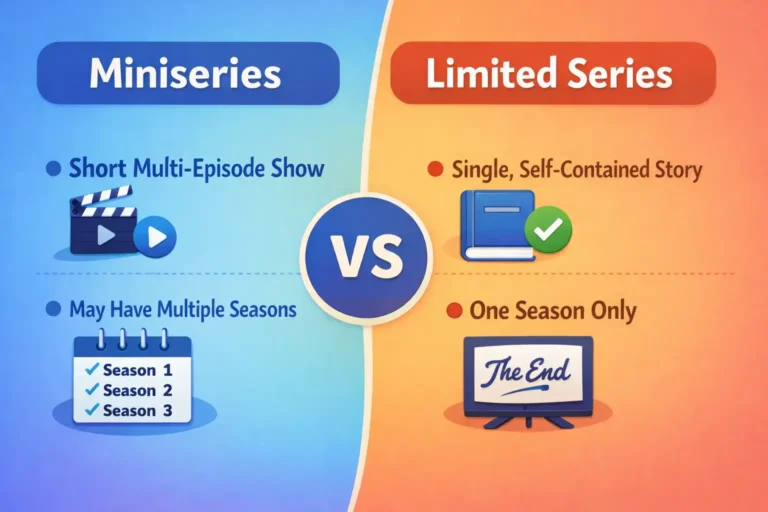
Miniseries is a short TV show with a fixed number of episodes and a complete story.
Limited series is also short, but it may allow future seasons if the story expands.
Key points:
- Both have a planned ending
- Miniseries usually stays one season only
- Limited series can return if needed
Easy rule:
Use miniseries for fully closed stories. Use limited series for stories that may continue later.
Meaning of Miniseries
A miniseries is a short television series with a fixed story and clear ending.
- It has a set number of episodes
- The story starts and ends in one season
- It does not continue later
Examples:
- A historical drama shown in 5 episodes
- A crime story that ends after one season
Meaning of Limited Series
A limited series is also short, but it has more flexibility.
- It has a planned number of episodes
- The story may end, but can expand later
- It may return if popular
Examples:
- A drama that ends but gets a second season later
- A show that follows different stories each season
The Origin of Miniseries vs Limited Series
The term miniseries became popular in the 1970s. TV networks used it for short, event-based shows. These shows told one complete story over a few episodes. They were often based on books or real events.
Later, the term limited series started to appear. Streaming platforms and modern TV networks wanted more flexibility. They used this term to describe short shows that might return if successful.
So, the confusion started because both formats look similar. However, the intent behind them is slightly different. Miniseries focuses on a fixed story. Limited series allows future expansion.
Writers often confuse them because both have fewer episodes than regular series. Editors usually see both terms used in the same context, especially in reviews and award categories.
British vs American English Spelling
There is no spelling difference between miniseries and limited series in British and American English.
Both regions use the same forms:
- Miniseries
- Limited series
However, usage preference can vary slightly.
| Region | Preferred Usage |
|---|---|
| US | Limited series is more common in media |
| UK | Miniseries is still widely used |
| Global | Both terms are accepted |
In contrast, the meaning remains the same across regions. The difference is about usage trend, not spelling.
How to Choose the Right Word Fast
Choosing between miniseries vs limited series is simple when you focus on context.
For US audience:
- Use limited series for modern streaming content
- It sounds more current and industry standard
For UK or Commonwealth:
- Use miniseries more often
- It feels more traditional and familiar
Global or professional writing:
- Use limited series when unsure
- It works well in modern media contexts
If the show clearly has no future seasons, then miniseries is a safe choice. If there is a chance of continuation, then limited series is better.
Common Mistakes with Miniseries vs Limited Series
Many people use these terms incorrectly. Here are common mistakes:
❌ Incorrect: This limited series will never have another season
✅ Correct: This miniseries will never have another season
❌ Incorrect: The miniseries might return next year
✅ Correct: The limited series might return next year
Short explanation:
- Miniseries = fixed and closed
- Limited series = flexible and expandable
Miniseries vs Limited Series in Real Life Examples
Understanding real usage helps avoid confusion.
Emails:
- “We are producing a miniseries based on a true story.”
- “This limited series may expand if viewers like it.”
News:
- “The miniseries received critical praise for its ending.”
- “The limited series is expected to return next year.”
Social media:
- “Just finished this amazing miniseries. Loved the ending.”
- “This limited series needs another season.”
Professional writing:
- “The project is structured as a miniseries.”
- “The platform ordered a new limited series.”
These examples show how context changes the word choice.
Miniseries vs Limited Series – Word Usage Patterns and Search Trends
Search trends show that people often mix these terms. Many users search both together to understand the difference.
Typical users include:
- Students learning media terms
- ESL learners
- Content writers and bloggers
- TV and film enthusiasts
Writers often search this keyword because they want clarity in reviews and articles. They do not want to use the wrong term.
A real-world confusion example:
A journalist calls a show a miniseries, but later the show gets a second season. This creates confusion for readers and affects credibility.
So, using the correct term improves clarity and trust.
Comparison Table: Miniseries vs Limited Series
| Feature | Miniseries | Limited Series |
|---|---|---|
| Meaning | Short show with fixed story | Short show with possible continuation |
| Part of Speech | Noun | Noun |
| Context | Traditional TV, closed stories | Modern streaming, flexible stories |
| Formal Usage | Acceptable | More common in modern media |
| Common Mistake | Used for expandable shows | Used for fully closed stories |
| Correct Example | “A 6-episode historical miniseries” | “A limited series that may return” |
This table helps you see the difference quickly.
FAQs
Is miniseries the same as limited series?
No. They are similar, but not identical. Miniseries is fully closed. Limited series may expand later.
Which one is correct in formal writing?
Both are correct. However, limited series is more common in modern professional writing.
Can they be used interchangeably?
Sometimes, yes. But not always. Context decides the correct term.
Why do people confuse them?
Both describe short shows. Also, media platforms use them loosely.
Can grammar tools catch this mistake?
No. Most tools do not understand context. They treat both as correct.
Is there a British vs American difference?
No spelling difference exists. Only usage preference changes slightly.
Conclusion
Miniseries and limited series look very similar, but their meanings are not exactly the same. A miniseries tells one complete story and ends. A limited series also has a short format, but it allows future seasons if needed.
The main confusion comes from modern media usage. Streaming platforms often use both terms, which makes it hard for viewers and writers to understand the difference.
In short, always focus on the story structure. If the story is fully closed, use miniseries. If the story may continue, use limited series.
The one mistake to avoid is calling an expandable show a miniseries. This creates confusion.
Finally, remember this simple rule:
Closed story = miniseries. Flexible story = limited series.