Many English learners pause when they see ourselves vs ourself. Both words look almost the same. Only one letter changes. Yet that small change creates confusion.
Writers often ask a simple question: Is “ourself” correct, or should we always use “ourselves”? Students, ESL learners, and even experienced writers sometimes mix them up. The confusion appears in emails, essays, and social media posts.
The problem matters because reflexive pronouns must match the subject. If they do not match, the sentence sounds wrong or unclear. Editors usually notice this mistake quickly.
This guide explains the difference in very clear language. You will learn the meaning of each word, where it appears in real writing, and why people confuse them. You will also see real examples from daily English.
By the end, you will know when to use “ourselves” and when “ourself” may appear, and you will remember one simple rule that prevents mistakes every time.
Ourselves vs Ourself – Quick Answer
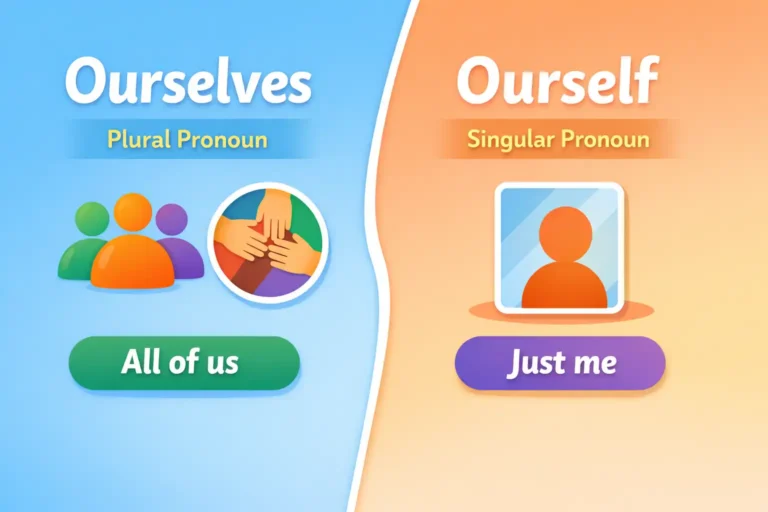
Meaning of Ourselves
- Reflexive pronoun for we / us (plural).
- Used when a group refers back to itself.
Examples:
- We prepared ourselves for the exam.
- We reminded ourselves about the meeting.
Meaning of Ourself
- Rare reflexive form used with singular “we.”
- Appears in formal or royal language.
Examples:
- We present ourself before the council.
- The monarch spoke about ourself in the speech.
Easy rule:
Use ourselves in normal English. Use ourself only in rare formal contexts where “we” means one person.
The Origin of Ourselves vs Ourself
Understanding the history of these words helps explain the confusion today.
The pronoun “ourselves” formed from two parts:
- our (possessive form of we)
- selves (plural of self)
Old English used reflexive forms to show that the subject and object are the same. Over time, English created plural reflexive pronouns such as:
- ourselves
- yourselves
- themselves
Because we is plural, English naturally uses ourselves.
However, the unusual word “ourself” appeared in history for a different reason.
Kings, queens, and leaders sometimes used the “royal we.” One person spoke as if they represented a nation or authority. In that case, we referred to one individual, not a group.
For that reason, writers occasionally used ourself as the reflexive pronoun.
Example from historical style:
- We declare ourself ruler of this land.
Today, this form appears rarely. Most modern English uses ourselves almost all the time.
Therefore, the confusion exists because both words exist, but one is extremely rare.
British vs American English Spelling
Unlike many English word comparisons, ourselves vs ourself does not involve spelling differences between British and American English.
Both regions follow the same rule.
- Ourselves → standard plural reflexive pronoun
- Ourself → rare singular reflexive linked to royal or institutional “we”
So writers in the US, UK, Canada, and Australia generally use ourselves.
Examples in modern English:
- We asked ourselves an important question.
- We prepared ourselves for the presentation.
In contrast, formal or ceremonial language may show the rare form:
- We dedicate ourself to the service of our country.
Because modern writing rarely uses the royal “we,” the plural form dominates everyday language.
How to Choose the Right Word Fast
Most writers need a quick rule, not a long explanation.
Follow these simple steps.
For everyday English (global usage)
Use ourselves.
Example:
We taught ourselves how to code.
For academic, professional, and business writing
Still use ourselves.
Example:
We should remind ourselves about the project deadline.
For rare formal or ceremonial language
You may see ourself if one person uses “we.”
Example:
We present ourself as your servant.
In modern writing, editors almost always prefer ourselves.
Therefore, the safest choice in normal communication is always ourselves.
Common Mistakes with Ourselves vs Ourself
Writers often confuse these forms because they focus only on the word “self.”
However, the key issue is whether the subject is plural or singular.
Here are frequent mistakes.
❌ We should prepare ourself for the test.
✅ We should prepare ourselves for the test.
Explanation: “We” is plural, so the reflexive pronoun must also be plural.
❌ We reminded ourself to stay calm.
✅ We reminded ourselves to stay calm.
Explanation: The group refers back to itself.
❌ We can fix the problem ourself.
✅ We can fix the problem ourselves.
Editors often see this mistake when learners shorten plural reflexive pronouns incorrectly.
Remember: plural subject → plural reflexive pronoun.
Ourselves vs Ourself in Real Life Examples
Seeing the words in real contexts helps clarify the difference.
Emails
- We introduced ourselves to the new team members.
- We reminded ourselves to send the report.
News writing
- The committee asked ourselves an important question about the policy.
- We must hold ourselves accountable for our decisions.
Social media
- We told ourselves to stay positive today.
- We challenged ourselves to finish the project.
Formal or ceremonial writing
- We dedicate ourself to the service of the people.
Notice how ourselves appears naturally in daily English, while ourself appears mainly in ceremonial tone.
Ourselves vs Ourself – Word Usage Patterns and Search Trends
Online searches show that many people look up ourselves vs ourself because the words look similar.
Students and ESL learners often search this comparison. Writers also check it when editing essays or reports.
Grammar tools sometimes highlight ourself as an unusual form. Because of that warning, users want to confirm the rule.
Editors usually notice misuse in group statements. For example:
Incorrect sentence:
We decided to challenge ourself.
Readers may feel the sentence sounds strange, but they may not know exactly why.
The correct sentence should say:
We decided to challenge ourselves.
Therefore, understanding this small grammar rule improves clarity in many forms of writing.
Ourselves vs Ourself Comparison Table
| Feature | Ourselves | Ourself |
| Meaning | Reflexive pronoun for plural “we” | Rare reflexive for singular “we” |
| Part of Speech | Reflexive pronoun | Reflexive pronoun |
| Context of Use | Everyday English | Ceremonial or royal language |
| Formal vs Informal | Used in both | Mostly formal or historical |
| Common Mistake | None when used with “we” | Incorrectly used with plural “we” |
| Correct Example | We taught ourselves new skills. | We dedicate ourself to the crown. |
This table shows clearly that ourselves is the standard form in modern English.
Frequently Asked Questions
Is ourselves the same as ourself?
No. Ourselves is plural, while ourself is a rare singular form used with the royal “we.”
Which one is correct in modern writing?
In almost all situations, ourselves is correct.
Can ourselves and ourself be used interchangeably?
No. Their usage depends on whether “we” refers to many people or one person.
Why do people confuse ourselves vs ourself?
The words look almost identical. Many learners assume both work the same way.
Can grammar tools detect this mistake?
Yes. Most grammar checkers flag ourself in normal sentences.
Is there a British vs American difference?
No. Both British and American English follow the same rule.
Is ourself incorrect?
Not always. It appears in rare historical or ceremonial contexts, but everyday English uses ourselves.
Conclusion
The difference between ourselves vs ourself becomes clear once you understand the role of the subject.
English reflexive pronouns must match the subject in number. Because “we” usually refers to more than one person, the correct reflexive pronoun is ourselves.
The word ourself exists in English history. It appeared when leaders or monarchs used the royal “we.” In that case, a single person spoke as if they represented an authority or institution. However, modern English rarely uses this style.
For everyday communication, emails, essays, business writing, and social media, the correct and natural choice is ourselves.
Writers often make one simple mistake: they shorten the word and write ourself when the subject is plural. Editors notice this quickly because the grammar no longer matches.
Overall, the easiest rule to remember is this:
If we means a group, always use ourselves.
That single rule keeps your sentences clear, natural, and grammatically correct.

Daniel Morris writes about English word differences and spelling confusion. His focus is to provide clear, simple explanations with practical usage examples.