You type fast. You feel stress. Then you write a message: “Sorry for the delay, I panicked.” But your screen shows a red line under panick. Now you pause. Is it panic or panick?
Many people face this small but common problem. Students, writers, and ESL learners often stop and wonder which spelling is correct. The word sounds like it could end with -ck. After all, we write back, lock, sick, and check. So the mistake feels logical.
However, English does not always follow simple sound rules. This is where confusion begins. And when you write emails, essays, posts, or reports, this tiny spelling doubt can slow you down.
In this guide, you will learn why panick is wrong, where this mistake comes from, and how to remember the correct form easily forever.
Panic vs Panick – Quick Answer
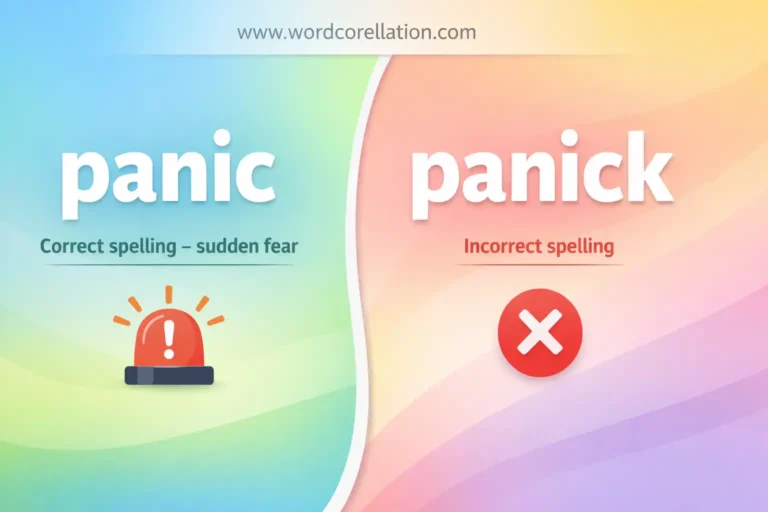
- Correct word: panic
- Wrong spelling: panick ❌
- The word never ends with -ck
- Past tense: panicked (adds -ked, not -cked)
Easy rule:
If the base word is panic, never add k at the end.
Example:
- ✅ I panic before exams.
- ❌ I panick before exams.
The Origin of Panic vs Panick
The word panic comes from Greek. It comes from the god Pan. In old stories, Pan would make sudden loud noises in forests. People felt fear without knowing why. This strange fear was called panic fear.
Later, English kept the word as panic.
So the spelling comes from history, not sound.
That is why it does not follow the usual -ck sound rule.
Writers often confuse this because English has many short words that end with -ck. But panic is different because of its Greek root.
British English vs American English Spelling
There is no difference between British and American English here.
Both use:
| Region | Correct Spelling | Incorrect |
| US | panic | panick |
| UK | panic | panick |
| Australia | panic | panick |
In contrast to words like color/colour or organize/organise, this word stays the same everywhere.
Which Spelling Should You Use?
You should always use panic.
This applies to:
- US writing
- UK writing
- Academic work
- Emails
- Professional documents
- Social media posts
There is no case where panick is correct.
So you never need to think twice.
Common Mistakes with Panic vs Panick
Writers often add k because of sound habits.
Here are frequent errors:
❌ I always panick before interviews.
✅ I always panic before interviews.
❌ Stop panicking! (written as panickingk)
✅ Stop panicking!
The confusion grows when adding endings like -ed or -ing.
Remember this pattern:
- panic → panicked
- panic → panicking
You add k only when adding a suffix. Not in the base word.
Panic vs Panick in Everyday Examples
You see this word in daily life.
Emails
I panic when deadlines move closer.
News
People panic during sudden market drops.
Social media
Don’t panic. Stay calm and think.
Professional writing
The team began to panic after the system failed.
In every case, the base word stays panic.
Panic vs Panick – Usage Patterns & Search Interest
Many users search this because spellcheck marks panick as wrong. Students and ESL learners search it often. Writers also pause when typing fast.
This mistake causes small embarrassment in formal writing. A single extra k can make a sentence look careless.
Editors usually see this error in essays and emails. And it happens because people trust sound more than spelling history.
Comparison Table
| Feature | Panic | Panick |
| Meaning | Sudden fear | Not a real word |
| Part of speech | Noun / Verb | — |
| Context of use | Formal and informal | Incorrect everywhere |
| Formal usage | Correct | Wrong |
| Common mistake | Adding extra “k” | The mistake itself |
| Correct example | I panic in crowds. | — |
This table shows clearly that only one form exists.
FAQs – People Also Ask
Is panick a real word?
No. It is always a spelling mistake.
Why does panic not end with -ck?
Because it comes from Greek origin, not English sound rules.
Is panic spelled differently in the UK?
No. The spelling is the same worldwide.
Why do people write panick?
Because many short words end with -ck, so the brain copies the pattern.
Can grammar tools catch this?
Yes. Most spellcheck tools mark panick as wrong.
What is the past tense of panic?
Panicked. You add -ked.
Can panic be a noun and a verb?
Yes. Panic describes fear and the act of feeling fear.
Conclusion
Small spelling doubts can slow your writing. Panic vs panick is one of those tiny traps that catch many people. The mistake feels logical because of sound patterns. But history, not sound, controls this word.
Overall, the correct spelling is always panic. You never write panick. When you add endings, you only add k before -ed or -ing.
So remember this simple rule:
No k in panic — unless a suffix follows.
Finally, once you know this, you will never stop to think about it again. Your writing will flow faster and look cleaner every time.

Daniel Morris writes about English word differences and spelling confusion. His focus is to provide clear, simple explanations with practical usage examples.