You land in a new country. You walk off the plane. Then you see signs: Passport Control and Customs. Many travelers stop and wonder. Which line comes first? Are they the same? Did I miss something important?
This confusion happens all the time. New travelers mix the terms. Even frequent flyers forget the difference. The problem matters because the order affects your travel flow. If you go the wrong way, airport staff will send you back. That feels stressful, especially after a long flight.
So this guide clears everything in simple words. You will learn what passport control does, what customs checks, and why both exist. You will also see real examples. By the end, you will know exactly where to go and what each step means.
Passport control vs customs – Quick Answer
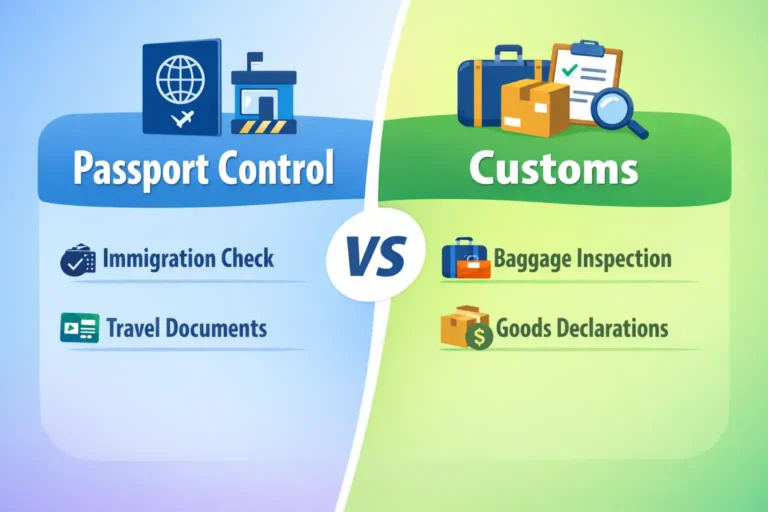
- Passport control checks who you are
- Customs checks what you carry
Example:
- Officer scans your passport → passport control
- Officer checks your bags → customs
Easy rule: Identity first, luggage second.
Why Passport Control and Customs Exist (Simple Explanation)
Passport control started as a security step. Countries needed a way to track who enters and leaves. Governments created border checkpoints. These officers confirm identity, nationality, and visa status. The goal focuses on people.
Customs came from trade and taxes. Long ago, merchants moved goods across borders. Governments taxed imported items. Customs officers enforced those rules. The goal focuses on objects and money.
The confusion happens because both appear at airports. Travelers see officers in uniform in both areas. The spaces look similar. So many assume they do the same job. However, the purpose differs completely.
Passport control protects borders through identity checks. Meanwhile, customs protects the economy and safety through goods inspection.
Common Terms: Immigration, Passport Control, Customs (What They Mean)
There is no spelling difference between passport control and customs. Both British and American English use the same terms.
| Term | US English | UK English |
| Passport control | Passport control | Passport control |
| Customs | Customs | Customs |
The confusion is not spelling. It is function.
How to Use “Passport Control” vs “Customs” Correctly
If you talk about identity checks, use passport control.
If you talk about bags or declared goods, use customs.
For UK or Commonwealth:
The phrase stays the same.
For global or professional writing:
Both terms are standard and universal.
There is no regional change. The meaning stays stable worldwide.
Common Mistakes with passport control vs customs
❌ I waited at customs to show my passport
✅ I showed my passport at passport control
Customs officers focus on goods, not identity.
❌ Passport control checked my suitcase
✅ Customs checked my suitcase
Passport officers do not inspect luggage.
❌ Customs stamped my passport
✅ Passport control stamped my passport
Only immigration officers stamp travel documents.
Writers often mix the roles because both happen in the airport arrival zone. Editors usually see this error in travel blogs and news reports.
Examples: Passport Control vs Customs in a Sentence
Emails
“I cleared passport control quickly, but customs took longer.”
News
“Officials increased passport control screening during peak travel.”
Social media
“Customs stopped me for food items 😅”
Professional writing
“Passengers must complete passport control before entering customs inspection.”
Each example shows a clear role difference. Identity first. Items second.
Typical Airport Arrival Order (Step-by-Step)
This comparison appears often in travel seasons. Students, ESL learners, and first-time travelers search it most. Writers also check the difference when describing airport scenes.
Misuse causes real confusion. Imagine a guidebook that swaps the steps. A traveler could enter the wrong area. Airport security would redirect them. That creates stress and delays.
So the distinction is practical, not academic. It affects real movement in real spaces.
Comparison Table
| Feature | Passport Control | Customs |
| Meaning | Identity check | Goods inspection |
| Part of speech | Noun phrase | Noun |
| Context | Immigration entry | Border goods control |
| Formal vs informal | Always formal | Always formal |
| Common mistake | Thinking it checks bags | Thinking it checks identity |
| Correct example | “Passport control stamped my visa.” | “Customs checked my luggage.” |
This table removes the confusion instantly.
FAQs
Is passport control the same as customs?
No. Passport control checks identity. Customs checks items.
Which comes first at the airport?
Passport control usually comes before customs.
Can they be used interchangeably?
No. Each has a separate function.
Why do people confuse them?
Both happen in the same arrival area.
Can grammar tools catch this mistake?
Usually no. The sentence may stay grammatically correct.
Is there a British vs American difference?
No spelling or meaning difference exists.
Do all countries follow this order?
Most international airports follow the same structure.
Conclusion
Travel feels smoother when you understand airport steps. Passport control and customs serve different jobs, and the order matters. Passport control confirms identity. Customs inspects belongings. Many travelers mix the terms, but the difference stays simple once you see the focus.
Overall, remember that passport control deals with people, while customs deals with objects. In short, identity comes first and luggage comes second. Finally, the one mistake to avoid is swapping their roles in writing or speech.
Easy rule to remember:
Passport = person. Customs = cargo.
Keep that rule in mind, and airport signs will always make sense.

Daniel Morris writes about English word differences and spelling confusion. His focus is to provide clear, simple explanations with practical usage examples.