
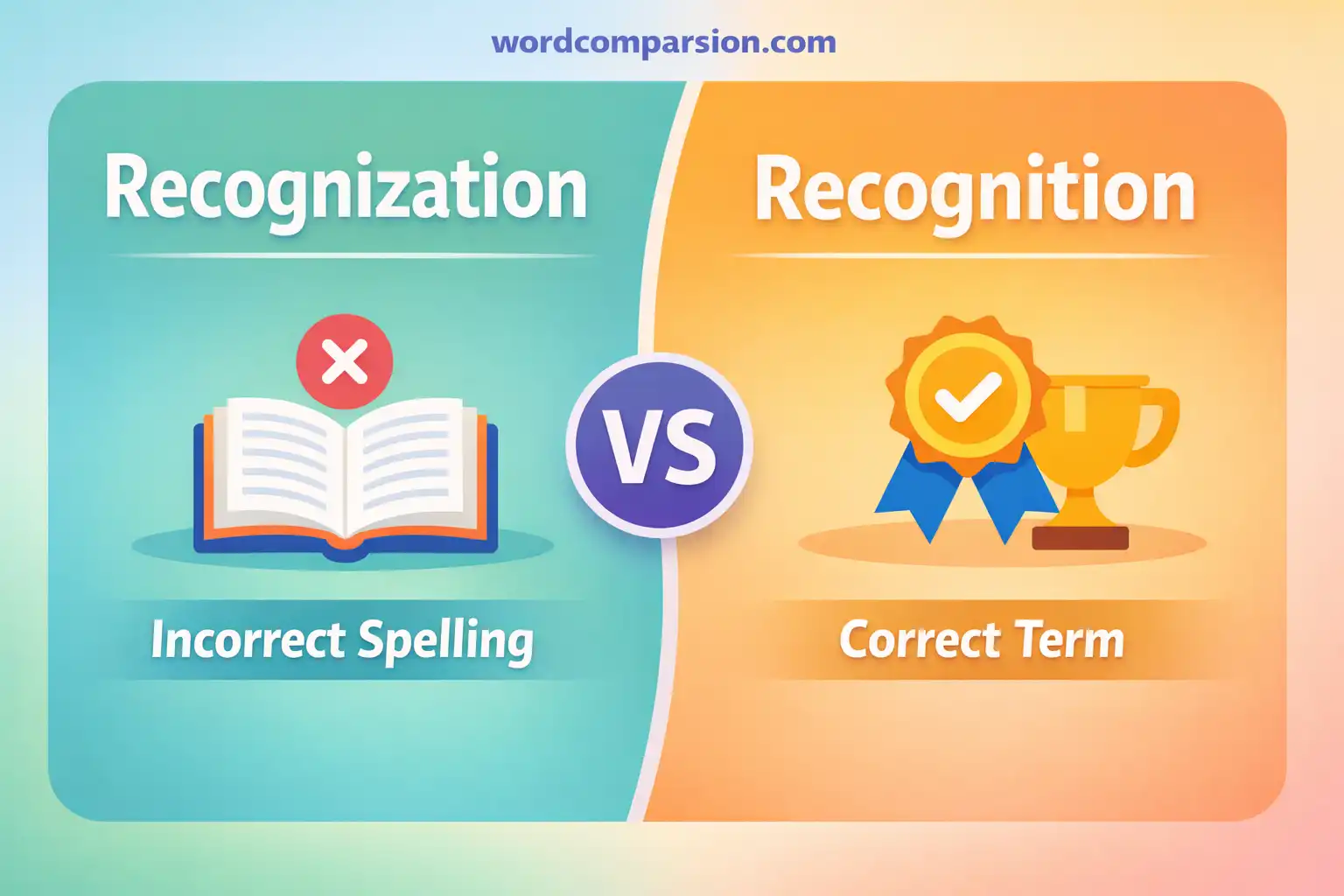
Many learners stop when they see the word recognization. It looks real. It sounds formal. So people type it in emails, essays, and reports. Then a grammar tool marks it wrong. That moment creates doubt. Is recognization a real word? Or is recognition the only correct form?
This confusion happens because English has many words that end in -tion and -ization. Both endings feel natural. So writers and students guess. Even professionals guess sometimes. The mistake spreads online, and then more people copy it. Because of that, the wrong spelling starts to look normal.
This article solves that confusion step by step. You will learn which word is correct, why the mistake exists, and how to avoid it forever. The explanation stays simple, clear, and practical. By the end, you will know the rule and use it with confidence.
Recognization vs Recognition – Quick Answer
Recognition is the correct word.
Recognization is incorrect in standard English.
- Use recognition in writing and speech
- Never use recognization
Example:
✅ She received recognition for her work
❌ She received recognization for her work
Easy rule: If you mean praise or identification, always choose recognition.
The Origin of Recognization vs Recognition
The word recognition comes from Latin roots. The base word means “to know again” or “to identify.” English adopted it centuries ago. Writers, scholars, and legal systems used it consistently. Because of that long history, recognition became fixed as the standard form.
So where did recognization come from?
English also has many words ending in -ization, like organization or modernization. Learners see that pattern and try to apply it to other verbs. The brain looks for symmetry. It feels logical. However, language does not always follow logic. Some words keep older forms.
Editors often see this mistake from students and ESL learners. The confusion comes from pattern guessing, not ignorance. Still, modern dictionaries reject recognization. It remains a spelling error in formal English.
British English vs American English Spelling
Some words change between British and American English. For example, organization vs organisation. That pattern leads people to wonder if recognization is a regional variant.
It is not.
Both British and American English use recognition. There is no accepted spelling difference here.
| Region | Correct spelling |
| American English | recognition |
| British English | recognition |
| Commonwealth English | recognition |
In contrast to many other words, this spelling stays the same everywhere. That makes the rule easy to remember.
Which Spelling Should You Use?
The rule is simple because only one form is correct.
US: Always write recognition
UK / Commonwealth: Always write recognition
Global professional writing: Use recognition
There is no audience where recognization becomes acceptable. Even informal writing avoids it. Therefore the safest choice is always recognition.
Common Mistakes with Recognization vs Recognition
Writers repeat a few predictable errors.
❌ The company earned recognization
✅ The company earned recognition
Explanation: The incorrect ending copies other -ization words
❌ She wants public recognization
✅ She wants public recognition
Explanation: The noun form is fixed in English
These mistakes happen because the brain applies a pattern. However, English keeps exceptions. Recognition is one of them.
Recognization vs Recognition in Everyday Examples
Seeing the word in context helps memory.
Email
“I appreciate the recognition you gave the team.”
News writing
“The artist gained international recognition.”
Social media
“Hard work deserves recognition!”
Professional writing
“The project received recognition from industry leaders.”
Every example uses the same spelling. The meaning stays clear and natural.
Recognization vs Recognition – Why People Confuse Them
The confusion spreads for several reasons.
First, learners see many -ization words. That pattern feels strong. So they build a similar form automatically.
Second, search engines show the misspelling often. People copy what they see. Popular mistakes create a feedback loop.
Third, ESL learners rely on sound. Both words sound believable. Without correction, the error sticks.
A real-world problem appears in resumes. A candidate writes “recognization” in a professional document. Hiring managers may view it as a language weakness. The message still makes sense, but the spelling affects credibility. Because of that, understanding the correct form matters.
Comparison Table: Recognization vs Recognition
| Feature | Recognition | Recognization |
| Meaning | Praise or identification | Intended same meaning |
| Part of speech | Noun | Misspelling |
| Context of use | Formal and informal writing | Not accepted |
| Formal usage | Correct | Incorrect |
| Common mistake | Rare | Frequently confused |
| Correct example | She received recognition | ❌ She received recognization |
This table removes the confusion instantly: only one word belongs in standard English.
Semantic FAQs
Is recognization the same as recognition?
No. Recognition is correct. Recognization is a spelling error.
Which one is correct in formal writing?
Recognition is always correct.
Can they be used interchangeably?
No. Professional writing rejects recognization.
Why do people confuse them?
Because many English words end in -ization.
Can grammar tools catch this mistake?
Yes. Most modern tools flag recognization immediately.
Is there a British vs American difference?
No. Both regions use recognition.
Will people understand recognization?
They may understand it, but it looks incorrect.
Conclusion
English feels logical until it suddenly is not. The pair recognization vs recognition shows how patterns can mislead writers. The brain expects symmetry. So it creates a word that sounds right. However, language history decides the final form, not logic alone.
Recognition is the only accepted spelling in modern English. It works in emails, essays, business reports, and social media. Using the wrong form does not break communication, but it weakens credibility. Writers often lose trust over small spelling habits. That is why this distinction matters.
Overall, the safest memory trick stays simple. Recognition is fixed. There is no alternative version. Finally, remember one rule: If you mean praise or identification, always write recognition and never add extra letters.

Ibrahim Jhon is an English language editor with over ten years of experience working with writers, publishers, and international businesses. He specialises in word choice, grammar accuracy, and the differences between British and American English.