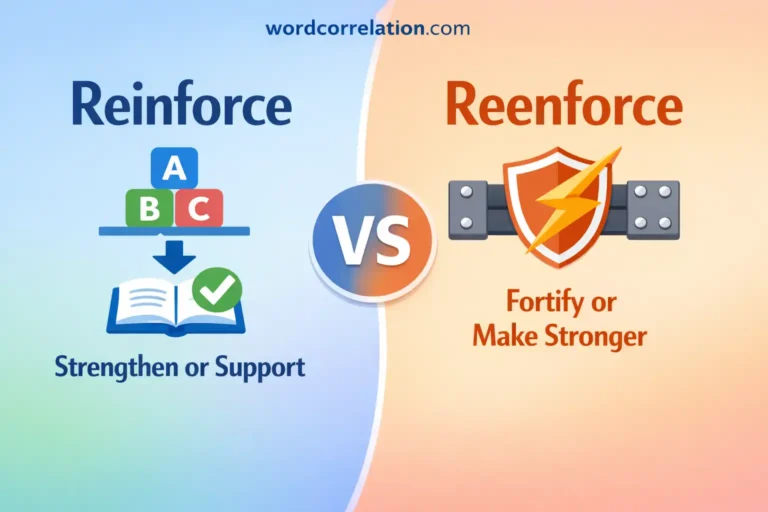
Have you ever wondered whether to use “reinforce” or “reenforce”? You’re not alone! Many people mix up these two words because they look and sound so similar. But there’s only one right choice. In this article, we’ll explain the difference and show you when to use each word. By the end, you’ll know how to avoid the common mistake of using reenforce instead of reinforce.
So, why is this confusion so common? It happens because “reenforce” seems like a valid word, but it’s actually a mistake. Reinforce is the proper term, and understanding why will make you a stronger writer. Keep reading to learn the real meaning of both words and how to use them correctly.
Get ready to clear up the confusion once and for all! We’ll give you simple examples, rules, and tips that will help you always choose the right word—reinforce!
Reinforce vs Reenforce – Quick Answer
- Reinforce is the correct word, meaning to make something stronger or support something further.
- Example: The teacher used extra exercises to reinforce the lesson.
- Reenforce is an incorrect spelling of reinforce and should not be used.
Rule: Always use reinforce. Forget reenforce—it’s a common mistake!
The Origin of Reinforce vs Reenforce
The confusion between “reinforce” and “reenforce” comes from their similar pronunciation and spelling. Let’s break them down:
- Reinforce comes from the Old French reinforcier, meaning “to strengthen” or “to make stronger.” It entered English in the 15th century and has remained the correct form for expressing the act of making something stronger, whether physically, emotionally, or conceptually.
- Reenforce is a common misspelling. Although many people mistakenly add the extra “e,” it’s not a word recognized in the dictionary.
This historical origin helps explain why “reinforce” is the right choice. The extra “e” in “reenforce” is simply a typo that many make, but it doesn’t have any linguistic backing.
British English vs American English Spelling
Interestingly, reinforce does not change between British English and American English. The correct spelling is always reinforce in both varieties. You might come across regional spelling differences with other words, but for “reinforce,” there’s no need to worry about that here.
Which Spelling Should You Use?
You should always use reinforce, regardless of the region or type of writing.
- For US English: reinforce is the preferred spelling.
- For UK / Commonwealth English: Again, reinforce is used.
- For Global / Professional Writing: Stick to reinforce universally in any formal or informal context.
If you ever find yourself unsure, just remember that reenforce doesn’t exist in standard English usage. Always opt for reinforce.
Common Mistakes with Reinforce
Many English learners and writers mistakenly use reenforce, thinking it’s a valid form. However, this is an error that can confuse readers. Let’s look at some common mistakes:
❌ Incorrect → I will reenforce my argument with more evidence.
✅ Correct → I will reinforce my argument with more evidence.
❌ Incorrect → The builder will reenforce the structure with steel beams.
✅ Correct → The builder will reinforce the structure with steel beams.
As you can see, using “reenforce” in your writing is a simple error. Correcting this ensures that your writing sounds more professional and clear.
Reinforce in Everyday Examples
Let’s explore how reinforce is used in different contexts:
- Emails: I will reinforce the importance of deadlines in my next email to the team.
- News: The government’s new policies aim to reinforce the economy after the crisis.
- Social Media: This post will reinforce our brand’s commitment to quality.
- Formal Writing: The research findings reinforce the theory proposed by the experts.
In each case, “reinforce” means to strengthen, support, or make something clearer.
Reinforce – Usage Patterns & Search Interest
The word reinforce is widely used in both everyday and academic language. Common user groups include:
- Students: Teachers often use reinforce to describe supporting concepts or practices in the classroom.
- Writers: Writers may reinforce key ideas throughout their articles or essays.
- Professionals: In business settings, reinforce is used when emphasizing policies, procedures, or training.
Misusing reenforce instead of reinforce can cause confusion. For example, an academic paper with “reenforce” could undermine the credibility of the writer, as it is simply incorrect.
Comparison Table: Reinforce vs Reenforce
| Meaning | Reinforce | Reenforce |
| Part of Speech | Verb | Incorrect verb form |
| Context of Use | To strengthen or support something | Not valid in standard English |
| Formal vs Informal | Used in both formal and informal writing | Not used in any context |
| Common Mistakes | Reinforce your efforts | Reenforce your efforts (incorrect) |
| Correct Example | The evidence reinforces his argument. | The evidence reenforces his argument (incorrect) |
Semantic FAQs (People Also Ask)
Is reinforce the same as reenforce?
No, reinforce is the correct word. Reenforce is a common misspelling.
Which one is correct in formal writing?
Reinforce is the correct choice in all forms of writing.
Can they be used interchangeably?
No, only reinforce is correct.
Why do people confuse them?
The confusion comes from the similar pronunciation and spelling of reinforce and reenforce.
Can grammar tools catch this mistake?
Yes, most grammar tools will catch reenforce as a typo.
Is there a British vs American difference?
No, both British and American English use reinforce.
Conclusion
In short, reinforce is the correct term, and it means to strengthen, support, or emphasize something. The mistake of using reenforce is common but easily avoided. To avoid confusion and ensure your writing is clear, always remember to use reinforce in all contexts. A quick rule to remember: If you’re unsure, reinforce is always the right choice.
Now, when you write, you’ll confidently know when and how to use reinforce. Keep practicing, and soon it will become second nature!

Daniel Morris writes about English word differences and spelling confusion. His focus is to provide clear, simple explanations with practical usage examples.