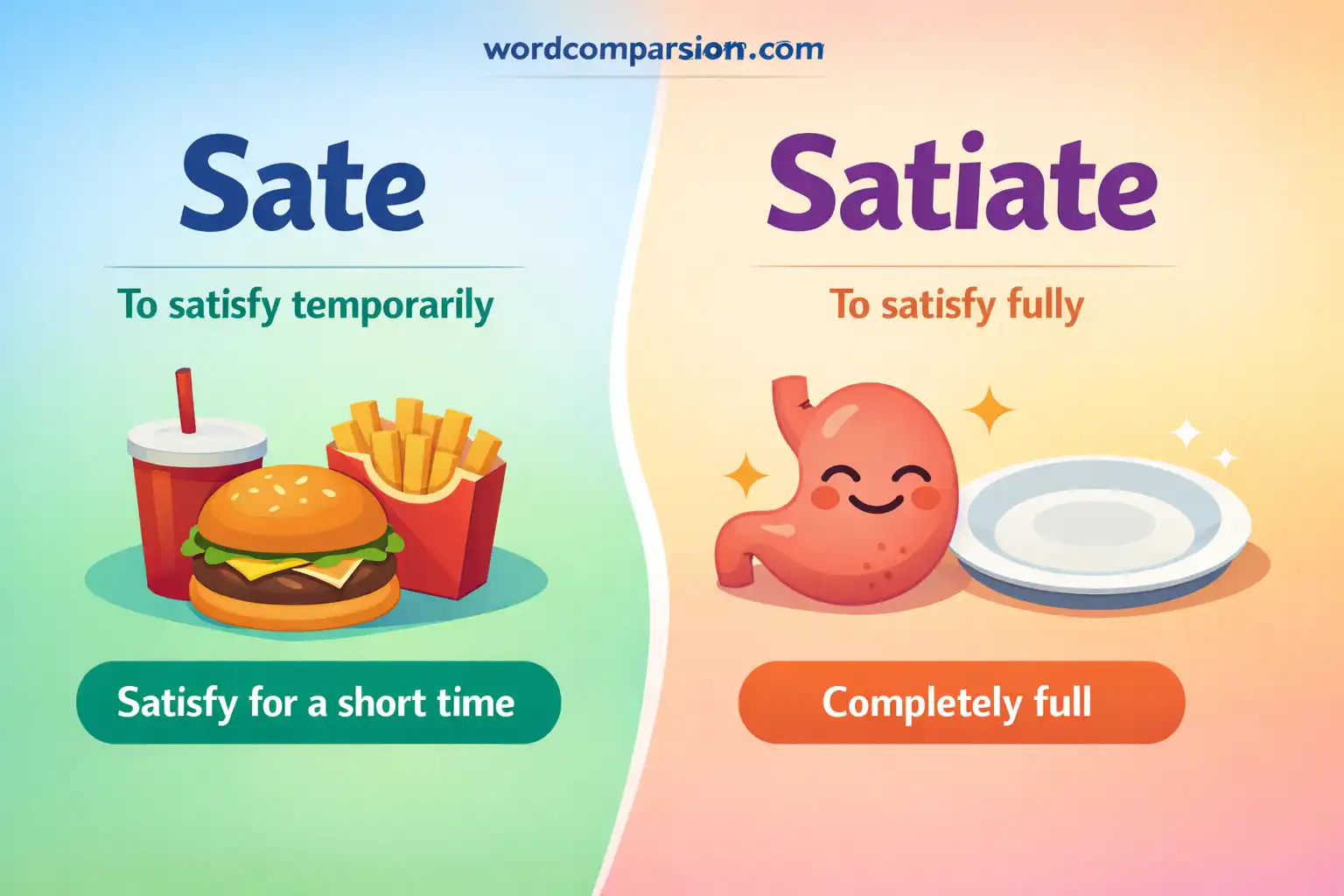
We all love a good meal, but when it comes to expressing how we feel after eating, the words “sate” and “satiate” often create confusion. While they seem similar, they carry subtle differences that can trip up writers, students, and non-native speakers. If you’ve ever hesitated while choosing between these two words, you’re not alone.
In this article, we’ll explore the difference between “sate” and “satiate” to clear up the confusion. Whether you’re writing an essay, a social media post, or a business email, understanding when and how to use each word will make your writing more precise and effective. Many people get confused when using “sate” and “satiate,” thinking they are interchangeable. This mix-up often arises because both words relate to satisfying hunger or desires.
While “satiate” is commonly used to refer to satisfying physical hunger, “sate” has a more general meaning that can also apply to other types of fulfillment, such as emotions or desires. Both words can be used in formal and informal writing, but choosing the wrong one can sound awkward or unnatural. Let’s dive deeper into their meanings, origin, and common usage to help you use these words correctly.
Sate vs Satiate – Quick Answer
- Sate: To satisfy or fulfill a desire, need, or appetite, typically used in a broader context.
- Satiate: To satisfy hunger or a physical need, often used specifically in relation to food.
Decision Rule: Use “sate” when referring to any desire or emotional fulfillment, and use “satiate” for satisfying hunger or specific cravings.
The Origin of “Sate” and “Satiate”
The confusion between “sate” and “satiate” can be traced back to their origins, which both come from Latin roots.
- Sate: Derived from the Latin word saturare, meaning “to fill or satisfy.” The word entered English in the 15th century and has since been used in a variety of contexts beyond just hunger.
- Satiate: This word also originates from the Latin satiare, meaning “to satisfy hunger.” The term was first recorded in English in the 16th century, with its use focusing more narrowly on hunger and desire fulfillment.
Both words evolved to mean “to fill or satisfy,” but their usage expanded in different directions.
Reason for Confusion Today
In modern language, both “sate” and “satiate” are used to express the idea of fulfilling a need, especially hunger. However, while “satiate” is more formal and specific to hunger, “sate” is often used for a wider range of needs, such as emotional or intellectual desires. The mistake often happens when writers use them interchangeably without considering the context.
British English vs American English Spelling
Both “sate” and “satiate” are spelled the same way in both British and American English. There is no difference in their spelling, but it’s essential to use them correctly based on context.
Examples:
- Sate: “He tried to sate his curiosity with more information.”
- Satiate: “The large meal helped to satiate his hunger.”
Which Spelling Should You Use?
Since there is no distinction in spelling between British and American English, the focus should be on choosing the right word for the context. If you’re writing for an international or global audience, use “satiate” when specifically referring to hunger, and “sate” when describing other forms of satisfaction or fulfillment.
Common Mistakes with “Sate” and “Satiate”
One of the most common mistakes people make is using “satiate” when referring to non-physical desires. For example, saying “The movie satiated my curiosity” sounds unnatural because “satiate” specifically refers to physical needs, like hunger. The correct word in this case would be “sate.”
Incorrect: “The news satiated his curiosity.”
Correct: “The news sate his curiosity.”
“Sate” in Everyday Examples
Let’s look at how “sate” is used in various real-life contexts:
- Emails: “I hope this email helps sate your questions.”
- News: “The book will sate the curiosity of history buffs.”
- Social Media: “The new product release sated our customers’ demand.”
- Formal Writing: “The desire to be acknowledged can only be sated through true understanding.”
“Satiate” in Everyday Examples
Now let’s look at “satiate” in everyday examples, focusing on its use in relation to physical hunger or satisfaction.
- Emails: “This buffet will surely satiate your hunger.”
- News: “After a long day, a hearty meal is enough to satiate the appetite.”
- Social Media: “The pizza finally satiated my craving for cheese.”
- Professional Writing: “Only a good lunch can satiate the hunger of our employees during the meeting.”
Sate vs Satiate – Usage Patterns & Search Interest
Both words are commonly searched by ESL learners, students, and writers. Search trends show that “satiate” is more commonly associated with food, while “sate” is used more frequently in broader contexts. Writers often search for these words when they are unsure about how to express fulfillment beyond hunger.
Example of Misuse: A student writing an essay might say, “The book satiated my interest,” which would be incorrect. The proper word in this case would be “sate” since the interest is not related to a physical need.
Comparison Table: “Sate” vs “Satiate”
| Aspect | Sate | Satiate |
| Meaning | To fulfill any desire or need (physical or emotional). | To fulfill hunger or a physical craving. |
| Part of Speech | Verb | Verb |
| Context of Use | Can be used in a variety of contexts (hunger, curiosity, etc.). | Primarily used in the context of food and hunger. |
| Formal vs Informal Use | Can be formal or informal. | Often more formal, especially in relation to food. |
| Common Mistakes | Incorrect: “The meal sate his curiosity.” | Incorrect: “The meal satiated his interest.” |
| Correct Example | “The long meeting sated his curiosity.” | “The hearty stew satiated his hunger.” |
Semantic FAQs (People Also Ask)
- Is “Sate” the same as “Satiate”?
- No, “sate” is broader and can refer to fulfilling any desire, while “satiate” specifically relates to satisfying hunger.
- Which one is correct in formal writing?
- “Satiate” is more commonly used in formal writing when talking about hunger, while “sate” can be used in informal and formal settings for other types of fulfillment.
- Can they be used interchangeably?
- Not always. Use “sate” for general desires and “satiate” specifically for hunger.
- Why do people confuse them?
- Both words mean to satisfy or fulfill, which leads to confusion, especially since they overlap in meaning.
- Can grammar tools catch this mistake?
- Yes, many grammar tools will highlight the misuse of “satiate” in non-hunger contexts.
- Is there a British vs American difference?
- No, both “sate” and “satiate” are used the same way in both British and American English.
- Is “Sate” used more in informal contexts?
- Yes, “sate” is often used in informal settings, but can also appear in formal writing when referring to desires beyond hunger.
Conclusion
In short, “sate” and “satiate” are related but not interchangeable. “Sate” refers to fulfilling any desire or need, while “satiate” is specifically tied to hunger or physical cravings.
The key mistake to avoid is using “satiate” for emotional or non-physical needs. Remember, when in doubt, use “sate” for broader desires and “satiate” for physical hunger.

Virginia Woolf is a British writer and essayist whose work centers on close reading, linguistic precision, and the careful examination of meaning. Her professional background spans fiction, literary criticism, and long-form essays, where attention to word choice and semantic nuance is central rather than decorative. Woolf approaches language as a system of relationships, treating individual words not as interchangeable units but as carriers of tone, context, and psychological weight.
Her research-based writing reflects sustained engagement with how meaning shifts across usage, rhythm, and narrative position. Through essays and critical studies, she demonstrates how subtle differences in wording shape interpretation, emotional response, and intellectual clarity. This focus aligns naturally with word comparison and semantic analysis, where accuracy matters more than flourish.
Woolf helps readers understand meaning differences by slowing language down, isolating terms, and examining how sense emerges through contrast. Her work builds trust by prioritizing clarity, textual evidence, and respect for the reader’s interpretive intelligence.