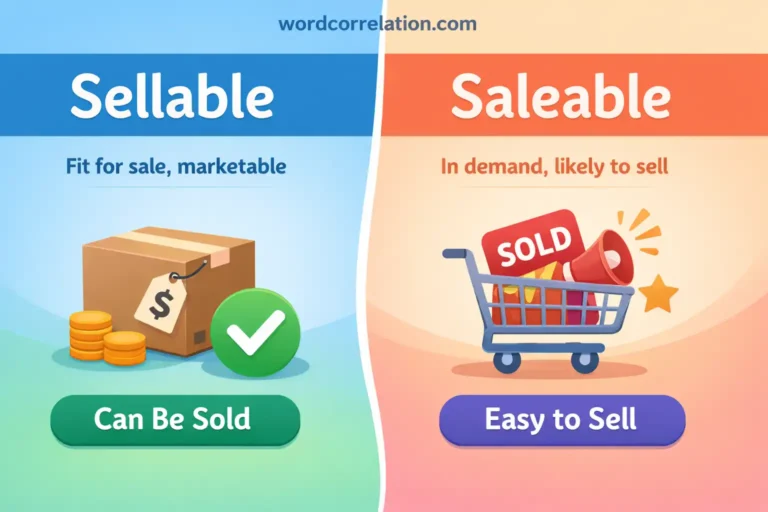
People often stop and think when they see the words sellable and saleable. They look almost the same, they sound the same, and they both seem to mean “able to be sold.” Because of this, writers, students, and even professionals feel unsure. They wonder which spelling is correct and which one they should use.
This confusion usually shows up in emails, product descriptions, school work, and online content. Someone writes sellable, then doubts it. Someone else writes saleable, then worries it looks wrong. The problem is not small. Using the “wrong” form can make writing feel less clear or less professional, especially for global readers.
This article solves that problem in a simple way. You will learn what sellable vs saleable really means, why both forms exist, and when each one is best. By the end, you will know exactly which word to choose and why, without guessing or second-guessing yourself.
Sellable vs Saleable – Quick Answer
Both words are correct. They mean the same thing.
- Sellable is used more in American English
- Saleable is used more in British English
Easy rule:
If you write for the US, use sellable.
If you write for the UK, use saleable.
Example:
- This product is sellable in the US market.
- This product is saleable under UK law.
The Origin of Sellable vs Saleable
Both words come from the verb sell, which means to exchange something for money. Over time, English created adjectives to describe things that can be sold. That is how these two spellings appeared.
Sellable follows a very direct pattern. It comes from sell + able. Many modern English words work this way, so it feels natural to many writers today.
Saleable, on the other hand, comes from an older spelling tradition. It is linked to the noun sale, not just the verb sell. British English kept this form, and it stayed common in legal and formal writing.
Because English spread across different regions, both spellings survived. Today, they exist side by side, which is why people still ask about sellable vs saleable.
British English vs American English Spelling
This is where the difference becomes clear.
In American English, writers strongly prefer sellable. It looks simpler and matches modern spelling habits.
In British English, saleable is more common. It appears often in official texts, laws, and formal writing.
However, the meaning does not change.
| Region | Preferred spelling |
| United States | Sellable |
| United Kingdom | Saleable |
| International / mixed | Either (choose one style) |
In contrast to some spelling differences, this one does not affect understanding. Readers usually recognize both forms.
Which Spelling Should You Use?
The best choice depends on your audience.
- US audience: Use sellable
- UK or Commonwealth audience: Use saleable
- Global or professional writing: Pick one spelling and stay consistent
If you mix both spellings in one article, it can look careless. Consistency matters more than the spelling itself.
Also, style guides often decide this for you. So, if you follow a company or school style guide, use the form they prefer.
Common Mistakes with Sellable vs Saleable
Writers usually do not use the wrong word. Instead, they make small mistakes around usage.
❌ This item is not sell.
✅ This item is not sellable.
❌ Sellable and saleable have different meanings.
✅ Sellable and saleable mean the same thing.
Another common mistake is overthinking. Many learners believe one form must be incorrect. In fact, both are correct, just regional.
Sellable vs Saleable in Everyday Examples
Emails
- “This product is sellable after inspection.”
- “The item is not saleable due to damage.”
News
- “The company recalled items that were no longer sellable.”
- “Unsold stock was declared saleable again after testing.”
Social Media
- “Finally fixed it! Now it’s sellable again.”
- “Old books can still be saleable if they are rare.”
Formal or Professional Writing
- “Only saleable goods may enter the market.”
- “The report lists all sellable assets.”
These examples show that meaning stays the same. Only spelling changes.
Sellable vs Saleable – Usage Patterns & Search Interest
People search for sellable vs saleable because they want certainty. Students want correct answers. ESL learners want confidence. Writers want to avoid mistakes.
Editors often see both spellings used correctly, but mixed in one text. That is where problems appear. A reader may not feel confused, but the writing looks inconsistent.
In real life, this matters in places like:
- Product listings
- Legal or business documents
- Academic writing
Using the right spelling for the right audience builds trust and clarity.
Comparison Table: Sellable vs Saleable
| Feature | Sellable | Saleable |
| Meaning | Able to be sold | Able to be sold |
| Part of speech | Adjective | Adjective |
| Main usage | American English | British English |
| Formal tone | Neutral | Slightly formal |
| Common mistake | Thought to be wrong | Thought to be old |
| Correct example | A sellable product | A saleable product |
This table shows that the difference is about style, not meaning.
FAQs About Sellable vs Saleable
Is sellable the same as saleable?
Yes. They have the same meaning and usage.
Which one is correct in formal writing?
Both are correct. Choose based on regional style.
Can sellable and saleable be used interchangeably?
Yes, but do not mix them in the same text.
Why do people confuse sellable vs saleable?
Because the spelling looks different, but the meaning is the same.
Can grammar tools catch this mistake?
Most tools accept both spellings and do not flag them.
Is there a British vs American difference?
Yes. American English prefers sellable, British English prefers saleable.
Conclusion
Overall, the confusion around sellable vs saleable comes from spelling, not meaning. Both words are correct, both mean “able to be sold,” and both are used every day in real writing.
The key point is audience. American readers expect sellable. British readers expect saleable. Global readers understand both, but consistency matters. Mixing spellings can weaken your writing, even if the grammar is correct.
The one mistake to always avoid is thinking one form is wrong. It is not. Instead, choose the spelling that fits your audience and stay with it from start to finish.
Easy rule to remember:
Same meaning, different regions. Pick one, and be consistent.

Daniel Morris writes about English word differences and spelling confusion. His focus is to provide clear, simple explanations with practical usage examples.