Words can trick the eye. You read fast, and your brain fills gaps. So you may type stear when you mean steer. This happens in emails, essays, and even posts. Many learners and writers search steer vs stear because both look right. But only one is real in modern English.
This confusion matters. A small spelling slip can change trust. It can also break the meaning of a sentence. If you write, “Please stear the car,” the reader pauses. The message feels careless, even if the idea is clear.
So this guide solves the problem in a simple way. You will learn what steer means, why stear appears, where the mistake starts, and how to avoid it every time.
Steer vs Stear – Quick Answer
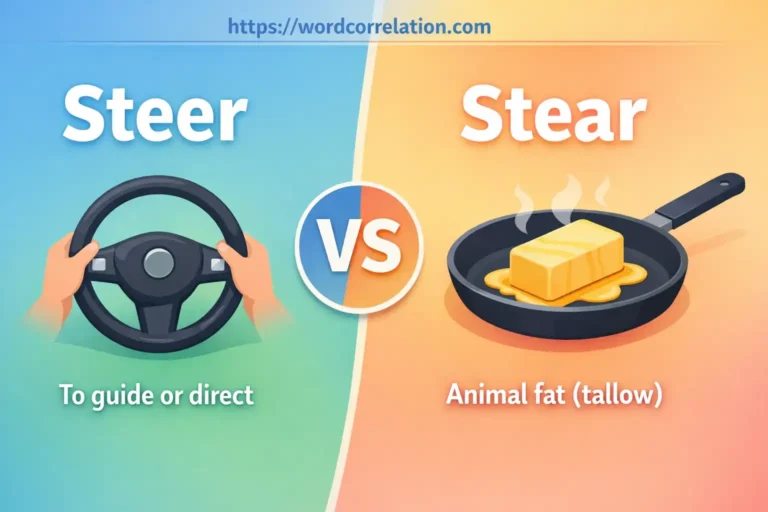
- Steer is correct. It means to guide or control direction.
- Stear is a spelling mistake in modern English.
- Example: “Steer the boat left.”
- Easy rule: If you mean guide or control, always write steer.
The Origin of Steer vs Stear
The word steer comes from Old English stēoran. It meant to guide a ship. Later, people used it for carts, horses, and then cars. The meaning stayed the same: guide the direction.
So where did stear come from? It did not come from standard English. Instead, it appears because English spelling can feel tricky. The sound /stɪər/ makes some writers think of “ea” as in hear or near. So they type stear by guess.
Editors often see this error from ESL learners and fast typists. The brain matches sound with the wrong letter pair. Over time, the misspelling spreads in search and social posts, which creates more confusion.
However, in dictionaries and formal writing, stear does not exist as a valid word.
British English vs American English Spelling
There is no spelling difference between British and American English here.
Both use steer.
| Version | Correct Spelling |
| American English | steer |
| British English | steer |
| Australian English | steer |
| Canadian English | steer |
In contrast to words like color/colour, this word never changes.
Which Spelling Should You Use?
Use steer in all cases.
- In the US: write steer
- In the UK and Commonwealth: write steer
- In global or professional writing: write steer
There is no audience where stear is correct. If you see it, treat it as a typo.
Common Mistakes with Steer vs Stear
Writers often make small, repeat errors with this word.
- ❌ Please stear the car slowly.
✅ Please steer the car slowly. - ❌ He tried to stear the team in the right direction.
✅ He tried to steer the team in the right direction. - ❌ This policy will stear the company forward.
✅ This policy will steer the company forward.
The mistake happens because the sound feels like it needs “ea”. But English does not follow that pattern here.
Steer vs Stear in Everyday Examples
You will see steer in many daily contexts.
Emails
“Can you steer this project toward the deadline?”
News
“The captain steered the ship through the storm.”
Social media
“Let’s steer the talk back to the topic.”
Professional writing
“Good leaders steer teams with clarity and calm.”
In each case, the idea is guide, not a new spelling.
Steer vs Stear – Usage Patterns & Search Interest
Many students, ESL learners, and new writers search this term. They hear the word first, then try to spell it. Spellcheck tools often catch stear, but not always in fast typing.
A real problem appears in professional emails. If someone writes “stear,” the reader may doubt the writer’s care. The meaning stays clear, but the tone drops.
So this confusion is small but important. Correct spelling keeps writing clean and trusted.
Comparison Table
| Feature | Steer | Stear |
| Meaning | Guide or control direction | No meaning in modern English |
| Part of speech | Verb, noun | Not a valid word |
| Context of use | Driving, leading, guiding | Typo or misspelling |
| Formal vs informal | Used in all writing | Never correct |
| Common mistake | Spelled as “stear” | Confused with “steer” |
| Correct example | Steer the car carefully | ❌ Stear the car carefully |
FAQs – People Also Ask
Is stear a real word?
No. It is a misspelling of steer.
Is steer the same as stear?
No. Only steer has meaning.
Which one is correct in formal writing?
Always steer.
Why do people confuse steer and stear?
The sound makes writers guess the wrong vowel pattern.
Can grammar tools catch this mistake?
Most tools flag stear as an error.
Is there a British vs American difference?
No. Both use steer.
Can steer be used in a non-driving sense?
Yes. It also means to guide ideas, teams, or talks.
Conclusion
Small spelling errors can create big confusion. Steer vs stear is a common one because the ear misleads the eye. You hear the sound and guess the wrong letters. But the rule is simple.
Steer means to guide, control, or direct. It works for cars, ships, teams, talks, and plans. Stear has no place in modern English writing.
Overall, remember this: if you mean guide the direction, write steer. Never add “ea” in the middle.
Finally, one easy rule to keep:
Guide = steer. There is no stear.

Daniel Morris writes about English word differences and spelling confusion. His focus is to provide clear, simple explanations with practical usage examples.