Many people stop while writing when they see walk through and walkthrough. They look the same, but they do not work the same. Because of this, writers often guess. That guess can change the meaning of a sentence. It can also make writing look careless.
This confusion happens in emails, guides, school work, and even job documents. Some people use one word. Others use two words. Grammar tools do not always help, so the mistake keeps repeating.
This article fixes that problem. You will learn what each form means, when to use it, and why the difference matters. You will also see clear examples from daily writing. By the end, you will know the correct choice in seconds, without doubt.
Walk Through vs Walkthrough – Quick Answer
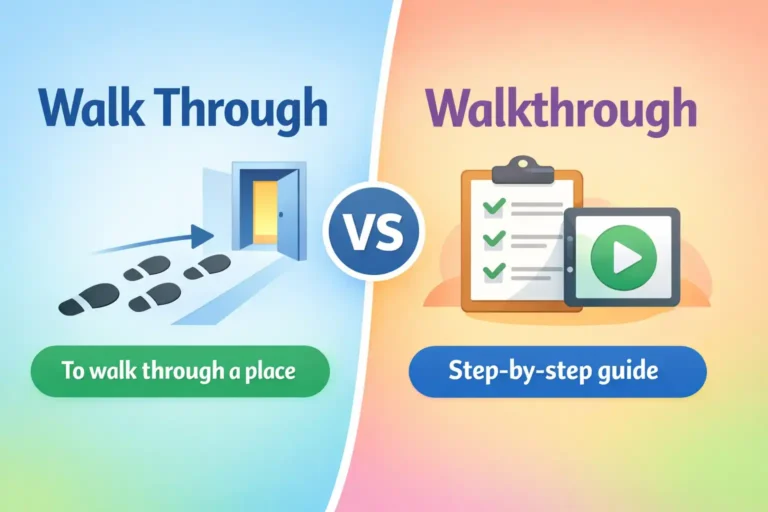
- Walk through = a verb phrase
Example: “I will walk through the steps with you.” - Walkthrough = a noun
Example: “This guide is a full walkthrough.”
Easy rule:
👉 If you can add “the steps,” use walk through.
👉 If you name a guide or process, use walkthrough.
The Origin of Walk Through vs Walkthrough
The phrase walk through came first. It was a literal action. People walked through a door, a room, or a place. Over time, the meaning expanded. It started to mean explaining something step by step.
Later, writers needed a short name for these step-by-step guides. So, walkthrough became a noun. It named the explanation itself, not the action.
Today, both forms exist because English often turns actions into things. That is why confusion happens. The words share meaning, but their grammar roles are different.
British English vs American English Spelling
There is no spelling difference between British and American English for these words.
- Both use walk through as two words for the verb.
- Both use walkthrough as one word for the noun.
However, style habits can differ. American tech writing often uses walkthrough in product guides. British writing may use it slightly less, but the rule stays the same.
| Form | US English | UK English |
| walk through | ✔️ | ✔️ |
| walkthrough | ✔️ | ✔️ |
So, spelling is not the issue. Usage is the real problem.
How to Choose the Right Word Fast
For US Writers
Use walkthrough for tutorials, software guides, and manuals. Use walk through when describing the act of explaining.
For UK / Commonwealth Writers
Follow the same rule. Focus on grammar role, not region.
For Global or Professional Writing
Be consistent. Use walkthrough as a noun and walk through as a verb phrase. Editors look for this clarity.
Key reminder:
If the word acts like a thing, it is walkthrough.
If it shows an action, it is walk through.
Common Mistakes with Walk Through vs Walkthrough
❌ “This document will walk through.”
✅ “This document is a walkthrough.”
→ The sentence needs a noun, not a verb.
❌ “I will walkthrough the process.”
✅ “I will walk through the process.”
→ The sentence shows an action.
These small errors change meaning. They also reduce clarity, especially in professional writing.
Walk Through vs Walkthrough in Everyday Examples
Emails
- “Let me walk through the plan with you.”
- “I attached a short walkthrough for help.”
News Writing
- “The coach will walk through the strategy.”
- “The article includes a full walkthrough.”
Social Media
- “I’ll walk through my routine today.”
- “New app walkthrough posted!”
Formal Writing
- “This section will walk through the findings.”
- “Appendix A contains a detailed walkthrough.”
Walk Through vs Walkthrough – Usage Patterns
Writers and editors see walk through and walkthrough used in different contexts, and this can cause confusion, especially for learners and non-native speakers.
In general:
- walk through (two words) appears when someone describes an action — like stepping through a task or explaining something step by step.
- walkthrough (one word) appears as a noun naming the guide, plan, or document itself.
In specific fields, this distinction shows up clearly:
- In software engineering, a walkthrough refers to a structured review or process explanation. (wikipedia)
- In video gaming, a walkthrough refers to a detailed guide that shows how to complete levels or challenges. (wikipedia)
These real-world usages support the rule explained earlier: use walk through when describing an action, and use walkthrough when naming a thing (document, guide, protocol, etc.).
Editors looking through many documents confirm that the most common mistake is treating walkthrough as if it were a verb — for example writing “I will walkthrough” instead of “I will walk through.” This error often slips past automated spelling checks because “walkthrough” is a correctly spelled word — just the wrong form for the sentence.
Comparison Table: Walk Through vs Walkthrough
| Feature | Walk Through | Walkthrough |
| Meaning | To explain step by step | A step-by-step guide |
| Part of Speech | Verb phrase | Noun |
| Context | Action or process | Document or content |
| Formal Use | Yes | Yes |
| Common Mistake | Used as a noun | Used as a verb |
| Correct Example | “I will walk through it.” | “This is a walkthrough.” |
FAQs: Walk Through vs Walkthrough
Is walk through the same as walkthrough?
No. One is an action. The other is a thing.
Which one is correct in formal writing?
Both are correct when used properly.
Can they be used interchangeably?
No. Grammar decides the choice.
Why do people confuse them?
They share meaning but differ in form.
Can grammar tools catch this mistake?
Sometimes, but not always.
Is there a British vs American difference?
No. The rule is the same everywhere.
Conclusion
Overall, walk through and walkthrough are easy once you see the pattern. The confusion comes from meaning, not spelling. Both relate to step-by-step explanations, but grammar decides the form.
Use walk through when someone performs the action of explaining. Use walkthrough when naming the guide or process itself. Mixing them up can confuse readers and weaken your writing.
In short, always ask one question before choosing.
Is this an action or a thing?
If it is an action, use walk through.
If it is a thing, use a walkthrough.
Remember this rule, and you will never hesitate again.

Daniel Morris writes about English word differences and spelling confusion. His focus is to provide clear, simple explanations with practical usage examples.