Are you confused about the terms “walkthrough” and “walk through”? You’re not alone! Many people use them interchangeably without realizing that they are not the same. While both phrases refer to similar actions, they have different meanings and usage contexts. In this article, we’ll break down the distinction between “walkthrough” and “walk through” to clear up the confusion and help you use them correctly in various settings.
The reason for this confusion is simple: both terms describe actions related to walking and are often used in similar contexts. However, their grammatical functions and correct usage are quite different. Let’s take a closer look at what each term means, when to use them, and common mistakes that even seasoned writers often make.
By the end of this guide, you’ll have a solid understanding of how and when to use “walkthrough” versus “walk through,” ensuring that your writing is both accurate and clear.
Walkthrough vs Walk Through – Quick Answer
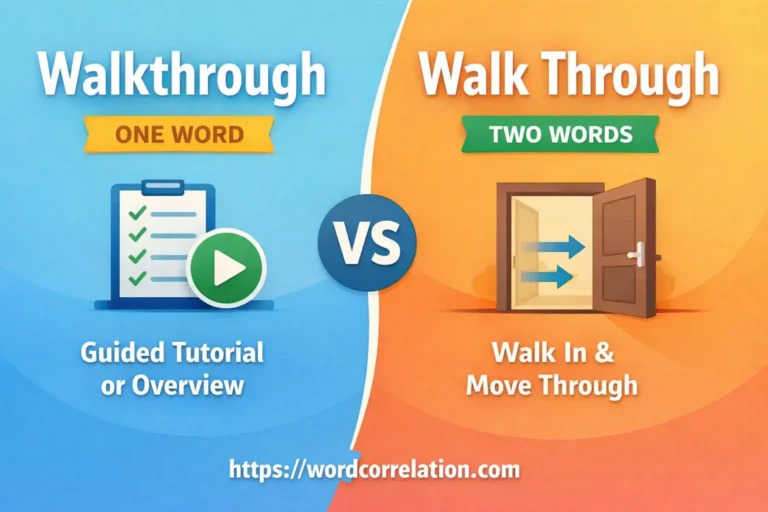
Walkthrough is usually used as a noun Walk through is used as a verb phrase
- Walkthrough: A noun. It refers to a detailed guide or demonstration, often used in instructions, tutorials, or problem-solving contexts.
- Example: “The video provided a step-by-step walkthrough of the software.”
- Walk through: A verb phrase. It refers to the action of walking through something or going through an area.
- Example: “Let’s walk through the building to see the new renovations.”
Meaning (walkthrough vs walk through)
Walkthrough meaning refers to a step by step explanation or guided tour of a process.
If you searched walk through vs walkthrough the difference is mainly grammar and how the phrase is used.
Walkthrough is usually a noun while walk through is a verb phrase.
The Origin of Walkthrough and Walk Through
The term “walkthrough” has its roots in the idea of walking through something step by step. Historically, it referred to a detailed, structured process of showing someone how to do something. This could include tutorials or guides, where the process is explained in detail.
On the other hand, “walk through” originated as a phrasal verb. It combined the verb “walk” with the preposition “through,” meaning to move through a space or an area. This term is commonly used when describing the act of physically walking through something, such as a building, an obstacle, or a process.
While both terms are based on walking, their contexts differ. Over time, “walkthrough” has evolved into a noun referring to a guide or tutorial, while “walk through” remains a verb phrase indicating movement.
Reason for Confusion Today
The confusion often arises because of the similarity in pronunciation and their relationship to walking. People tend to mix them up, especially in writing, as they sound similar when spoken. This is particularly common in digital content and instructional materials, where both terms might be used to describe a similar process, such as going through steps or procedures.
However, the main difference lies in grammar. “Walkthrough” is a noun that can refer to a detailed guide, while “walk through” is a verb phrase used to describe the action of walking through something. Understanding this distinction is key to using them correctly.
British English vs American English Spelling
Interestingly, the spelling does not differ between British and American English. Both “walkthrough” and “walk through” are spelled the same in both dialects. There is no major variation in spelling that would affect your choice between the two terms, so the confusion primarily lies in the grammatical usage rather than the spelling itself.
Which Spelling Should You Use?
- US: Both “walkthrough” (noun) and “walk through” (verb phrase) are used in American English. The distinction between them remains the same.
- UK / Commonwealth: The same rules apply in British English. No difference exists in spelling, but usage should follow the grammatical rules for noun and verb phrase distinctions.
- Global or professional writing: No difference in spelling. Focus on context—use “walkthrough” as a noun (for guides or tutorials), and “walk through” as a verb phrase (for physical movement or process explanation).
Common Mistakes with Walkthrough
While the terms are simple, people often make a few key mistakes when using them:
- Using “walkthrough” as a verb
❌ Incorrect: “I will walk you through the tutorial walkthrough.”
✅ Correct: “I will walk you through the tutorial.” - Using “walk through” as a noun
❌ Incorrect: “I need a walk through for this game.”
✅ Correct: “I need a walkthrough for this game.”
Walkthrough in Everyday Examples
- Emails
When writing emails to clients or colleagues about procedures, you might offer a detailed walkthrough of a process.
Example: “Please find attached a walkthrough of how to submit the report.” - News
In news reports, walkthroughs often explain complex topics in step-by-step formats.
Example: “A walkthrough of the new government policies was released this morning.” - Social Media
On social media platforms, walkthroughs are frequently used to help followers understand how to use new apps or features.
Example: “Check out this walkthrough of the new Instagram update.” - Formal or Professional Writing
In formal writing, walkthroughs provide detailed instructions.
Example: “The engineer provided a thorough walkthrough of the machine’s operating procedure.”
Walkthrough – Usage Patterns & Search Interest
The search interest for both “walkthrough” and “walk through” is fairly high, particularly in the gaming, education, and tech industries. Users typically search for “walkthrough” when looking for guides or detailed tutorials. Meanwhile, “walk through” is often searched when someone needs to understand the action of physically moving through something, such as a room or a process.
Writers, students, and ESL learners often encounter confusion with these terms, and the misuse of one over the other can lead to minor misunderstandings in professional communication.
Comparison Table
| Feature | Walkthrough | Walk through |
| Meaning | A detailed guide or tutorial | To move through an area or process |
| Part of Speech | Noun | Verb Phrase |
| Context of Use | Instructional, guides, tutorials | Physical movement, explanation |
| Formal vs Informal | Common in formal, technical contexts | Can be used in both formal and informal contexts |
| Common Mistakes | Used incorrectly as a verb | Used incorrectly as a noun |
| Correct Example | “Here’s a walkthrough of the app.” | “Let’s walk through the process.” |
Semantic FAQs (People Also Ask)
- Is Walkthrough the same as Walk through?
- No. “Walkthrough” is a noun, while “walk through” is a verb phrase.
- Which one is correct in formal writing?
- “Walkthrough” is used in formal writing as a noun, especially in instructional or technical contexts.
- Can they be used interchangeably?
- No, they cannot. “Walkthrough” is a noun; “walk through” is a verb phrase.
- Why do people confuse them?
- The terms sound similar and both involve the idea of walking, which creates confusion in usage.
- Can grammar tools catch this mistake?
- Yes, grammar tools can typically detect when “walkthrough” is used incorrectly as a verb.
- Is there a British vs American difference?
- No, the usage and spelling of both terms are the same in British and American English.
- Noun vs verb walkthrough how do I use them Use walkthrough as a noun for a guide and use walk through as a verb when describing the action.
Conclusion
To summarize, the difference between “walkthrough” and “walk through” is straightforward. Walkthrough is a noun used to refer to a detailed guide or tutorial, while walk through is a verb phrase used when describing the action of moving through an area or process. To avoid confusion, remember: use “walkthrough” for guides and tutorials, and “walk through” when discussing physical or metaphorical movement.
The key rule to remember: “Walkthrough” is for guides, and “walk through” is for actions. Keep this distinction in mind, and you’ll never confuse these two terms again.

Daniel Morris writes about English word differences and spelling confusion. His focus is to provide clear, simple explanations with practical usage examples.