You finish a hard task. You wipe sweat from your face. Then you say, “whew!”
But your friend types “phew!” in a message after the same moment. Now you pause. Which one is right?
Many writers, students, and ESL learners stop at this point. They see both words online. They hear the same sound in speech. So they wonder if one is wrong, or if both mean different things. This small doubt often shows up in emails, stories, captions, and even school work.
This guide clears that confusion in a very simple way. You will learn the real meaning, the origin, the correct usage, and when to use whew or phew without guessing.
Whew vs Phew – Quick Answer
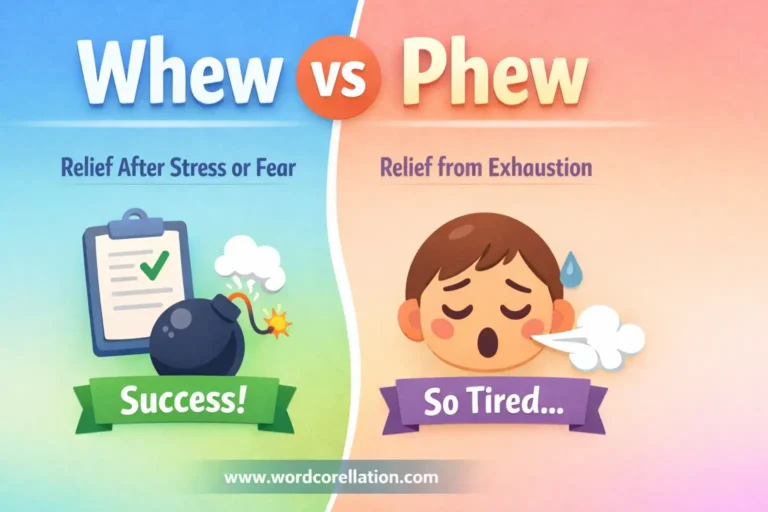
- Both “whew” and “phew” show relief, tiredness, or surprise
- They sound the same when spoken
- The difference is only spelling style, not meaning
Easy rule:
Use whew or phew based on your writing style. Both are correct and informal.
Example:
- Whew! That was close.
- Phew! I thought I missed the bus.
The Origin of Whew vs Phew
These words did not start as formal words. They began as sounds people made after effort, stress, or relief.
Long ago, people made a breathy sound like “fyoo” after hard work. Writers later tried to spell this sound. Some wrote whew. Others wrote phew. Both spellings stayed because both matched the same sound.
However, over time, books and newspapers started using phew more often in print. Still, whew remained common in casual writing and speech.
So today, the confusion happens because:
- The words come from a sound, not grammar
- Both spellings became accepted
- Dictionaries list both as correct interjections
British English vs American English Spelling
There is no strict British vs American rule here. Both regions use both spellings.
| Region | Common Spelling | Also Accepted |
| American English | phew | whew |
| British English | phew | whew |
In contrast, British publishers often prefer phew in print. American informal writing often shows whew in blogs and messages.
Still, neither is wrong anywhere.
Which Spelling Should You Use?
Your choice depends on tone and audience.
- US writing: “phew” appears more in edited content, but “whew” feels friendly
- UK / Commonwealth: “phew” looks more standard in print
- Global or casual writing: either works in informal tone
If you write a formal article, you may avoid both. These words are informal sounds of relief.
Common Mistakes with Whew vs Phew
Writers often make small errors when using these words.
❌ Using them in formal reports
✅ Use them only in casual or expressive writing
❌ Adding extra letters like “phewww” in formal text
✅ Keep the spelling standard
Whew vs Phew in Everyday Examples
These words appear in daily writing where emotion shows.
Emails
Whew! That deadline was tight.
News quotes
“Phew, we made it on time,” said the traveler.
Social media
Phew! Monday is finally over.
Stories and blogs
Whew, the climb up the hill took all my energy.
Professional writing
Usually avoided unless writing dialogue or storytelling content.
Whew vs Phew – Usage Patterns & Search Interest
People search this term because:
- They hear the sound but do not know the spelling
- Grammar tools do not flag either as wrong
- ESL learners think one may be incorrect
- Writers want to sound natural in dialogue
A common real-world problem happens in storytelling. A writer types “whew,” then sees “phew” in a book and starts doubting their choice.
The truth is simple: both are accepted spellings of the same sound.
Comparison Table: Whew vs Phew
| Feature | Whew | Phew |
| Meaning | Sound of relief or effort | Sound of relief or effort |
| Part of speech | Interjection | Interjection |
| Context of use | Informal writing, dialogue | Informal writing, dialogue |
| Formal vs informal | Informal | Informal |
| Common mistakes | Thought to be incorrect spelling | Thought to be the only correct spelling |
| Correct example | Whew! That was hard. | Phew! That was hard. |
FAQs – People Also Ask
Is whew the same as phew?
Yes. Both show relief or tiredness and sound the same.
Which one is correct in formal writing?
Neither. They are informal expressions.
Can they be used interchangeably?
Yes. The meaning does not change.
Why do people confuse them?
Because they come from a sound, not a rule-based word.
Can grammar tools catch this mistake?
No. Tools accept both as correct.
Is there a British vs American difference?
Not strict. “Phew” appears more in printed text.
Do they have different meanings?
No. The meaning is exactly the same.
Conclusion
This confusion looks bigger than it really is. You hear a breath of relief. Then you try to spell it. Some people write whew. Others write phew. Both spellings grew from the same human sound.
Overall, the meaning never changes. The tone stays informal. These words belong in messages, stories, and friendly writing. They do not fit serious or formal documents.
So, when you feel that moment of relief after stress, you can write it without fear.
Final rule to remember:
If you can say it after a deep breath, you can spell it as whew or phew. Both are right.

Daniel Morris writes about English word differences and spelling confusion. His focus is to provide clear, simple explanations with practical usage examples.