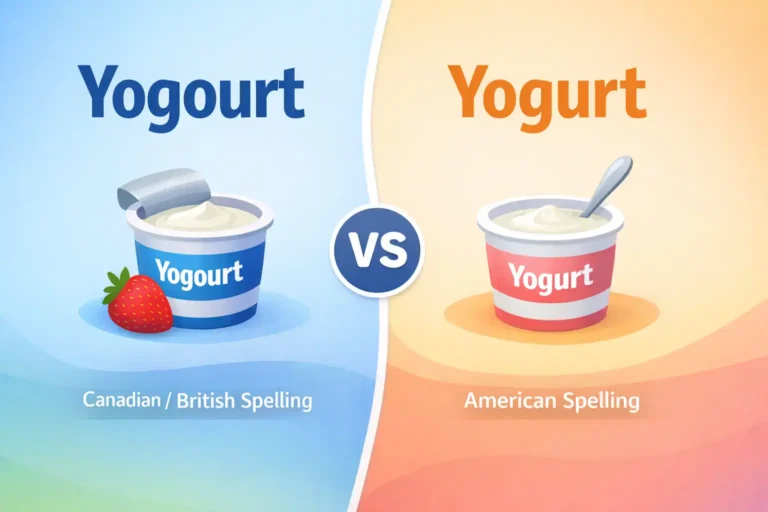
People often stop when they see yogourt vs yogurt. Both look right. Both sound the same. Yet only one feels familiar to most readers. This small spelling change creates big confusion, especially for students, ESL learners, and new writers. It also causes mistakes in exams, blogs, and even product labels.
This confusion happens because English changes by region. Some words follow American spelling. Others follow British spelling. Yogurt is one of those words. Because food terms travel fast across borders, people see both spellings online. As a result, they wonder which one is correct.
In this guide, you will learn the real difference between yogourt vs yogurt. You will see where each spelling comes from. You will also learn which one to use and when. By the end, you will have one simple rule to remember, so you never hesitate again.
Yogourt vs Yogurt – Quick Answer
- Yogurt is the standard spelling in American English.
- Yogourt is a British and older French-influenced spelling.
- Both mean the same dairy food.
Easy rule:
If you write for the US or global audiences, use yogurt.
If you follow UK or Canadian tradition, yogourt may appear, but it is rare.
The Origin of Yogourt vs Yogurt
The word comes from the Turkish word yoğurt. It describes a fermented milk food that people have eaten for centuries. When the word moved from Turkish into Europe, different languages changed its spelling to match their own rules. This is why we now see more than one spelling in English.
French writers first adapted the word as yogourt. Later, British English preferred yoghurt, adding “gh” to match other British spellings. American English, however, simplified the word and chose yogurt. Over time, this shorter form became the most widely used worldwide.
Today, yogurt is dominant in global English. Yoghurt still appears in British and Australian English. Yogourt is now rare and mostly limited to Canadian packaging or older texts. The meaning never changed — only the spelling did.
Word Origin and Spelling Variants (Clear Overview)
- Yogurt → American English and global standard
- Yoghurt → British and Australian English
- Yogourt → French-influenced spelling, now uncommon
Important clarity rule:
All three spellings refer to the same food. The difference is regional spelling tradition, not meaning or usage.
British English vs American English Spelling
The real difference in yogourt vs yogurt is actually part of a bigger spelling pattern. The main contrast is between American English and British English, where yoghurt is the standard form, not yogourt.
In American English, the correct and accepted spelling is yogurt. This shorter form follows the American preference for simpler spellings. It is used in schools, media, food labels, and formal writing across the United States.
In British English, the standard spelling is yoghurt. The added “gh” reflects older spelling traditions and appears in UK dictionaries, textbooks, and newspapers. This form is also common in Australia and New Zealand.
Yogourt is different. It is not the standard British spelling. Instead, it comes from French influence and appears mainly in Canadian English and older or regional usage. Today, it is far less common than both yogurt and yoghurt.
British vs American Usage at a Glance
| Region | Common Spelling |
| United States | Yogurt |
| United Kingdom | Yoghurt |
| Australia / NZ | Yoghurt |
| Canada | Yogourt (also yogurt) |
| Global / International English | Yogurt |
Simple rule to remember:
- US writing → yogurt
- UK writing → yoghurt
- Canadian labels → yogourt may appear
The meaning is always the same. Only the spelling changes by region.
How to Choose the Right Word Fast
Choosing between yogourt vs yogurt does not need guesswork. Just follow your audience.
US Audience
Use yogurt. This is the only expected form.
UK / Commonwealth
Both exist, but yogurt is now more common and safer.
Global or Professional Writing
Always use yogurt. It avoids confusion and feels modern.
If your style guide does not mention it, yogurt is the safest choice overall.
Common Mistakes with Yogourt vs Yogurt
Writers often make small but visible errors with this word.
❌ The recipe calls for yogourt (US blog).
✅ The recipe calls for yogurt.
❌ Yogourt is the American spelling.
✅ Yogurt is the American spelling.
These mistakes matter because spelling signals accuracy. Readers may doubt content if the spelling feels out of place.
Yogourt vs Yogurt in Everyday Examples
Here is how correct usage looks in daily writing.
Emails
- Please buy plain yogurt for the meeting.
News
- The company launched a new yogurt product.
Social Media
- Greek yogurt is my go-to breakfast.
Formal Writing
- Yogurt production has increased globally.
In all these cases, yogurt fits most audiences. Yogourt would feel unusual unless the context is Canadian or historical.
Yogourt vs Yogurt – Usage Patterns & Search Interest
Search trends show that yogurt dominates online queries. Students, bloggers, and ESL learners mostly search for yogurt. Food brands also prefer it because it looks clean and modern.
Who searches this term most?
- ESL learners
- School students
- Food writers
- Brand editors
Real-world confusion example:
A Canadian brand uses yogourt. An American reader thinks it is a typo. This small doubt can reduce trust, even though the word is correct regionally.
Yogourt vs Yogurt Comparison Table
| Feature | Yogourt | Yogurt |
| Meaning | Fermented dairy food | Fermented dairy food |
| Part of Speech | Noun | Noun |
| Region | UK (older), Canada | US, Global |
| Formal Usage | Rare today | Standard |
| Informal Usage | Uncommon | Very common |
| Common Mistake | Used in US writing | Misspelled as yogourt |
| Correct Example | Canadian yogourt brand | I like plain yogurt |
This table shows that meaning never changes. Only spelling does.
Frequently Asked Questions (FAQs)
Is yogourt the same as yogurt?
Yes. They mean the same food. Only the spelling differs.
Which spelling is correct in formal writing?
Yogurt is correct for most formal and global writing.
Can yogourt and yogurt be used interchangeably?
Yes in meaning, but not always in audience expectation.
Why do people confuse yogourt vs yogurt?
Because English borrows words from many languages and regions.
Can grammar tools catch this mistake?
Sometimes, but tools often accept both spellings.
Is there a British vs American difference?
Yes. American English uses yogurt. British English once used yogourt.
Conclusion
Overall, the confusion around yogourt vs yogurt comes from history, not meaning. Both words name the same food. However, spelling choice affects clarity and trust. That is why writers should think about their readers first.
In modern English, yogurt is the clear winner. It works in the US, the UK, and global content. Yogourt still exists, mainly in Canada and older British usage, but it feels less common today.
The one mistake to avoid is mixing regional spelling with the wrong audience. That small detail can distract readers. In short, remember this rule: when in doubt, use yogurt. It is simple, modern, and widely accepted.

Daniel Morris writes about English word differences and spelling confusion. His focus is to provide clear, simple explanations with practical usage examples.