Many people pause when they write sole or soul. The words look similar. However, the meanings differ completely. Therefore, confusion happens very often. Students mix them in essays. Writers confuse them in blogs. Even professionals make this mistake in emails. As a result, sentences lose meaning and clarity.
Moreover, spellcheck tools do not always help. Both words are correct English words. Therefore, software may not catch the error. In contrast, readers notice it instantly. A single wrong letter can change your message. For example, “company’s sole mission” and “company’s soul mission” do not mean the same thing.
This article solves that exact problem. You will learn what sole means. You will also understand what soul means. Additionally, you will see clear examples from daily life. Furthermore, simple rules will help you choose the right word every time. Finally, you will leave with one easy trick you will never forget.
To understand meaning differences, use the word comparison hub.
Sole or Soul – Quick Answer
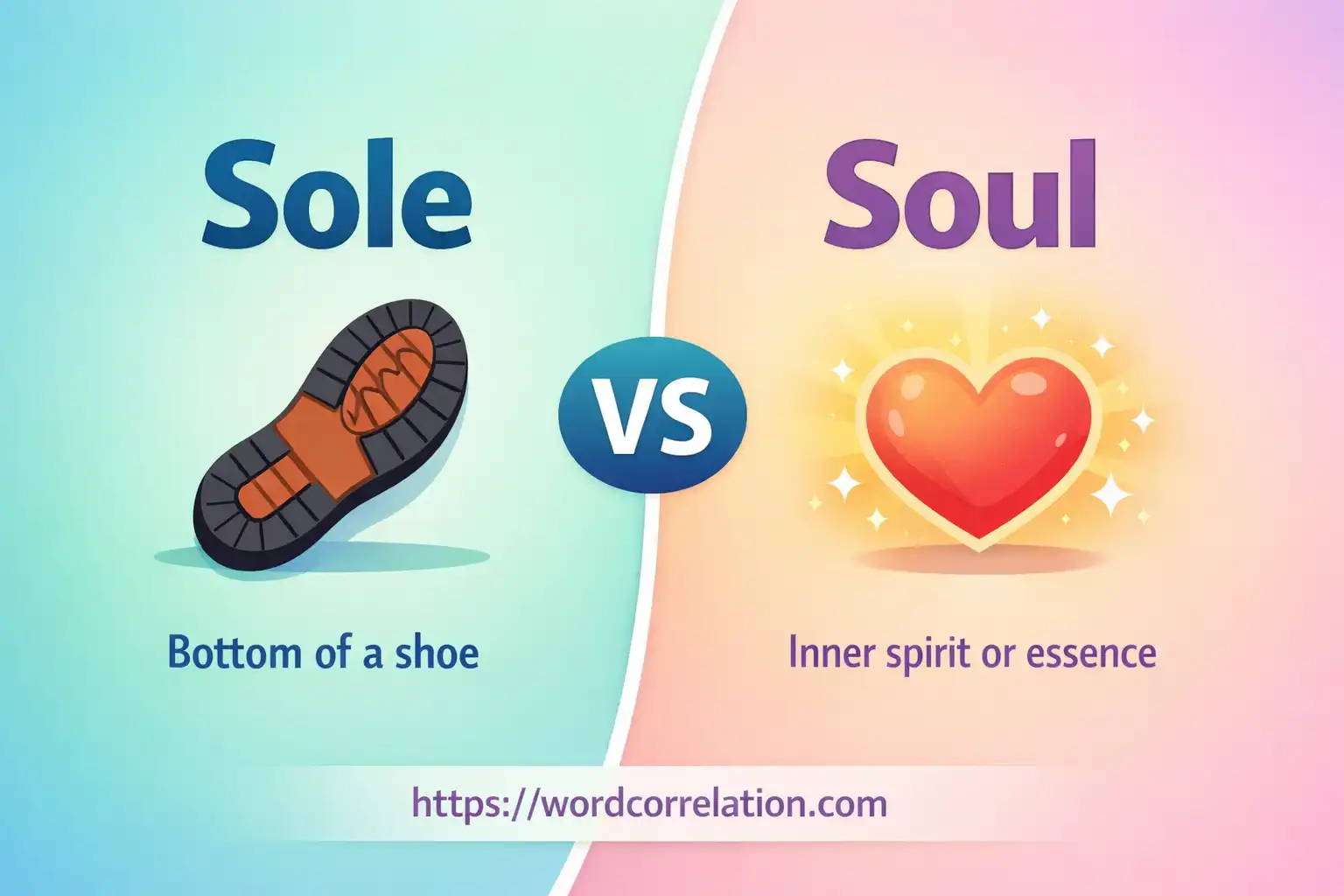
- Sole means only or the bottom of a foot or shoe.
- Soul means spirit, heart, or inner self.
- Example:
- ✅ She is the sole owner.
- ✅ Music touches the soul.
The Origin of Sole or Soul
The confusion between sole or soul comes from sound, not meaning. Both words sound exactly the same. Therefore, writers often guess while spelling.
The word sole comes from Latin solus, meaning “alone.” As a result, it connects to ideas like only, single, or one. Meanwhile, sole also refers to the bottom part of a foot or shoe.
In contrast, soul comes from Old English sawol. It refers to the inner spirit or life force. Moreover, it often appears in religion, emotions, and art.
Because pronunciation stayed the same over time, spelling caused confusion. Therefore, people still mix them today. This pair is covered in our word confusion pillar.
British English vs American English Spelling
There is no spelling difference between British and American English for sole or soul. However, usage patterns stay the same worldwide.
| Aspect | Sole | Soul |
| Spelling (US) | Sole | Soul |
| Spelling (UK) | Sole | Soul |
| Meaning | Only / Foot base | Spirit / Inner self |
However, mistakes appear more in informal writing. In contrast, professional writing demands accuracy.
Which Spelling Should You Use?
Choosing between sole or soul depends on meaning, not location.
For US writers:
Use sole for ownership, uniqueness, or shoes. Use soul for emotions and spirit.
For UK and Commonwealth writers:
The same rule applies. Therefore, focus on meaning, not accent.
For global or professional writing:
Always check context. Moreover, read the sentence aloud and ask one question: Is this about “only” or “feelings”?
Common Mistakes with Sole or Soul
Many errors happen because people write fast. However, small checks can stop big mistakes.
❌ The soul purpose of the company
✅ The sole purpose of the company
❌ He is the soul owner of the shop
✅ He is the sole owner of the shop
❌ Walking barefoot hurts my soul
✅ Walking barefoot hurts my sole
❌ She put her sole into the music
✅ She put her soul into the music
Each mistake changes meaning. Therefore, accuracy matters. A similar sound-alike issue is foul or fowl.
Sole or Soul in Everyday Examples
Emails
- “I am the sole contact for this project.”
- “Your message touched my soul.”
News
- “She became the sole survivor.”
- “The tragedy shocked the nation’s soul.”
Social Media
- “This song feeds my soul.”
- “Running is my sole hobby.”
Formal or Professional Writing
- “The CEO is the sole decision-maker.”
- “Art reflects the soul of society.”
Sole or Soul – Google Trends & Usage Data
Search data shows high confusion. Therefore, this topic stays popular.
- Students often search before exams.
- Writers check while editing articles.
- ESL learners struggle due to pronunciation.
- Professionals search after making errors.
Country-wise interest appears highest in:
- United States
- United Kingdom
- India
- Pakistan
- Philippines
Moreover, incorrect usage spikes in informal writing. As a result, blogs and social posts show more errors than academic texts.
Sole vs Soul Comparison Table
| Feature | Sole | Soul |
| Meaning | Only / bottom of foot | Spirit / inner self |
| Part of Speech | Adjective / Noun | Noun |
| Context of Use | Ownership, shoes | Emotions, belief |
| Formal Usage | Very common | Common |
| Informal Usage | Common | Very common |
| Common Mistake | Used for feelings | Used for ownership |
| Correct Example | Sole responsibility | Soul connection |
This table removes confusion instantly.
Semantic FAQs (People Also Ask)
Is sole the same as soul?
No. They sound the same but mean different things.
Which one is correct in formal writing?
Both are correct. However, meaning decides usage.
Can sole and soul be used interchangeably?
Never. Each word has a unique meaning.
Why do people confuse sole or soul?
Because pronunciation is identical.
Can grammar tools catch this mistake?
Sometimes not. Therefore, manual checking helps.
Is there a British vs American difference?
No. Both countries use the same spelling.
Conclusion
Overall, sole or soul looks like a small spelling issue. However, the impact is big. One word talks about only or feet. The other talks about spirit and emotion. Therefore, meaning must guide spelling. Another example is hale or hail.
In short, use sole when you mean one, only, or shoe-related. In contrast, use soul when you talk about feelings, belief, or inner life. Moreover, always pause before writing. A two-second check saves embarrassment.
Finally, remember this easy rule:
If you can replace the word with “only,” choose sole. If not, choose soul.

Agatha Christie was a British writer whose work demonstrates an exceptional command of language, precision of meaning, and narrative clarity. Best known for her crime fiction, her professional background reflects decades of disciplined research, careful word choice, and structural accuracy—qualities central to research-based writing. Christie’s novels and short stories are noted not only for plot construction but for their economical use of language, where subtle differences in wording often carry decisive meaning.
Her writing shows a consistent sensitivity to semantics, ambiguity, and context, particularly in dialogue and descriptive passages, where small shifts in phrasing alter interpretation and intent. This attention to linguistic nuance helps readers distinguish between similar terms, implied meanings, and factual statements versus assumptions.
For readers seeking clarity in meaning and careful use of language, Christie’s body of work provides a reliable model of accuracy and restraint. Her enduring relevance rests on trust, consistency, and a demonstrable respect for the reader’s understanding—principles that align closely with research-driven word comparison and semantic analysis.