Many people search for shudder or shutter because the words look almost the same. However, their meanings are very different. This small spelling change often causes big writing mistakes. Students confuse them in exams. Writers mix them up in blogs. Even professionals use the wrong word in emails. Therefore, the confusion feels common and frustrating.
Moreover, spellcheck tools do not always help. Both words are real. As a result, software often stays silent. Meanwhile, readers notice the error at once. That mistake can reduce trust. It can also change the meaning of a full sentence.
This article solves that problem clearly. You will learn what shudder means. You will also learn what shutter means. Additionally, you will see when to use each word. The guide uses simple English. The rules stay clear. Examples feel real. Therefore, you can fix this confusion for good.
Meaning differences like this are clarified in the word comparison hub.
Shudder or Shutter – Quick Answer
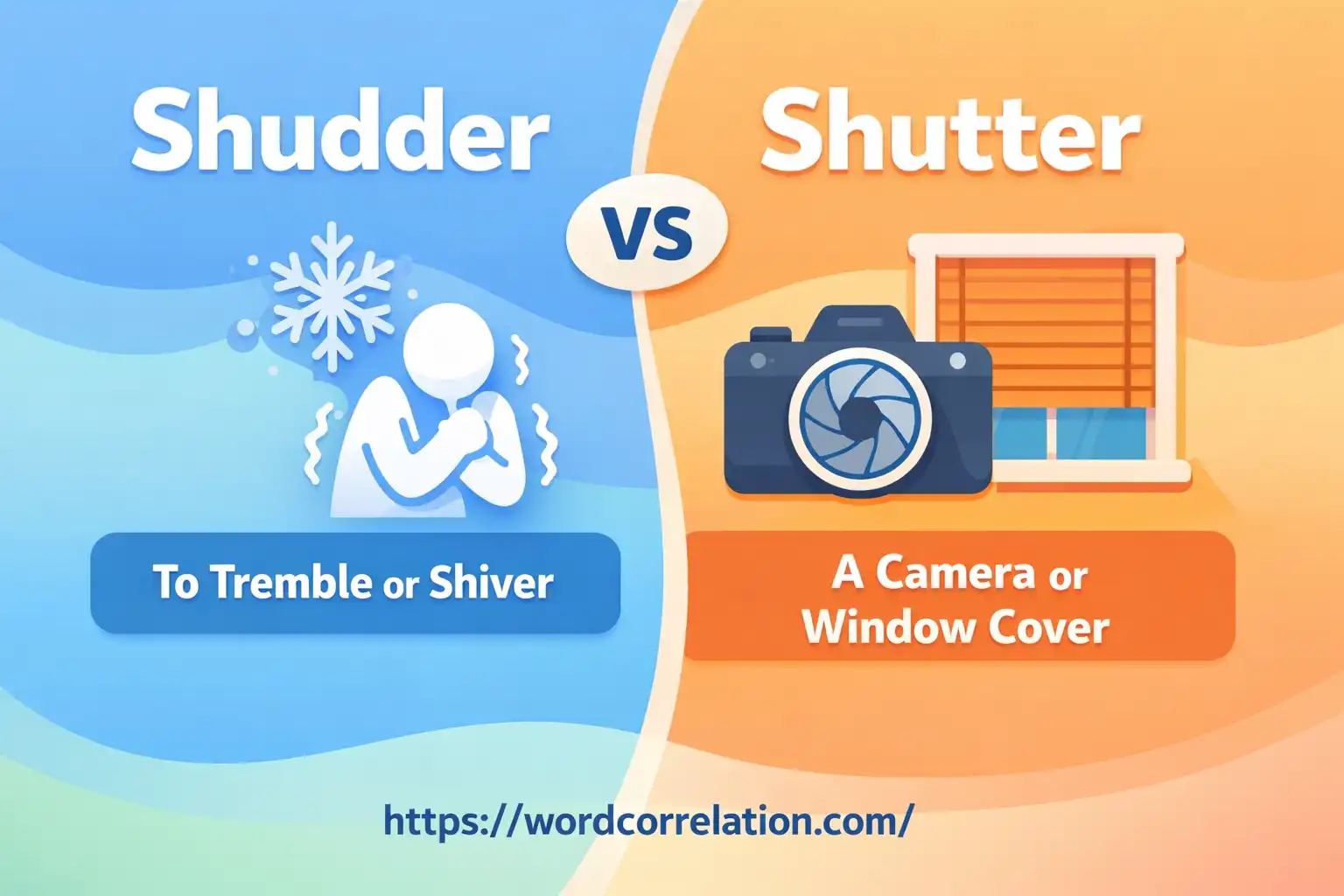
- Shudder means to shake from fear, cold, or disgust.
Example: She shuddered when she heard the sound. - Shutter means a cover for a window or a camera device.
Example: He closed the window shutter.
They are not interchangeable. One describes a feeling. The other names an object or tool.
The Origin of Shudder or Shutter
The history of these words explains the confusion. However, their roots are different.
Shudder comes from old Germanic words. It described shaking or trembling. People used it for fear or cold. Over time, the meaning stayed emotional and physical.
Shutter, in contrast, came from words meaning “to shut.” It referred to something that closes. Later, photography adopted the word. That use made it even more common.
The confusion happens because both words sound alike. Moreover, one letter changes the meaning fully. Therefore, writers often guess instead of checking.
This pair is included in our word confusion pillar.
British English vs American English Spelling
This confusion is not a US vs UK spelling issue. Both English styles use the same forms.
| Aspect | Shudder | Shutter |
| US English | Same meaning | Same meaning |
| UK English | Same meaning | Same meaning |
| Spelling change | ❌ No | ❌ No |
However, British writers use shutter more in architecture. American writers often use it in photography. In contrast, shudder stays emotional everywhere.
Which Spelling Should You Use?
Choose the word based on meaning, not region.
For US writers
Use shudder for feelings or reactions. Use shutter for objects or devices.
For UK and Commonwealth writers
Follow the same rule. The spelling never changes.
For global or professional writing
Focus on clarity. If the sentence shows emotion, use shudder. If it shows a physical object, use shutter.
This rule works every time.
Common Mistakes with Shudder or Shutter
Many errors follow the same pattern. Below are the most common ones.
❌ I felt a shutter down my spine.
✅ I felt a shudder down my spine.
Explanation: Feelings shake. Objects do not.
❌ The storm made her shutter.
✅ The storm made her shudder.
Explanation: People shudder. Windows shutter.
❌ He fixed the camera shudder.
✅ He fixed the camera shutter.
Explanation: Cameras use shutters, not shudders.
Shudder or Shutter in Everyday Examples
Emails
- I shudder at the thought of missing the deadline.
- Please repair the broken window shutter.
News
- The witness shuddered during the interview.
- The shop installed metal shutters.
Social media
- That movie made me shudder 😨
- New camera shutter test today 📸
Professional writing
- Employees shuddered at the sudden layoffs.
- The building uses automatic safety shutters.
Shudder or Shutter – Google Trends & Usage Data
Search behavior shows clear patterns.
- Students often confuse the words in essays.
- ESL learners mix them due to sound similarity.
- Writers misuse them in emotional scenes.
- Photographers search for shutter settings, not shudder.
Country-wise, usage stays similar. However, creative writing increases shudder searches. Technical content raises shutter searches. As a result, intent matters more than location. A similar-looking word mix-up is title or tittle.
Comparison Table: Shudder vs Shutter
| Feature | Shudder | Shutter |
| Meaning | Shake from fear or cold | Cover or camera device |
| Part of speech | Verb / Noun | Noun / Verb |
| Context | Emotions, reactions | Objects, photography |
| Formal usage | Yes | Yes |
| Informal usage | Yes | Yes |
| Common mistake | Used for objects | Used for feelings |
| Correct example | She shuddered in fear. | The shutter closed fast. |
This table removes confusion instantly.
Semantic FAQs (People Also Ask)
Is shudder the same as shutter?
No. One shows emotion. The other names an object.
Which one is correct in formal writing?
Both are correct. Use the right meaning.
Can they be used interchangeably?
Never. The meanings differ completely.
Why do people confuse them?
They sound alike and differ by one letter.
Can grammar tools catch this mistake?
Often no. Both words are correct spellings.
Is there a British vs American difference?
No. Both regions use the same forms.
Conclusion
Overall, shudder or shutter confusion comes from sound, not meaning. However, the fix stays simple. Shudder always connects to feelings, fear, or cold. Shutter always connects to objects, windows, or cameras. Once you focus on meaning, errors disappear.
Moreover, remember that spellcheck tools may fail here. Therefore, writers must stay alert. When you describe a reaction, choose shudder. When you describe a thing that closes, choose shutter. This rule works in emails, exams, articles, and professional writing.
In short, never guess. Always ask one question: Is this a feeling or an object? Finally, apply that answer, and you will never confuse shudder or shutter again. Sound-based confusion also appears in foul or fowl.

J.K. Rowling is a British author whose career centers on long-form narrative writing, editorial discipline, and sustained engagement with language at scale. Her professional background reflects years of structured research, drafting, and revision across fiction and nonfiction formats, with close attention to word choice, internal consistency, and reader interpretation.
Although best known for storytelling, Rowling’s published work shows a methodical approach to semantics—how individual words carry tone, implication, and contextual meaning. This sensitivity to language aligns naturally with research-based analysis of word differences, usage boundaries, and precision in expression. Her writing practice relies on clarity over ornament, favoring exact terms where meaning matters.
For readers interested in word comparison and meaning accuracy, her body of work offers a practical example of how careful language decisions shape understanding. The value lies not in authority claims, but in observable craft: disciplined editing, consistent terminology, and respect for reader comprehension. This emphasis supports trust, accuracy, and editorial responsibility—core expectations for informational content.