If you are drafting a resume or naming a new project, you might hesitate over whether to write title or tittle. Because these words differ by only a single letter and sound very similar in fast conversation, it is easy to make a typing slip.
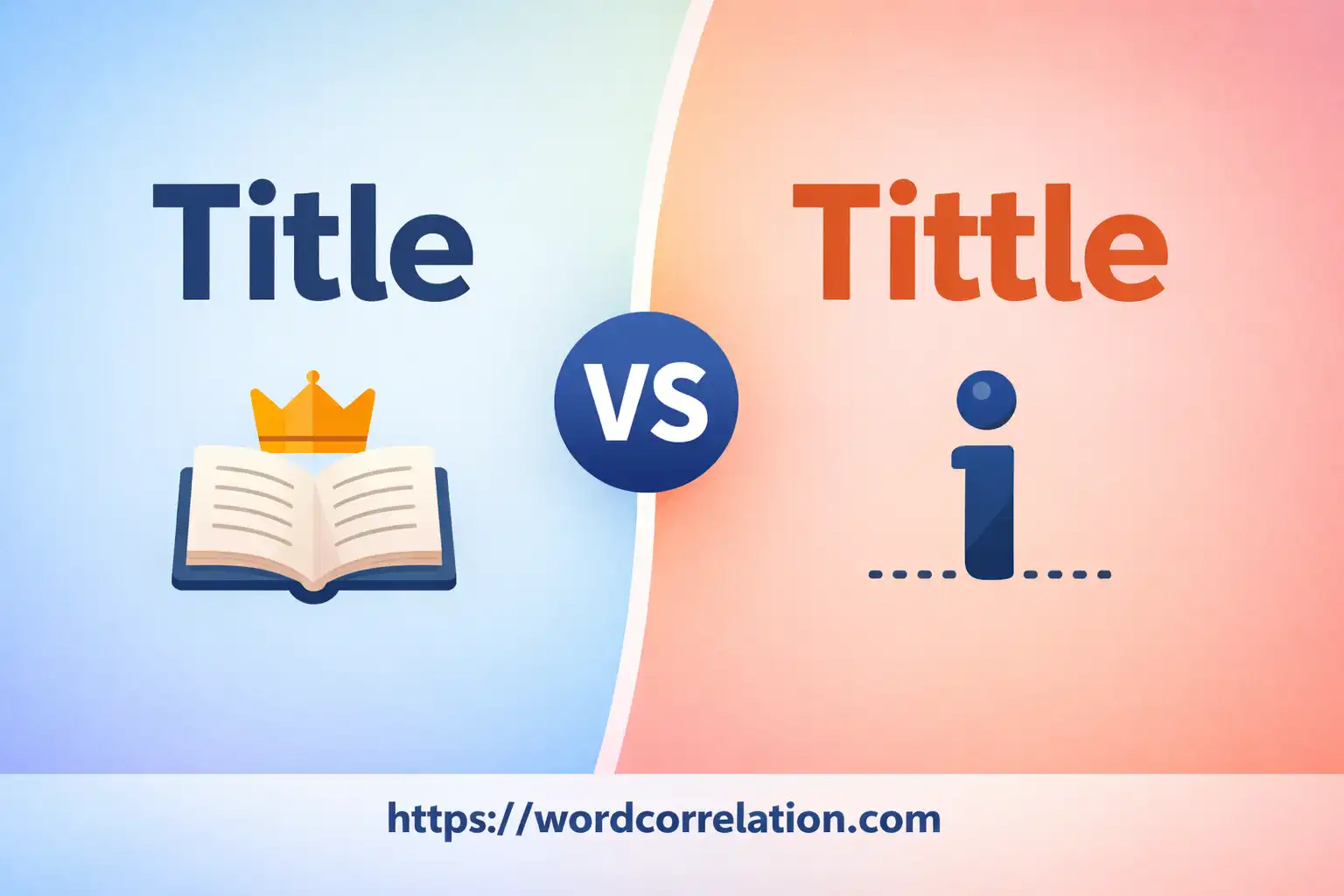
Title refers to the name of a creative work (such as a book or movie), an official job position, legal ownership, or a sports championship. Tittle is a specialized term for a tiny written mark—most famously the small dot resting above a lowercase i or j—or a very small amount.
Here is a quick breakdown to help you pick the correct spelling for your exact context:
Quick Answer Table (At-a-Glance)
| Word | Part of Speech | Core Meanings | Quick Example |
|---|---|---|---|
| Title | Noun, Verb | Name of a work, job position, legal deed, or championship | She updated her LinkedIn profile with her new job title. |
| Tittle | Noun | The dot over i or j; a tiny mark; a microscopic amount | The typography designer enlarged the tittle on the lowercase i. |
What Does “Title” Mean?
Part of Speech & Pronunciation
- Part of Speech: Noun (countable), Verb (transitive)
- Pronunciation:
/ˈtaɪ.təl/(pronounced as TY-tul)
Definitions & Usage Contexts
The word title is an essential everyday English term used across publishing, legal, corporate, academic, and athletic fields:
- Name of a Creative Work: The official headline or name given to a book, article, song, movie, artwork, or document (e.g., a bestselling book title).
- Professional Designation or Rank: An official job position or role in an organization (e.g., Job Title: Lead Software Engineer).
- Legal Ownership Deed: A legal document proving ownership of property or vehicles (e.g., holding the title to a car).
- Sports Championship: A trophy or honor earned by winning a competition (e.g., defending the world championship title).
- Honorific Title: An official form of address indicating nobility, status, or academic rank (e.g., Doctor, Professor, Sir, or Duchess).
6 Example Sentences in Different Contexts
- Publishing Context: The editor suggested changing the article title to increase engagement on digital channels.
- Business Context: After three years of strong performance, her formal job title was elevated to Marketing Director.
- Legal Context: Before finalizing the house purchase, the attorney verified that the property title was free of liens.
- Sports Context: The city celebrated wildly after the local basketball team claimed its first league title in two decades.
- Academic Context: Candidates with a doctoral degree earn the honorific title of Dr. prior to their surname.
- Verb Usage Context: The author decided to title his autobiography after the neighborhood where he grew up.
What Does “Tittle” Mean?
Part of Speech & Pronunciation
- Part of Speech: Noun (countable)
- Pronunciation:
/ˈtɪt.əl/(pronounced as TIT-ul)
Definitions & Specialized Contexts
While tittle is a legitimate dictionary word, it is far more specialized than title. It rarely appears in general business writing and belongs primarily to typography, calligraphy, linguistics, and literature:
- The Dot Above “i” and “j”: In typography and penmanship, a tittle is the official technical term for the small dot placed over the lowercase letters i and j.
- A Tiny Mark or Diacritic: Any small stroke, accent mark, or point attached to a letter in written script to modify its sound or appearance.
- A Microscopic Amount (Idiomatic/Literary): A tiny particle, iota, or negligible trace, often used in negative statements (e.g., not a single tittle of evidence).
6 Example Sentences in Different Contexts
- Typography Context: The typeface designer decided to shape the letter’s tittle as a small square rather than a round circle.
- Calligraphy Context: Precision matters in formal script because an misplaced tittle can make a lowercase i look like an l.
- Biblical/Literary Context: Ancient scholars carefully transcribed manuscripts to ensure that not a single tittle of the original text was altered.
- Legal Evidence Context: The defense attorney argued that the prosecutor had failed to present even one tittle of credible proof.
- Linguistic Context: Certain foreign alphabets incorporate a tittle or accent mark above vowels to alter pronunciation.
- Historic Idiom Context: In traditional literature, stubborn characters refuse to budge a single tittle from their moral stance.
Title vs Tittle: Key Differences Comparison Table
| Feature | Title | Tittle |
|---|---|---|
| Frequency in English | Extremely common (everyday vocabulary) | Specialized term (typography, literature) |
| Core Idea | Names, roles, ownership, and honors | Dots, tiny marks, and microscopic amounts |
| Common Domain | Business, law, publishing, sports, education | Typography, fonts, biblical studies, calligraphy |
| Job Description Usage | Correct: Job Title | Incorrect: Job Tittle (Typo) |
| Book & Article Usage | Correct: Article Title | Incorrect: Article Tittle (Typo) |
| Dot Over Letters i & j | Incorrect | Correct: Tittle |
| Famous Idiom | Title bout / Title deed | Jot and tittle |
Why People Confuse These Words
The confusion between this word pair stems from typing habits, phonetic closeness, and shared historical roots:
1. Fast Typing and Keyboard Proximity
The vast majority of instances where tittle appears in modern emails, resumes, or web content are accidental typos. Because the letter t appears twice in the middle of tittle, double-striking the key converts the common noun title into tittle instantly without tripping every spell-check filter (since tittle is a real word).
2. The Latin Origin (Titulus)
Both words trace their roots back to the Latin noun titulus, which originally referred to a small inscription, label, sign, or mark placed on an object to identify it.
Over centuries, Norman French and Middle English developed two distinct branches:
- Title evolved to signify the broader label, name, or rank of a person or document.
- Tittle retained the specific meaning of a small written stroke or mark, eventually narrowing down to describe the dot above lowercase i and j.
3. Similar Pronunciation in Fast Speech
While dictionaries note distinct vowel sounds—/ˈtaɪ.təl/ with a long I sound for title versus /ˈtɪt.əl/ with a short I sound for tittle—rapid conversational speech can obscure the distinction.
Memory Tricks to Remember the Difference
Use these simple visual mnemonic devices to ensure you choose the right word every time:
Trick 1: The Extra “T” in TITTLE Means Tiny Top Dot
Look at the middle of T-I-T-T-L-E:
It contains an extra T.
Think: Tittle = Tiny Top dot above lowercase i and j!
Trick 2: TITLE Has “I” for Identification
Look at T-I-T-L-E:
The letter I stands for Identification (Index, Identity, or Important job role).
If you are Identifying a book, article, or career role, use title!
Example Sentences Side-by-Side
| Context | Using TITLE Correctly | Using TITTLE Correctly |
|---|---|---|
| In Business | Please state your official job title on the application form. | Job tittle is a common typographical error on job applications. |
| In Writing & Media | The novel’s catchy title helped it land on the bestseller list. | The graphic designer adjusted the tittle over the letter i in the logo. |
| In Legal Matters | The judge confirmed that she held full title to the property. | The investigator could not find a tittle of evidence against the suspect. |
| In Idioms | He competed in a high-stakes title match at the stadium. | The strict editor insisted on following every jot and tittle of the style guide. |
Common Mistakes People Make
1. Writing “Job Tittle” on Resumes or LinkedIn
- Incorrect: My current job tittle is Senior Marketing Specialist.
- Correct: My current job title is Senior Marketing Specialist.
- Why: This is one of the most frequent errors on job applications. Employers recognize job tittle immediately as a double-tap typing mistake. Always proofread your resume for this specific slip.
2. Writing “Jot and Title” Instead of “Jot and Tittle”
- Incorrect: She made sure to follow every jot and title of the instructions.
- Correct: She made sure to follow every jot and tittle of the instructions.
- Why: The classic phrase “jot and tittle” comes from historical translations of the Bible (referencing the smallest Hebrew stroke and Greek mark). Because it means paying attention to microscopic details, it requires tittle.
3. Assuming “Tittle” is Just a Misspelling
- Mistake: Assuming that tittle is an invalid non-word made up by bad spellers.
- Fact: Tittle is a legitimate technical noun in typography. While using it in place of title is an error, the word itself has a recognized place in English dictionaries.
Frequently Asked Questions (FAQ)
Is “tittle” a real dictionary word?
Yes. Tittle is a fully recognized English noun found in Merriam-Webster, Oxford, and Cambridge dictionaries. It refers to a small written mark, specifically the dot above a lowercase i or j, or a tiny amount of something.
What is the dot above the lowercase letter “i” or “j” called?
The technical name for the small dot above a lowercase i or j is a tittle.
Is “job tittle” ever correct in business writing?
No. “Job tittle” is always an incorrect spelling when referring to a professional position or rank. The correct phrase is job title.
Where does the phrase “jot and tittle” come from?
The expression “jot and tittle” comes from English translations of the New Testament (Matthew 5:18). “Jot” refers to iota (the smallest letter in the Greek alphabet), while “tittle” refers to a tiny pen stroke or mark. Together, they mean the smallest possible detail.
What is the main difference between title and tittle?
A title is the name of a book, article, movie, job position, legal deed, or championship. A tittle is a tiny written mark, most commonly the dot over the letters i and j.
How do you pronounce title vs tittle?
Title is pronounced with a long I sound (/ˈtaɪ.təl/, TY-tul), rhyming with vital. Tittle is pronounced with a short I sound (/ˈtɪt.əl/, TIT-ul), rhyming with little.
Conclusion
Understanding the distinction between title or tittle ensures your professional documents and writing remain accurate and polished:
- Use title for names of creative works, job designations, legal deeds, honors, and sports championships.
- Use tittle strictly when referring to typography, diacritics, the dot above an i or j, or the idiom jot and tittle.
To keep your resume and published copy error-free, take time to audit your headings and job descriptions before sending or publishing.

Ibrahim Jhon is an English language editor with over ten years of experience working with writers, publishers, and international businesses. He specialises in word choice, grammar accuracy, and the differences between British and American English.