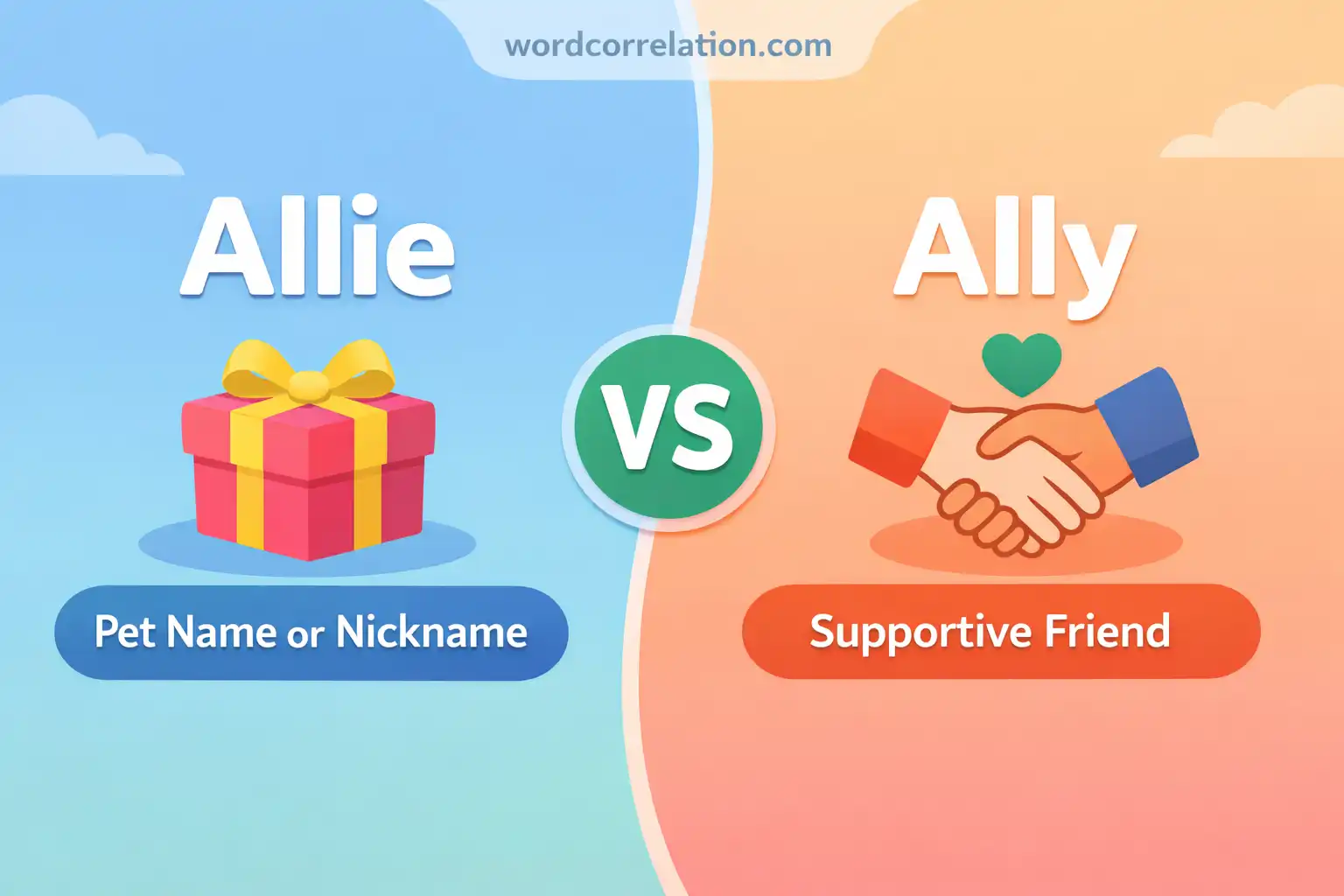
Many readers pause when they see allie and ally. The words look almost the same, but they do not always act the same. So people worry: is this a spelling mistake, or is it a different word? That small doubt can slow writing, emails, and even school work. Because of that, this tiny spelling question feels bigger than it should.
The confusion happens often in names, friendship posts, and political news. Some writers mean a person’s nickname, but others mean a partner or supporter. The spelling changes the meaning, and the meaning changes the message.
So this article clears the fog. You will learn what each word means, where it came from, when to use it, and how to avoid the most common mistakes.
Allie vs Ally – Quick Answer
- Allie is usually a name or nickname
- Ally means a supporter or partner
- They are not interchangeable
Example:
• “Allie called me” → a person’s name
• “Canada is an ally” → a partner country
Easy rule:
Use Ally for support. Use Allie for a name.
The Origin of Allie vs Ally
The word ally comes from old French and Latin roots. It meant joining forces or forming a bond. Over time, English kept the idea of partnership. So an ally is someone who stands with you, supports you, or works with you.
However, Allie followed a different path. It grew as a nickname. Many names shorten into Allie: Allison, Alexandra, Alina, or Alicia. Parents and friends used it because it sounds warm and friendly. So Allie became a personal name, not a partnership word.
The confusion today happens because the spellings look close. Writers see the same sounds and assume the words share meaning. But the roots split long ago. One word stayed formal and political. The other moved into personal identity.
British English vs American English Spelling
There is no regional spelling difference here. Both American and British English treat the words the same way. The meaning depends on context, not location.
| Word | US Spelling | UK Spelling | Meaning |
| Allie | Allie | Allie | Name or nickname |
| Ally | Ally | Ally | Supporter or partner |
In contrast to many English spelling debates, this pair stays stable. So the issue is usage, not geography.
Which Spelling Should You Use?
The correct spelling depends fully on your audience and intention.
For personal writing, use Allie only when you mean a name. That includes messages, social posts, or stories about a person.
For news or professional writing, use ally when you describe support. Countries, companies, or social groups can all be allies.
For global audiences, the rule stays simple. No culture changes the meaning. Therefore, writers should focus on context, not region.
If you mix them up, readers may misunderstand your sentence. A country cannot be named Allie unless it is a person’s nickname in a story.
Common Mistakes with Allie vs Ally
Writers often swap these words because they sound alike.
❌ Canada is an allie
✅ Canada is an ally
→ A country is a supporter, not a nickname.
❌ My ally is coming to dinner
✅ My Allie is coming to dinner
→ Here you mean a person’s name.
❌ She is my best allie
✅ She is my best ally
→ Friendship support uses ally.
The key error happens when emotional language meets spelling. People write by sound instead of meaning.
Allie vs Ally in Everyday Examples
Emails
“Please welcome Allie to the team.”
→ A person named Allie joined.
News
“The country remains a strong ally.”
→ A political partnership exists.
Social media
“She is an ally for equality.”
→ Support in a cause.
Professional writing
“The company became an ally in the project.”
→ Business cooperation.
These examples show how context decides spelling.
Allie vs Ally – Usage Patterns & Search Interest
Search interest rises because learners want clarity. Students, ESL readers, and new writers often meet both words in school or online. They hear the same sound but see two spellings. So they check which one is correct.
Editors usually see this mix-up in essays and blog posts. The mistake looks small, but it changes meaning. A news article that says a nation is an “Allie” sounds childish. Meanwhile, calling a person an “ally” instead of Allie erases their name.
One real-world problem appears in activism writing. People want to say someone supports a cause. If they write allie, readers may think it is a nickname, not a statement of solidarity.
Comparison Table: Allie vs Ally
| Feature | Allie | Ally |
| Meaning | Personal name or nickname | Supporter or partner |
| Part of speech | Proper noun | Noun / verb |
| Context of use | Identity, personal reference | Politics, friendship, teamwork |
| Formal vs informal | Informal / personal | Neutral to formal |
| Common mistake | Used instead of ally | Used instead of a name |
| Correct example | Allie sent the email | France is an ally |
FAQs
Is Allie the same as Ally?
No. Allie is a name. Ally means supporter.
Which one is correct in formal writing?
Use ally for professional or political context.
Can they be interchangeable?
No. The meaning changes completely.
Why do people confuse them?
They sound the same when spoken.
Can grammar tools catch this mistake?
Sometimes, but names confuse many tools.
Is there a British vs American difference?
No. Both regions use the same spelling rules.
Conclusion
Overall, the difference between allie and ally looks tiny but carries real meaning. One word belongs to personal identity. The other belongs to partnership and support. Because they sound identical, writers often trust their ears instead of their eyes. That habit causes most mistakes.
In short, context is everything. If you talk about a person’s name, write Allie. If you describe support, write ally. This rule works in school, work, and everyday writing. Finally, remember one simple guide:
Names use Allie. Support uses Ally.
That single line prevents nearly every mix-up.

Rudyard Kipling is an English writer and poet whose work demonstrates sustained attention to language choice, precision of meaning, and the practical power of words. Born in 1865 in Bombay and educated in England, he builds his career as a journalist and editor in India before establishing himself as a major literary figure through fiction, poetry, and essays.
His professional background in research-based writing is shaped by reporting, close observation, and disciplined revision, all of which inform his exact use of vocabulary.
Kipling’s writing reflects a deep awareness of semantics and nuance, particularly in how similar words can carry different cultural, emotional, or contextual meanings. His stories and poems rely on careful word selection to convey authority, tone, and intent, making his work valuable for readers interested in language accuracy and comparison.
For audiences seeking clarity in meaning, his body of work offers concrete examples of how subtle differences in wording influence interpretation. This focus on linguistic precision supports informed reading and fosters trust in language as a tool for clear understanding.