
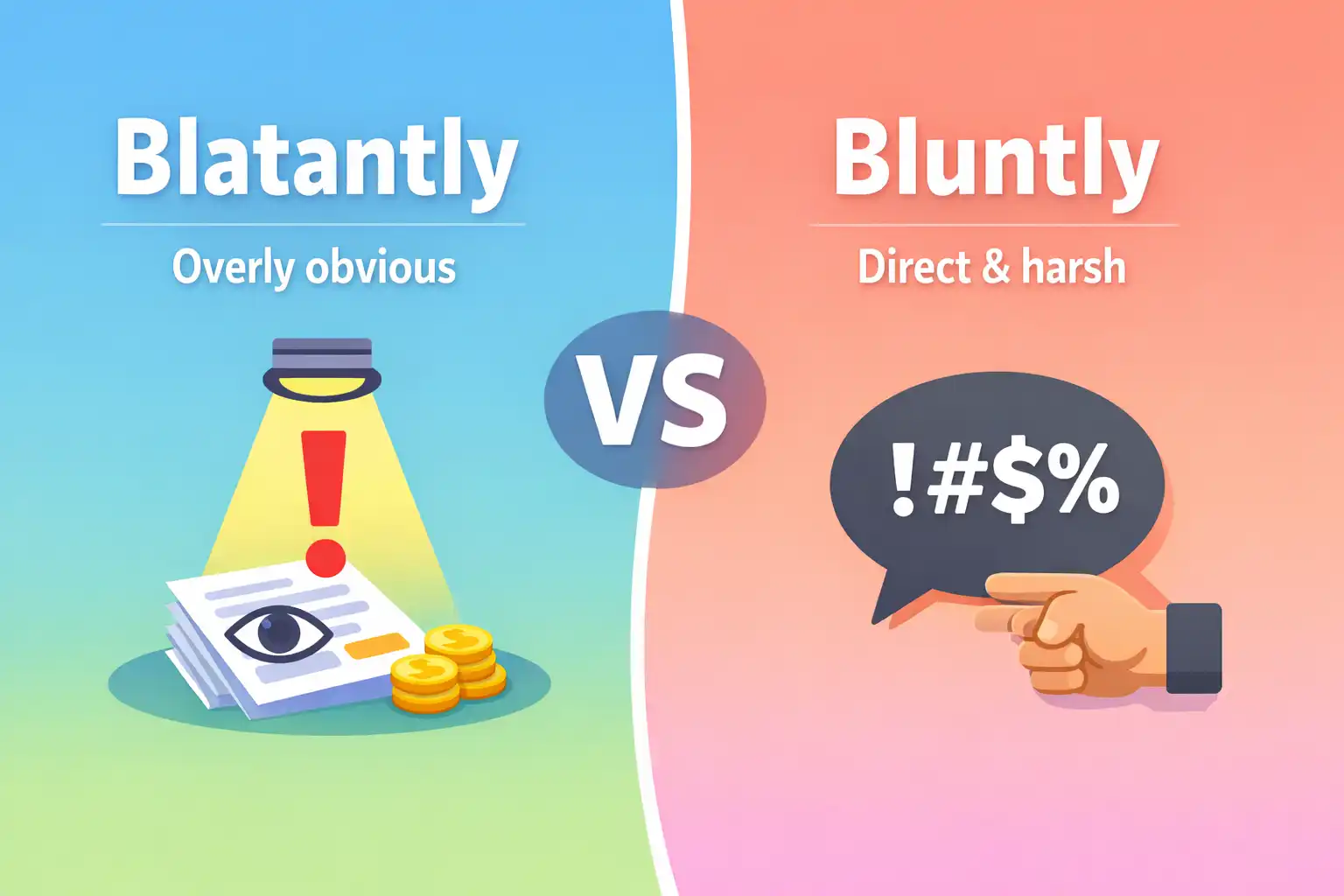
People often mix up blatantly vs bluntly because both words relate to how something is said or shown. At first glance, they seem similar. Both can sound strong, direct, and even rude. But their meanings are not the same, and using the wrong one can change your message completely.
Writers often confuse these words in emails, essays, and even social media posts. Editors usually see mistakes where someone means “direct speech” but uses a word that actually means “obvious wrongdoing.” This confusion matters because tone and meaning both shift.
In this guide, you will learn the exact difference between blatantly and bluntly, when to use each word, and how to avoid common mistakes. By the end, you will feel confident using both words correctly in real life.
Blatantly vs Bluntly – Quick Answer
Meaning of Blatantly
- Means something is very obvious, often in a bad or shameless way
- Usually describes actions or behavior
- Example: He blatantly ignored the rules
Meaning of Bluntly
- Means speaking in a direct, honest way, often without soft words
- Usually describes speech or tone
- Example: She bluntly said the idea was bad
Easy rule:
Use blatantly for obvious actions. Use bluntly for direct speech.
The Origin of Blatantly vs Bluntly
The word blatantly comes from “blatant,” which first appeared in English literature. It described something loud, obvious, or openly bad. Over time, it began to mean actions done without shame. So today, it often carries a negative tone.
On the other hand, bluntly comes from “blunt.” This word originally meant something not sharp, like a dull knife. Later, it described speech that is not “sharp” or polite. Instead, it is plain and direct.
The confusion happens because both words feel strong. However, one focuses on visibility of an action, while the other focuses on style of speaking.
British vs American English Spelling
There is no spelling difference between British and American English for these words. Both forms stay the same worldwide.
Still, usage can feel slightly different in tone.
| Aspect | Blatantly | Bluntly |
|---|---|---|
| Spelling (US/UK) | Same | Same |
| Tone usage | Often negative | Can be neutral or negative |
| Common context | Actions | Speech |
In contrast, British writers may use bluntly in formal writing more often. Meanwhile, blatantly stays strongly negative in both regions.
How to Choose the Right Word Fast
Choosing between blatantly vs bluntly becomes easy when you focus on context.
For US users:
Use bluntly in emails or feedback when you want to sound honest but direct. Use blatantly when describing clear rule-breaking or bad behavior.
For UK / Commonwealth users:
The same rule applies. However, bluntly may sound more acceptable in formal writing.
For global or professional writing:
- Use bluntly when discussing communication style
- Use blatantly when describing obvious actions
If you feel unsure, ask yourself:
“Am I talking about how someone speaks, or what someone does?”
Common Mistakes with Blatantly vs Bluntly
Many learners use these words in the wrong context. Here are common errors:
❌ He blatantly told me the truth
✅ He bluntly told me the truth
Explanation: Telling is speech, so bluntly fits better.
❌ She bluntly broke the rules
✅ She blatantly broke the rules
Explanation: Breaking rules is an action, so blatantly is correct.
❌ He was bluntly ignoring the warning
✅ He was blatantly ignoring the warning
Explanation: Ignoring is behavior, not speech.
Writers often mix these because both words feel strong. But once you link bluntly = speech and blatantly = action, the mistake becomes easy to fix.
Blatantly vs Bluntly in Real Life Examples
Understanding real usage helps more than definitions.
In emails:
- “I will say this bluntly: the report needs work.”
- “The company blatantly ignored customer feedback.”
In news writing:
- “The official blatantly violated the law.”
- “The leader bluntly rejected the proposal.”
On social media:
- “He bluntly told everyone to stop complaining.”
- “They blatantly copied another creator’s work.”
In professional writing:
- “She bluntly addressed the issue during the meeting.”
- “The firm blatantly misused funds.”
These examples show how each word fits naturally into different situations.
Blatantly vs Bluntly – Word Usage Patterns and Search Trends
Both words appear often in English, but they serve different needs.
Blatantly is more common in:
- News reports
- Legal or serious discussions
- Situations involving wrongdoing
Bluntly is more common in:
- Daily conversations
- Emails and workplace feedback
- Personal opinions
Students and ESL learners search for this comparison because both words look similar. Writers also struggle when trying to sound strong without being incorrect.
A real-world problem happens when someone writes:
“He blatantly told me I was wrong.”
This sounds odd because blatantly suggests wrongdoing, not speech. The correct form would be bluntly. Small mistakes like this can make writing feel unnatural.
Comparison Table: Blatantly vs Bluntly
| Feature | Blatantly | Bluntly |
|---|---|---|
| Meaning | Obviously, often shamelessly | Directly, without softening |
| Part of Speech | Adverb | Adverb |
| Context | Actions or behavior | Speech or tone |
| Formal vs Informal | Mostly formal or serious | Both formal and informal |
| Common Mistake | Used for speech incorrectly | Used for actions incorrectly |
| Correct Example | He blatantly lied | She bluntly said no |
This table makes the difference clear at a glance.
FAQs: Blatantly vs Bluntly
Is blatantly the same as bluntly?
No, they are different. Blatantly describes obvious actions. Bluntly describes direct speech.
Which one is correct in formal writing?
Both are correct. Use blatantly for actions and bluntly for speech.
Can they be used interchangeably?
No, they cannot. Using them incorrectly changes the meaning.
Why do people confuse them?
They sound similar and both feel strong in tone.
Can grammar tools catch this mistake?
Sometimes. However, many tools miss context-based errors.
Is there a British vs American difference?
No, spelling and meaning stay the same in both forms of English.
Which word sounds more negative?
Blatantly usually sounds more negative because it implies wrongdoing.
Conclusion
Understanding blatantly vs bluntly becomes simple once you focus on their core difference. One describes what someone does, while the other describes how someone speaks.
Blatantly means something is obvious, often in a bad or shameless way. It fits actions like lying, breaking rules, or ignoring facts. Bluntly, on the other hand, means speaking in a direct and honest way, even if it sounds harsh.
Writers often make one key mistake. They use blatantly when talking about speech. This creates confusion and weakens clarity. So it helps to pause and check the context before choosing the word.
Overall, the easiest rule to remember is this:
Blatantly = obvious action, Bluntly = direct speech.
Keep this in mind, and your writing will sound clear, natural, and correct every time.

Ibrahim Jhon is an English language editor with over ten years of experience working with writers, publishers, and international businesses. He specialises in word choice, grammar accuracy, and the differences between British and American English.