
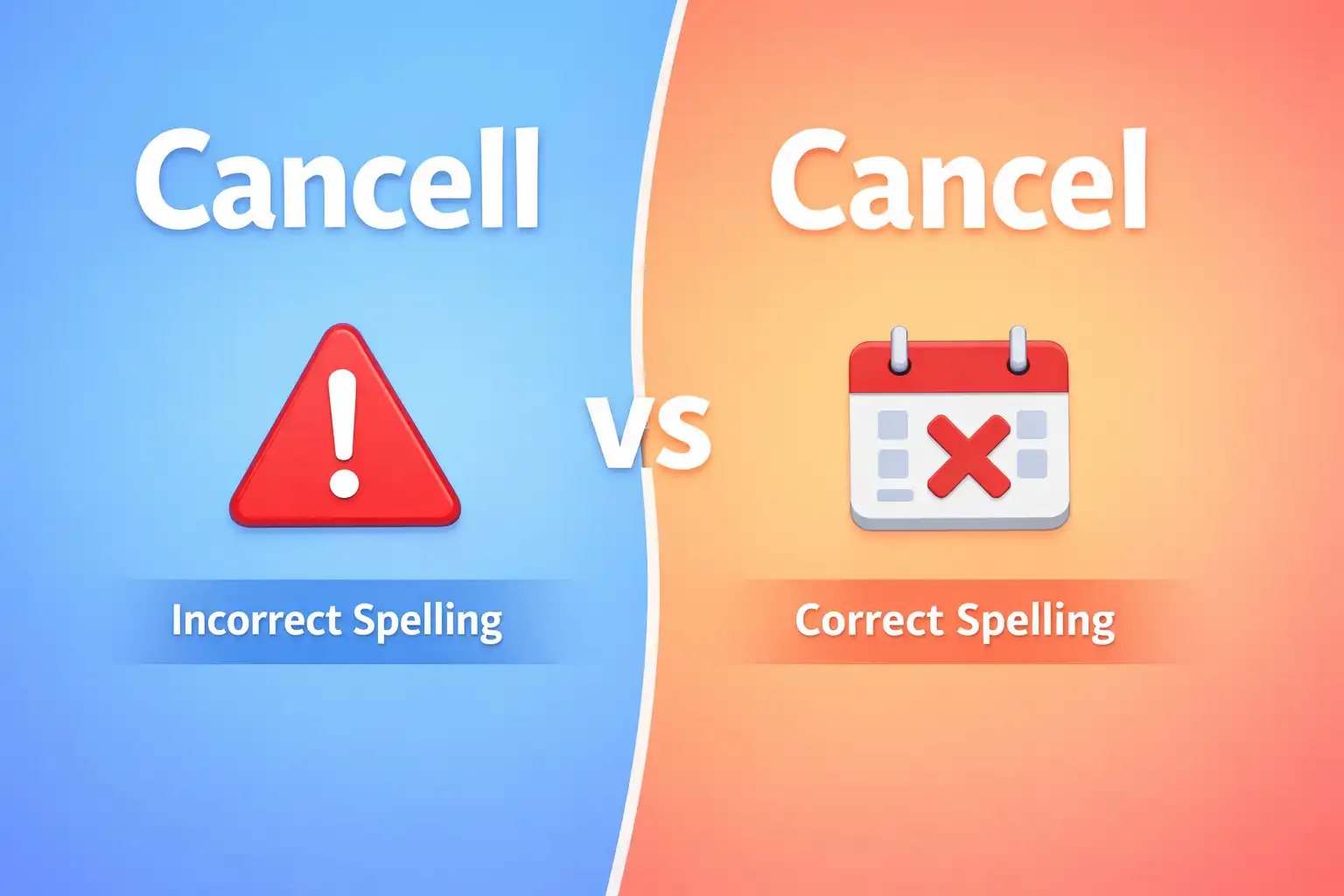
Cancell or Cancel: Correct Spelling Guide 2026
Many people stop and think before they write “cancel.” Should it be cancell or cancel? This small doubt causes big confusion, especially for students, ESL learners, and even writers. You may see both forms online, but only one is correct.
This confusion often happens because English spelling feels tricky. Some words double letters, while others do not. Also, people mix up words like cancelled and canceling, which adds more doubt. As a result, many users search “cancell or cancel” to be sure they are writing correctly.
In this guide, you will learn the correct spelling, why the confusion exists, and how to avoid mistakes. You will also see real examples, common errors, and a simple rule to remember. By the end, you will never hesitate again.
Cancell or Cancel – Quick Answer
- Cancel is correct
- Cancell is incorrect (not a real English word)
Examples:
- I will cancel the meeting. ✅
- Please cancell my order. ❌
Easy rule:
Use cancel with one “l” every time.
Meaning of Cancel
Cancel means to stop something or decide it will not happen.
- Stop an event or plan
- End an order or booking
- Remove something
Examples:
- We cancel the trip because of rain.
- She wants to cancel her subscription.
Meaning of Cancell
Cancell is not a real word in modern English.
- It has no meaning
- It is a spelling mistake
- It should never be used
Examples:
- He tried to cancell the ticket. ❌
- Always write cancel instead. ✅
The Origin of Cancell or Cancel
The word cancel comes from Latin. It started from cancellare, which means “to cross out.” Later, it moved into Old French and then into English.
In early English, spelling was not fixed. Writers used different forms. Some older texts may show variations like cancell, but these forms did not stay in modern English.
Today, dictionaries, schools, and style guides all agree. The correct spelling is cancel. That is why cancell is now considered an error.
The confusion still exists because English keeps many old spelling patterns. Also, people see words like cancelled and think the base word must have two “l” letters. But that is not true.
British vs American English Spelling
Here is where things get a bit tricky. The base word is the same, but its forms can change.
- Base form: cancel (same in US and UK)
- Past form:
- US: canceled
- UK: cancelled
So, the confusion comes from the double “l” in some forms.
| Form | American English | British English |
| Base | cancel | cancel |
| Past | canceled | cancelled |
| -ing | canceling | cancelling |
Key point:
The base word always stays cancel, not cancell.
How to Choose the Right Word Fast
You do not need to overthink this.
- In the US: use cancel, canceled, canceling
- In the UK: use cancel, cancelled, cancelling
- In global writing: choose one style and stay consistent
Simple tip:
The base word never changes. Always write cancel.
Common Mistakes with Cancell or Cancel
Many writers make small but clear mistakes. Here are the most common ones:
❌ please cancell my booking
✅ please cancel my booking
❌ I will cancell the meeting
✅ I will cancel the meeting
Why this happens:
- People copy wrong spellings from the internet
- They confuse it with cancelled
- They assume double letters are needed
Fix:
Remember: one “l” in cancel
Cancell or Cancel in Real Life Examples
Emails
- Please cancel my subscription before renewal.
- I need to cancel tomorrow’s appointment.
News
- The airline will cancel all flights due to weather.
- The event was canceled after low ticket sales.
Social Media
- I might cancel my gym membership.
- They had to cancel the show last minute.
Professional Writing
- We may cancel the contract if terms change.
- The company decided to cancel the project.
In all cases, cancell is never used.
Cancell or Cancel – Word Usage Patterns and Search Trends
Many people search “cancell or cancel” because they feel unsure while typing. This is very common among:
- Students
- ESL learners
- New writers
- Office professionals
Most errors happen in fast writing, such as emails or chats. Also, autocorrect may not always fix the mistake, which adds to confusion.
A real issue appears in business writing. For example, a wrong spelling like cancell order in a customer email can look unprofessional. It may reduce trust or cause confusion.
So, using the correct form matters more than people think.
Comparison Table: Cancell vs Cancel
| Feature | Cancel | Cancell |
| Meaning | Stop or end something | No meaning |
| Part of Speech | Verb | Not a valid word |
| Usage Context | Formal and informal | Never used |
| Correctness | ✅ Correct | ❌ Incorrect |
| Common Mistake | Rare | Very common typo |
| Example | I will cancel the plan | I will cancell the plan ❌ |
This table makes it clear. Only cancel is correct.
FAQs: Cancell or Cancel
Is cancell the same as cancel?
No. Cancel is correct. Cancell is a spelling mistake.
Which one is correct in formal writing?
Always use cancel. It is correct in all types of writing.
Can they be used interchangeably?
No. Only cancel should be used.
Why do people confuse them?
They see words like cancelled and think the base word has double “l.”
Can grammar tools catch this mistake?
Yes, most tools flag cancell as incorrect.
Is there a British vs American difference?
Only in forms like cancelled vs canceled. The base word stays cancel.
Is cancell ever correct in any case?
No. It is not correct in modern English.
Conclusion
The confusion between cancell or cancel is simple once you understand the rule. The correct spelling is always cancel. The form cancell is just a common mistake.
This issue often comes from words like cancelled, which use double “l” in British English. However, the base word never changes. That is the key point to remember.
In daily writing, mistakes like this can affect clarity and professionalism. So it helps to build a strong habit early. Always check your spelling, especially in emails or formal text.
Overall, you do not need to memorize many rules. Just follow one easy idea:
Use “cancel” with one “l” every time.
Finally, if you ever feel unsure, think of this:
If it ends in the base form, it is always cancel, not cancell.

Ibrahim Jhon is an English language editor with over ten years of experience working with writers, publishers, and international businesses. He specialises in word choice, grammar accuracy, and the differences between British and American English.