
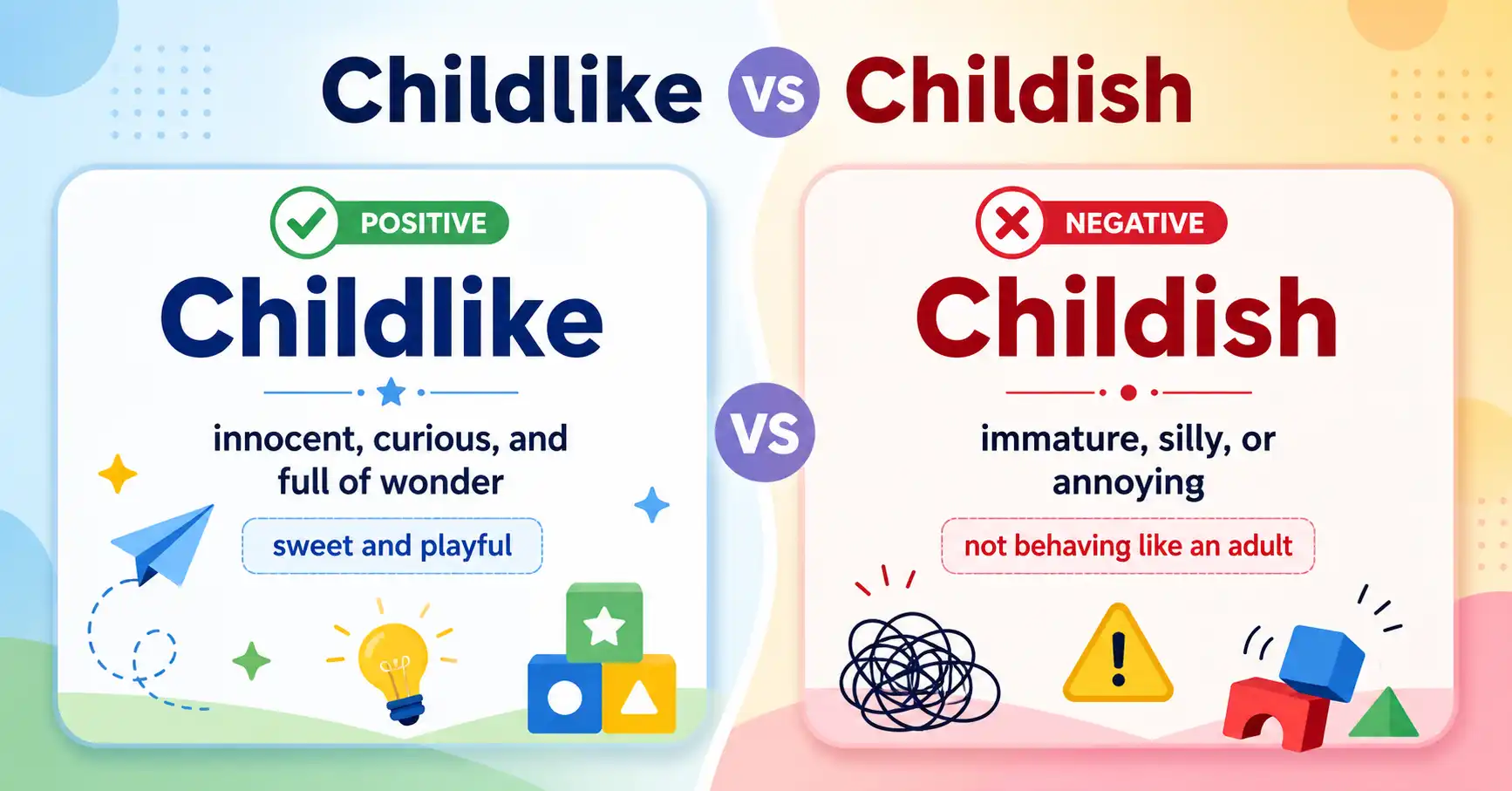
Words often carry hidden weights, and nothing illustrates this better than the childlike vs childish difference. While both words stem from the same root, using them interchangeably can lead to major misunderstandings in your writing and conversations. One describes a beautiful sense of wonder and innocence that we often lose as adults, while the other points toward immaturity and a lack of emotional growth.
In this guide, we will break down the nuances of these two adjectives, provide clear examples of how to use them correctly, and explain why being “childlike” might actually be the ultimate compliment.
Quick Answer: Childlike vs Childish — What Is the Core Difference?
The core difference between childlike and childish is connotation. Both words describe something that resembles a child, but:
• Childlike = POSITIVE qualities of a child: innocence, wonder, curiosity, openness, trust
• Childish = NEGATIVE qualities of a child: immaturity, selfishness, tantrums, blame-shifting
One-sentence definition: Childlike celebrates the best of childhood. Childish criticises the worst of childhood when it shows up in adults.
Side-by-Side Comparison: Childlike vs Childish
| Feature | Childlike | Childish |
| Connotation | Positive / Admirable | Negative / Disapproving |
| Core Trait | Innocence, wonder, curiosity | Immaturity, selfishness |
| Behavior in Adults | Charming, refreshing | Annoying, inappropriate |
| Emotional Response | Open, trusting, joyful | Tantrums, blame-shifting |
| In Relationships | Brings warmth and honesty | Causes conflict and friction |
| Origin (Etymology) | Mid-1500s (positive shift) | Before 12th century (neutral → negative) |
| Usage in Sentences | ‘She had a childlike smile’ | ‘His reaction was childish’ |
| Synonyms | Innocent, naive, open | Immature, petulant, puerile |
Etymology: Where Do These Words Come From?
Understanding the origin of these words removes all confusion permanently.
The Word “Childish”
Childish is the older of the two words. It dates back to Old English — before the 12th century — and originally had a completely neutral meaning: “of a child or typical of a child.” It was simply a descriptor with no good or bad flavour. However, by the 1400s, a second meaning emerged: describing the qualities of a child in a person who is no longer a child and therefore should know better. That negative meaning — silliness, lack of maturity, petulance — gradually became the dominant usage we recognise today.
The Word “Childlike”
Childlike entered the English language much later, around the mid-1500s. Its purpose from the beginning was to carry a positive meaning — describing innocence, trustfulness, openness, and ingenuousness in a person. Where “childish” evolved to carry a sting, “childlike” was specifically coined to provide a warm and complimentary alternative.
Linguistically speaking, the suffix “-ish” in English often implies “resembling in an annoying or inappropriate way” (e.g., foolish, oafish, brutish), while “-like” tends to mean “resembling in an appealing or neutral way” (e.g., lifelike, godlike, dreamlike). This suffix difference alone is the clearest grammatical signal of each word’s tone.
Full Definitions with Grammar Notes
What Does “Childlike” Mean?
Childlike (adjective): Having or showing qualities that are associated with children, especially the positive ones. When we describe an adult as childlike, we are paying them a compliment. We are saying they have preserved something genuinely valuable — an openness to the world, a sense of wonder, an honest enthusiasm — that most adults lose as they grow older.
Childlike qualities in an adult include:
• Innocent enthusiasm for simple pleasures
• Genuine curiosity and a love of learnin
Example sentences using “childlike”:
• Her childlike enthusiasm for the festival was absolutely contagious.
• Despite decades as a scientist, he maintained a childlike curiosity about the natural world.
What Does “Childish” Mean?
Childish (adjective): Having or showing behaviour that is considered typical of a child — especially in ways that are inappropriate, immature, or embarrassing for someone of adult age. When we describe an adult as childish, we are disapproving of something they said or did. We are pointing out that their behaviour falls short of the maturity we expect from a grown adult.
Childish traits in an adult include:
• Throwing emotional tantrums when things do not go their way
• Refusing to take responsibility and blaming others
• Being impulsive and unable to delay gratification
• Seeking constant attention and validation
• Using lies to protect themselves from consequences
• Stubborn refusal to compromise or consider other people’s perspectives
• Narcissistic tendencies — believing the world revolves around them
Example sentences using “childish”:
• His childish reaction to losing the game ruined the evening for everyone.
• It was incredibly childish of her to refuse to speak to him just because he disagreed.
• The manager’s childish behaviour in meetings made everyone uncomfortable.
• Throwing food when angry is childish and utterly unacceptable in adult society.
The Psychology Behind Childlike vs Childish Behaviour
Why Do Adults Behave Childishly?
From a psychological perspective, childish behaviour in adults is often traced to unresolved emotional development. Psychologists point to several possible explanations. Adults who did not receive consistent emotional security during childhood may still operate from a place of emotional reactivity — responding to stress the way a young child would, with anger, blame, or withdrawal. Clinical psychologists have noted that in extreme cases, persistent childish behaviour can be a marker of certain personality disorders, including narcissistic, borderline, histrionic, and dependent personality disorders.
In less clinical terms, most people show childish behaviour when they feel threatened. When someone is cornered, embarrassed, or has their ego bruised, the immature emotional responses — blame-shifting, sulking, or outbursts — can surface even in otherwise mature adults. This is why, as Psychology Today notes, people often show childish sides only under conditions of stress or perceived threat.
The Value of Childlike Qualities in Adults
Research in positive psychology and creativity has consistently found that childlike qualities — specifically curiosity, wonder, and imaginative play — are not signs of immaturity. They are signs of psychological health and creativity. Albert Einstein famously credited his scientific discoveries to his childlike curiosity, calling imagination more important than knowledge.
Adults who maintain a childlike approach to learning and exploration tend to be more innovative, more emotionally resilient, and more open to new experiences. They age better, form stronger relationships, and report higher levels of life satisfaction. The growing field of “play therapy” and research into adult play underlines that preserving childlike joy is not regression — it is flourishing.
Childlike vs Childish in Relationships
How Childish Behaviour Damages Relationships
In romantic relationships, friendships, and professional settings, childish behaviour is one of the most common sources of conflict and dysfunction. According to relationship psychology, childishness in relationships manifests as emotional immaturity — a state where a person expects others to be fully responsible for their happiness, security, and emotional regulation.
Key childish behaviours that damage relationships include:
• Silent treatment — using emotional withdrawal as punishment
• Inability to apologise or admit fault
• Constant need to “win” arguments rather than resolve them
• Jealousy and possessiveness rooted in insecurity
• Inability to have difficult conversations without explosive reactions
• Making everything about themselves — low empathy
These patterns trap relationships in cycles of conflict, miscommunication, and emotional exhaustion. Over time, childish dynamics erode trust, intimacy, and respect between partners.
How Childlike Qualities Enrich Relationships
Childlike qualities, on the other hand, are relationship assets. A person who brings childlike honesty, playfulness, curiosity, and openness into a relationship creates an environment of safety and joy. They are able to say what they feel without manipulation. They find delight in shared experiences. They trust their partner rather than approaching the relationship from a place of fear.
Childlike communication in relationships looks like:
• Saying ‘I feel hurt when this happens’ instead of ‘You always do this to me’
• Approaching disagreements with genuine curiosity — wanting to understand the other person
• Being present and playful, bringing lightness even to routine moments
• Trusting the other person rather than constantly testing them
Real-World Examples: Childlike vs Childish Side by Side
Scenario 1: At Work
Childish: A colleague receives critical feedback on a project and storms off, refuses to speak to the manager, and later complains to other team members that they were unfairly targeted.
Childlike: A senior engineer approaches every new technology with genuine excitement and shares that enthusiasm openly with the team, making learning feel like an adventure rather than a burden.
Scenario 2: In a Romantic Relationship
Childish: When his partner cancels a plan due to a work emergency, he sulks for two days, refuses to engage in conversation, and brings up the incident in unrelated arguments weeks later.
Childlike: She surprises her partner with a handmade birthday card full of honest, heartfelt words — unashamed of the effort and vulnerability it shows.
Scenario 3: With Money
Childish: He spends his entire month’s salary impulsively in the first week, then expects others to cover him and deflects all blame when asked about it.
Childlike: She lights up with genuine delight when she spots something she loves in a shop window, pointing it out to her friend with pure, unself-conscious joy — even if she doesn’t buy it.
Scenario 4: Learning Something New
Childish: He refuses to try a new skill because he is afraid of looking foolish, and mocks others who attempt it as a defense mechanism.
Childlike: She enrolls in pottery classes at fifty-three, fails cheerfully at centering clay, laughs at herself, and comes back every week — delighted by the process.
Grammar & Usage Tips: When to Use Each Word
If you are writing or speaking and want to use these words correctly, follow these simple rules:
Use “Childlike” when:
• You are complimenting someone’s innocence, wonder, or honest enthusiasm
• The qualities you are describing are admirable, charming, or endearing
• The person’s age does not make their behaviour inappropriate
• The context is positive — creativity, faith, openness, joy
Use “Childish” when:
• You are criticising someone for behaving immaturely
• The behaviour is inappropriate given the person’s age or situation
• The tone is disapproving or frustrated
• The qualities are negative — sulking, blame, tantrums, petulance
Common Mistake to Avoid
One of the most common mistakes in English is using “childish” to describe someone’s innocent excitement or playfulness — which accidentally insults them. For example, saying “He has a childish love of astronomy” when you meant to compliment him would imply his passion is somehow immature or silly. The correct word would be “childlike love of astronomy.”
The reverse mistake — calling something “childlike” when you mean to criticise it — softens your disapproval too much and may be misread as a compliment. If a colleague throws a tantrum at a meeting, their behaviour is childish, not childlike.
Related Terms and Concepts
For readers interested in the broader vocabulary network around these words, here are related terms that search engines associate with this topic (Semantic SEO / NLP entities):
• Puerile — Latin-rooted synonym for childish: ‘silly or childish especially in a way that shows a lack of seriousness or good judgment’
• Juvenile — another near-synonym: ‘unpleasantly childish’
• Immature — describes a general lack of emotional or mental development
• Naive — close to childlike but can suggest dangerous innocence rather than charming openness
• Innocent — a key synonym for childlike in many contexts
• Wonder — the emotional state most associated with childlike people
• Emotional maturity — the antonym of childish behaviour
• Inner child — a psychological concept describing the child-like emotional self within adults
• Play — a key behaviour associated with healthy childlike qualities in adults
Frequently Asked Questions (FAQ)
Q1: Is childlike a compliment?
Yes. Childlike is generally used as a compliment or positive observation. When you call someone childlike, you are saying they have preserved something genuinely valuable from childhood — innocence, curiosity, wonder, or honest enthusiasm.
Q2: Is childish always an insult?
In modern usage, childish almost always carries a negative or disapproving tone. However, historically the word was neutral. In rare literary or playful contexts, it can be used neutrally (e.g., ‘childish drawings’), but in most everyday conversations it implies criticism.
Q3: What is the difference between childish and immature?
Childish and immature are closely related but not identical. Childish behaviour often refers to specific surface-level actions — tantrums, sulking, silly petulance. Immature is broader and deeper — it suggests a person has not developed the emotional or psychological capacities expected for their age. All childish behaviour is immature, but not all immaturity looks childish.
Q4: Can a person be both childlike and childish?
Absolutely. A person can have childlike warmth, curiosity, and playfulness in one part of their life while showing childish immaturity in another — for example, someone who is genuinely open and creative at work but throws emotional tantrums in personal relationships. The two traits are not mutually exclusive.
Q5: How do I become more childlike and less childish?
The path from childish to childlike involves emotional self-awareness. Childish behaviour typically operates on autopilot — an unexamined reaction to feeling threatened or frustrated. Childlike behaviour, on the other hand, is a conscious choice to stay open, curious, and present. Strategies include practising emotional regulation, developing self-awareness through reflection or therapy, and deliberately cultivating wonder and gratitude in everyday life.
Q6: What does ‘childlike faith’ mean?
Childlike faith is a concept that appears in theology — particularly in Christian teaching — referring to the quality of trust, simplicity, and openness that children bring to their relationship with God. It is explicitly distinguished from childish faith, which involves demanding things, throwing spiritual tantrums, and expecting God to be a wish-fulfilling machine. Childlike faith trusts; childish faith demands.
Conclusion: The One Sentence You Need to Remember
If you remember only one thing from this entire article, let it be this:
“Childlike celebrates the best of childhood. Childish criticises the worst of childhood showing up in adults.”
Childlike people bring light into a room. Childish people drain it. Childlike qualities — wonder, curiosity, honesty, and innocent joy — are worth cultivating deliberately as you age. Childish qualities — immaturity, self-centredness, and emotional reactivity — are worth examining and growing beyond.
The difference between these two words is not merely grammatical. It is a lens through which we can look at our own behaviour and ask: in this moment, am I being the best of what a child can be — or the worst?

Ibrahim Jhon is an English language editor with over ten years of experience working with writers, publishers, and international businesses. He specialises in word choice, grammar accuracy, and the differences between British and American English.