
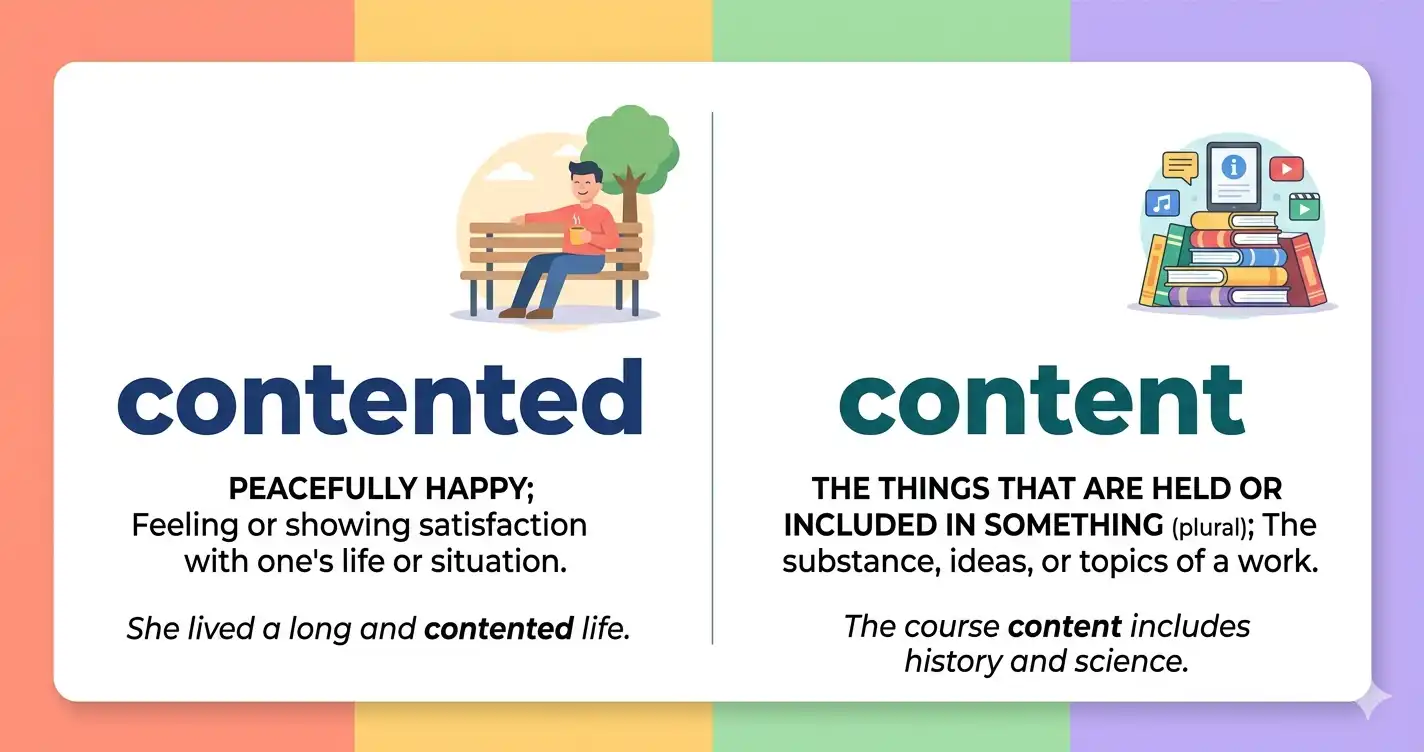
English is full of words that look almost the same but carry different weight when used in a sentence. “Contented” vs “content” are two such words. Both relate to feelings of happiness and satisfaction, yet swapping one for the other can subtly change the tone of what you are saying. Understanding this difference helps you write more precisely and speak more naturally.
This article breaks down everything you need to know about contented vs content — their definitions, grammatical roles, pronunciation, usage in sentences, adverb forms, and common mistakes.
What Does “Content” Mean?
The word “content” carries two completely different meanings depending on how you pronounce it.
When the stress falls on the first syllable — CON-tent — it functions as a noun. This is the version people use when talking about written material, website articles, or the items inside a container. For example, “the content of her essay was brilliant” or “the alcohol content in wine varies.”
When the stress falls on the second syllable — con-TENT — it functions as an adjective or a verb, and it relates to feelings of satisfaction. This is the version being compared with “contented” in this article.
As an adjective, “content” means being at peace with your current situation. It suggests a calm, quiet form of satisfaction — a feeling that nothing needs to change. The word “content” is more neutral and formal, often describing a calm sense of acceptance or being satisfied with what one has.
Examples:
- She was content with a simple life in the countryside.
- After finishing the project, he felt content with his effort.
- They are content to let things stay as they are.
“Content” means that you are completely happy with your current situation. It means that you do not want anything to change and that you feel satisfied.
As a verb, “content” means to satisfy or please someone. For example: “The small gift contented the child for a while.” Notice how the past tense of this verb — “contented” — is identical to the adjective. This is where the confusion often starts.
What Does “Contented” Mean?
“Contented” functions only as an adjective. It describes a state of happiness or satisfaction — but with a slightly different emotional quality than “content.”
According to Merriam-Webster, “contented” means feeling or showing satisfaction with one’s possessions, status, or situation.
“Contented” describes a deeper or more sustained level of satisfaction. Where “content” can describe a temporary feeling, “contented” often implies something longer lasting.
Examples:
- She lived a contented life filled with small joys.
- The cat curled up in its bed with a contented look on its face.
- He smiled a contented smile after completing the journey.
- They were a contented couple who found happiness in everyday moments.
Notice something in those sentences. “Contented” often appears before a noun — a contented smile, a contented life, a contented look. This is called an attributive adjective and it is one of the clearest grammatical differences between the two words.
Contented vs Content: The Core Difference
Here is where the real distinction becomes clear.
“Content” describes a calm, internal state of satisfaction, while “contented” expresses a visible or emotional form of happiness. Use “content” after verbs like “be” or “feel,” and “contented” before nouns, such as “a contented smile.”
Think of it this way. “I am content” tells us about a current, perhaps temporary state of mind. “She lived a contented life” tells us about a deeper, more enduring quality of happiness — something that shaped how she lived, not just how she feels right now.
“Content” leans toward a calm state of acceptance and satisfaction, while “contented” highlights a deeper sense of happiness and fulfillment.
Another way to understand it: “content” feels momentary. “Contented” feels settled.
| Feature | Content | Contented |
| Part of speech | Adjective or verb | Adjective only |
| Placement in sentence | After “be” or “feel” | Before nouns or after verbs |
| Duration of feeling | Often temporary | Often lasting |
| Tone | Neutral, calm | Warmer, more emotional |
| Example | I am content. | A contented sigh. |
Pronunciation: Why It Matters
Pronunciation is key with “content” because the same spelling carries two completely different meanings based on stress.
CON-tent (noun) = the material or substance inside something
con-TENT (adjective/verb) = satisfied, at ease
If you pronounce both forms the same way, confusion follows. English relies heavily on stress patterns to signal meaning. Mispronounce it and your listener hesitates.
“Contented” does not have this problem. It is always an adjective, always stressed on the second syllable — con-TEN-ted — and always refers to a feeling of satisfaction. This actually makes “contented” the less ambiguous of the two words in spoken English.
Grammatical Positions: Predicate vs Attributive
One of the most practical rules to remember:
“Content” is almost always used as a predicate adjective. This means it comes after the verb, typically after “be,” “feel,” or “seem.”
- She is content.
- He feels content.
- They seem content with the results.
It sounds awkward to say “a content person” or “a content smile” in standard English. Native speakers rarely use “content” directly before a noun.
“Contented” works comfortably in both positions. You can use it before a noun (attributive) or after a verb (predicate).
- A contented smile. (before noun — works perfectly)
- She is contented. (after verb — also correct)
Content is only a predicate adjective, following a form of a verb — while “contented” can appear in both positions.
This single rule alone solves most of the confusion between these two words.
Adverb Forms: Contentedly vs Contently
When you want to describe how someone does something with a sense of satisfaction, you move to the adverb form.
Contentedly is the standard adverb form, widely accepted and commonly used.
- She hummed contentedly as she worked in the garden.
- The baby slept contentedly after the long feeding.
- He accepted the outcome contentedly, without complaint.
Contently exists but is far less common. The standard and widely accepted form is “contentedly.” It means “in a satisfied way.” “Contently” is rare and informal, often seen in creative or poetic writing but not in formal English.
If you are writing anything formal — an essay, a report, professional correspondence — always use “contentedly.” Reserve “contently” only if you are writing creatively and want a lighter, less formal tone.
Common Mistakes and How to Avoid Them
Mistake 1: Using “content” before a noun
❌ She had a content smile on her face.
✅ She had a contented smile on her face.
Mistake 2: Treating both words as fully interchangeable
While they overlap in many situations, they are not always substitutes. “A contented life” suggests something deeper than “a content life.” The first sounds settled and meaningful; the second sounds flat.
Mistake 3: Confusing the noun “content” with the adjective
❌ The content of this video is very contented.
✅ The content of this video is very engaging. She looked contented while watching it.
Mistake 4: Using “contently” in formal writing
❌ He sat contently at his desk.
✅ He sat contentedly at his desk.
Real-World Usage Examples
Here is how both words appear naturally in sentences across different contexts:
Using “content”:
- After years of chasing goals, she was finally content with what she had built.
- He was not content to settle for second place.
- Are you content with the current arrangement?
- The workers seemed content, even without a raise.
Using “contented”:
- The elderly man led a contented life in a small village by the sea.
- A contented sigh escaped her as she closed the last page of the book.
- The dog gave a contented grunt and fell asleep in the sun.
- There was a contented stillness to the household that morning.
Notice how “contented” in these examples always adds warmth and depth. It paints a fuller picture.
Which One Should You Use?
Here is a simple decision guide:
- After “be,” “feel,” or “seem” → use content or contented (both work, but “content” is more natural in speech)
- Directly before a noun → always use contented
- To describe a lasting, settled state of happiness → prefer contented
- In casual conversation or quick writing → content is the simpler, safer choice
- For the adverb form → always use contentedly in formal writing
You will be better off using “content” in most cases when you want to show your true satisfaction toward something, while “contented” implies something has made you satisfied — though that feeling may be shorter-lived.
Summary
The difference between contented and content comes down to three key points. First, “content” works as both a predicate adjective and a verb, while “contented” works only as an adjective. Second, “content” sits after a verb in a sentence, while “contented” can sit comfortably before a noun. Third, “content” describes a calm and often momentary state of satisfaction, while “contented” carries a warmer, more enduring sense of fulfillment.
Many see “content” as being completely neutral, while “contented” has warmer, fuzzier overtones — as if adding the “-ed” adds a kind of emotional fabric softener to the word.
Both words are correct. Both are useful. Knowing when to reach for one versus the other is what separates polished writing from average writing. Now that you know the difference, your choice between the two will always be the right one.

Ibrahim Jhon is an English language editor with over ten years of experience working with writers, publishers, and international businesses. He specialises in word choice, grammar accuracy, and the differences between British and American English.