
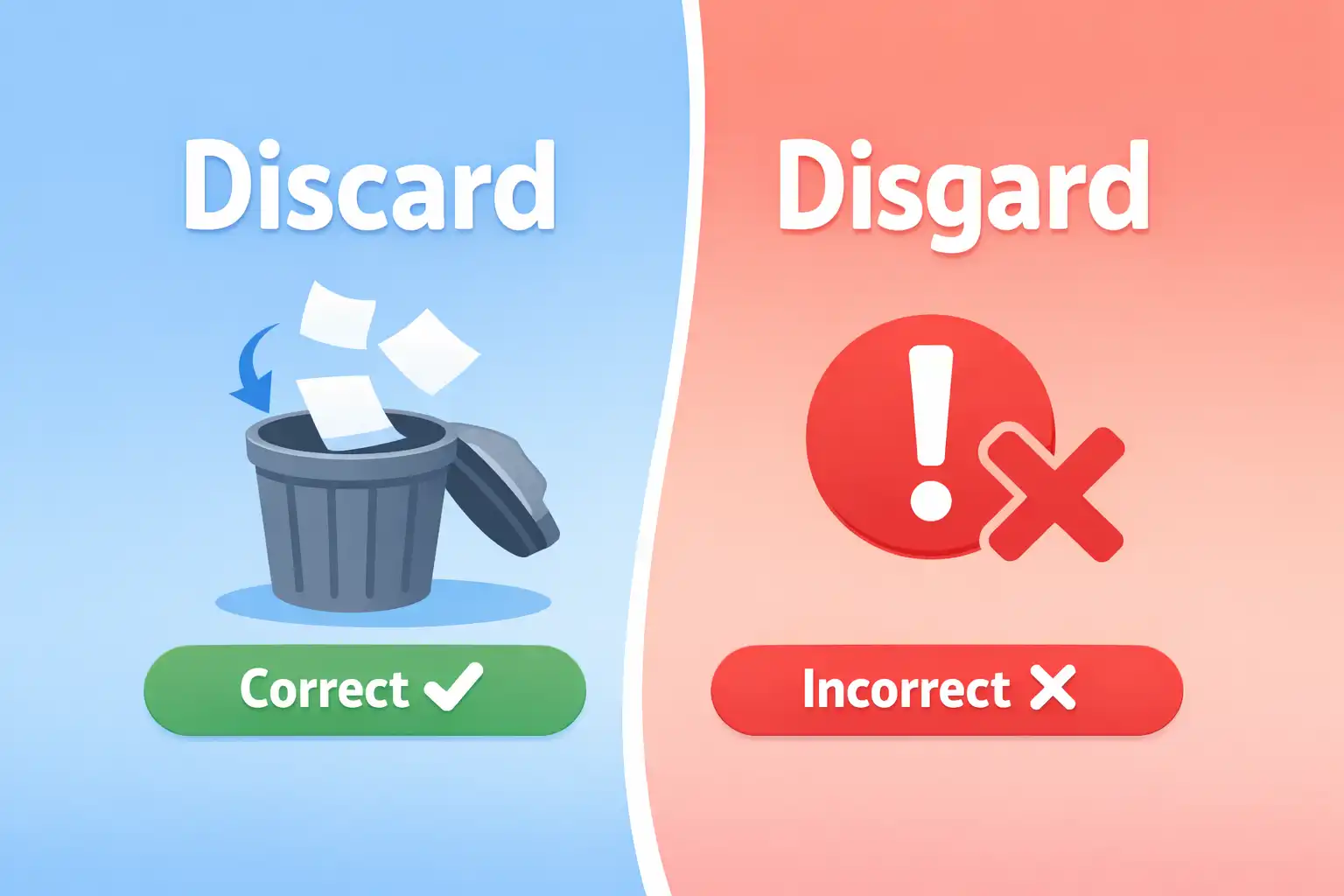
Many people stop and think when they write discard or disgard. The two words look very close. However, only one is correct. This small mistake can change how your writing looks. It can also affect trust, especially in emails, school work, or online posts.
Writers often confuse these spellings because English has many words with “-gard” or “-guard.” So the brain guesses the wrong pattern. Also, spell check tools do not always catch this error. That makes the problem worse.
In this guide, you will learn the correct spelling, why the confusion happens, and how to avoid it forever. You will also see real examples, common mistakes, and a simple rule that makes the choice easy. Wondering about discard or disgard? We compare both terms on our word comparison page to help clarify the difference.
discard-or-disgard – Quick Answer
- Discard is the correct spelling. It means to throw something away.
- Disgard is wrong. It is a spelling mistake.
Examples:
- Please discard old files.
- She discarded broken items.
Easy rule:
If you mean “throw away,” always use discard, not disgard.
Meaning of Discard
- Verb: to throw away something not needed
- Also used in cards: to remove a card from your hand
Examples:
- I will discard this paper.
- He discarded his old phone.
Meaning of Disgard
- Not a real English word
- Considered a spelling error
Examples:
- ❌ Please disgard this file
- ✅ Please discard this file
Easy rule again:
If you see “disgard,” fix it to “discard.”
The Origin of discard-or-disgard
The word discard comes from Old French. It comes from “descarter,” which means “to remove or reject.” The word later entered English and kept the same idea: to throw away or reject something.
Now, why do people write disgard?
The confusion comes from other English words like:
- guard
- regard
- safeguard
These words use “gard,” so writers guess “disgard” should also be correct. However, “discard” follows a different origin. So the spelling stays with “card,” not “gard.”
Today, this mistake happens a lot in quick typing, social media, and ESL writing. Learn how discard or disgard is used differently in UK and US English by exploring our UK vs US section.
British vs American English Spelling
There is no difference here. Both British and American English use the same spelling: discard.
| Type | Correct Spelling |
| American English | discard |
| British English | discard |
| Incorrect form | disgard |
However, in contrast, words like “colour” vs “color” change by region. But discard stays the same everywhere.
Examples:
- US: Please discard the draft
- UK: Please discard the draft
So, you do not need to worry about region here.
How to Choose the Right Word Fast
This case is very simple because only one word is correct.
For US writers:
Always use discard
For UK or Commonwealth writers:
Also use discard
Global or professional writing:
Use discard in all situations
There is no variation. So you can stay confident every time you write.
Quick tip:
Think of “card” inside “discard.” You remove a card. So you discard.
Common Mistakes with discard-or-disgard
Many writers make small errors. Here are the most common ones:
❌ Incorrect → ✅ Correct
- ❌ disgard → ✅ discard
- ❌ discart → ✅ discard
- ❌ discardd → ✅ discard
Explanation:
- “Disgard” comes from wrong guessing
- “Discart” is a typing error
- “Discardd” adds extra letters
Writers often type fast, so they miss these mistakes. But careful checking helps fix them.
discard-or-disgard in Real Life Examples
Now let’s see how discard works in real situations.
Emails:
- Please discard the old report.
- You can discard outdated files.
News:
- The company discarded unsafe products.
- Officials discarded false claims.
Social media:
- Time to discard bad habits!
- Just discard negative thoughts.
Professional writing:
- The system discards duplicate entries.
- Researchers discarded invalid data.
In each case, “discard” clearly shows removal or rejection.
discard-or-disgard – Word Usage Patterns and Search Trends
People often search “discard or disgard” because they feel unsure. This confusion is common among:
- Students
- ESL learners
- Beginner writers
- Content creators
Search trends show that users want quick clarity. They do not want long dictionary definitions. Instead, they need simple answers and real examples.
One real problem happens in job emails. If someone writes “disgard,” it may look careless. That can affect how others see their work.
So, learning the correct spelling helps both clarity and professionalism. Just as with discard or disgard, understanding the differences in terms like coach class vs economy can be confusing, but we help explain them.
Comparison Table: Discard vs Disgard
| Feature | Discard | Disgard |
| Meaning | To throw away | No meaning |
| Part of speech | Verb | Not a word |
| Context | Formal and informal | Never used |
| Formal use | Correct | Incorrect |
| Common mistake | Spelling confusion | Itself is the mistake |
| Example | Please discard waste | ❌ Please disgard waste |
This table shows clearly that only discard is valid.
FAQs
Is discard the same as disgard?
No. Discard is correct. Disgard is a spelling mistake.
Which one is correct in formal writing?
Always use discard in formal writing.
Can they be used interchangeably?
No. Only discard should be used.
Why do people confuse them?
People copy patterns from words like “guard” or “regard.”
Can grammar tools catch this mistake?
Some tools catch it, but not all. Manual checking helps.
Is there a British vs American difference?
No. Both use the same spelling: discard.
Is disgard ever correct in any case?
No. It is always incorrect.
Conclusion
The confusion between discard or disgard is very common, but the answer is simple. Only discard is correct. It means to throw away or remove something. On the other hand, disgard is not a real word at all.
This mistake happens because English has many similar-looking words. Writers often guess the wrong pattern. However, once you learn the origin and meaning, the confusion goes away.
In real life, using the correct spelling matters. It improves clarity, builds trust, and makes your writing look professional. This is true for emails, reports, and even social media posts. If you’re unsure about discard or disgard, exploring related confusions like wisp or whisp might offer some insight.
Overall, the best way to remember is this:
If you mean “throw away,” always use discard.
Finally, keep this simple rule in mind every time you write. It will help you avoid this mistake forever.

Ibrahim Jhon is an English language editor with over ten years of experience working with writers, publishers, and international businesses. He specialises in word choice, grammar accuracy, and the differences between British and American English.