
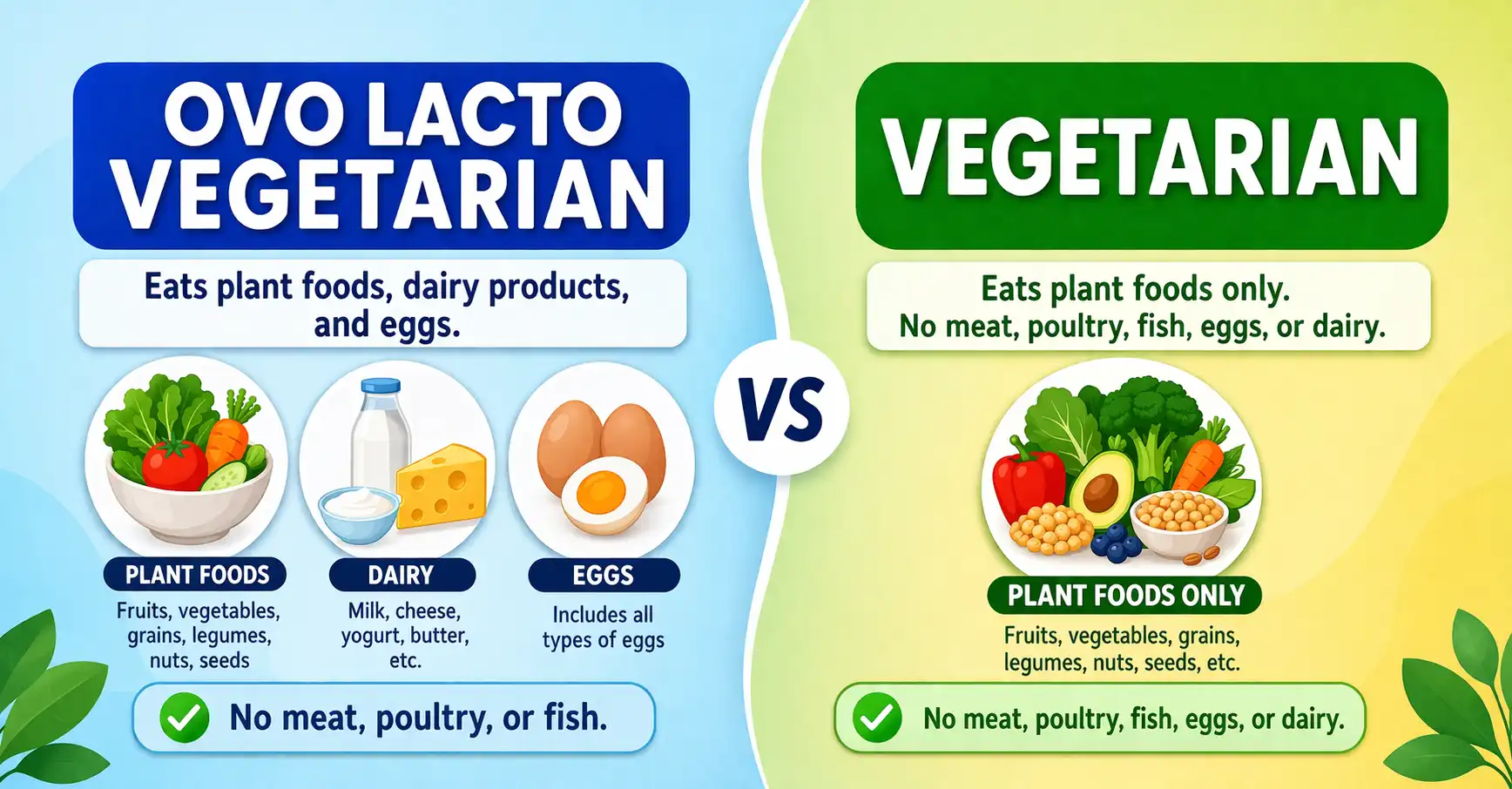
A food blogger I edited once described a breakfast recipe as “perfect for vegetarians” even though it used eggs and yogurt. A reader wrote in, annoyed, because she followed a strict no-egg vegetarian diet and felt misled. That kind of mix-up happens more often than writers think. I have corrected it in student essays, recipe cards, brand copy, and even a local news piece about school lunch options.
The confusion happens because vegetarian is both a broad label and, in everyday use, a vague one. Some writers use it as an umbrella term. Others use it as if it means one exact diet. Then ovo-lacto vegetarian adds another layer, since it sounds technical and gets dropped from casual writing even when it would be more precise.
Here is where most writers go wrong: they treat the two terms as equals. They are not. By the end of this article, you will know the exact difference, when to use each one, how editors read them, and where the wrong choice can make your writing look careless.
Ovo lacto vegetarian vs vegetarian – Quick Answer
An ovo-lacto vegetarian is a type of vegetarian who eats plant foods plus eggs and dairy. Vegetarian is the broader word. It can mean someone who avoids meat, but the exact foods allowed may vary unless the writer adds detail. When precision matters, ovo-lacto vegetarian is safer.
Meaning of Word A
Ovo-lacto vegetarian means a person who does not eat meat, poultry, or fish but does eat eggs and milk products. In edited food writing, this label usually appears when a writer needs to separate egg-and-dairy vegetarians from vegans or other vegetarian subtypes.
Meaning of Word B
Vegetarian usually means a person who does not eat meat, poultry, or fish. That said, the word often stays broad. In menus, articles, and school materials, it may or may not tell the reader whether eggs and dairy are included.
One decision rule
Use vegetarian for broad, general writing. Use ovo-lacto vegetarian when eggs and dairy matter to the meaning.
The Origin of ovo lacto vegetarian vs vegetarian
The real difference starts with the words themselves. Vegetarian grew from vegetable and became the standard English label for a meat-free diet. Ovo comes from the Latin ovum, meaning egg. Lacto comes from the Latin lac, meaning milk. Put together, ovo-lacto vegetarian is a compound label built for classification: eggs, milk, no meat.
That history explains the modern confusion. Vegetarian came into common use first and stayed broad. Ovo-lacto vegetarian arrived as a narrower term, mostly in nutrition writing, educational material, and food labeling. Writers often skip the longer term because it sounds formal. Then they lose precision.
I have seen this in product copy for meal kits. A writer labeled a cheese-and-egg pasta as “vegetarian,” which was technically fine, but the client later needed category pages separating egg-free meals from egg-containing meals. Because the original copy was too broad, the whole section had to be revised. One vague word created extra work.
A useful historical note: older food and health texts often used vegetarian without subtype labels because the audience already shared the context. Modern readers do not always share that context. Today, the narrower term matters more because diets are discussed in finer detail.
British vs American English
There is no major British vs American English spelling difference between vegetarian and ovo-lacto vegetarian. Both forms appear in both regions. The real difference is not spelling. It is tone and frequency.
In American writing, I see ovo-lacto vegetarian more often in academic, health, and diet-related content. In British and Commonwealth writing, vegetarian often carries the message on its own unless the writer needs to contrast it with vegan, pescatarian, or egg-free diets.
A university catering page I once edited for an international audience used vegetarian in one paragraph and ovo-lacto vegetarian in another without explanation. UK readers skimmed past it. ESL readers stopped and asked whether the two labels meant different meal plans. That is the tone problem in action.
| Point | American English | British/Commonwealth English |
| Spelling | vegetarian / ovo-lacto vegetarian | vegetarian / ovo-lacto vegetarian |
| Main difference | More likely to use technical subtype in formal content | More likely to keep the broader label in general content |
| Tone | Precision-first in diet and nutrition writing | Simpler wording in everyday public-facing copy |
| Best editorial move | Define once, then use the chosen term consistently | Define once, then avoid switching terms casually |
How to Choose the Right Word Fast
For a US audience, use vegetarian when the broader category is enough. Use ovo-lacto vegetarian when the reader needs to know that eggs and dairy are allowed. That includes recipes, campus dining pages, clinical forms, and product filters.
For a UK or Commonwealth audience, start with vegetarian unless the subtype changes the meaning. If a dessert contains gelatine, for example, vegetarian is already the key point. If a breakfast includes eggs and yogurt and the audience may assume egg-free, add the narrower term.
For global or professional writing, define the term once and remove guesswork. In my experience editing multilingual content, ESL writers often prefer the precise label because it feels safer. Native speakers often do the opposite and rely on context that is not actually on the page.
Here are the fast rules:
US guidance: If eggs or dairy matter, write ovo-lacto vegetarian.
UK/Commonwealth guidance: Use vegetarian first; narrow it only when needed.
Global/professional guidance: Pick the more precise term if the reader could misunderstand the diet.
The short answer is simple. Broad topic, broad word. Specific diet, specific term.
Common Mistakes with ovo lacto vegetarian vs vegetarian
Editors see this error most often in food content, school writing, and workplace communication.
❌ “Ovo-lacto vegetarian and vegetarian are two separate diets.”
✅ “Ovo-lacto vegetarian is one type of vegetarian diet.”
Why it is wrong: the first phrase treats the subtype as if it sits outside the main category.
❌ “The meal is vegetarian, so it contains no eggs or dairy.”
✅ “The meal is vegetarian, but it may still contain eggs or dairy.”
Why it is wrong: vegetarian does not automatically mean egg-free or dairy-free.
❌ “Our vegan and vegetarian cupcakes both include milk.”
✅ “Our vegetarian cupcakes include milk; our vegan cupcakes do not.”
Why it is wrong: I have seen this exact error in bakery copy, and it damages trust fast because the label affects buying decisions.
❌ “She is vegetarian because she only eats eggs and dairy.”
✅ “She follows an ovo-lacto vegetarian diet, which includes eggs and dairy along with plant foods.”
Why it is wrong: the sentence leaves out the full dietary pattern and sounds incomplete.
❌ Student essay: “Many vegetarians eat meat occasionally, unlike ovo-lacto vegetarians.”
✅ “People use vegetarian in different casual ways, but in formal writing it means no meat; ovo-lacto vegetarian adds that eggs and dairy are included.”
Why it is wrong: the original sentence confuses casual behavior with the definition of the diet.
ovo lacto vegetarian vs vegetarian in Real-Life Examples
In a professional email, precision matters when food is tied to planning:
“Two conference guests requested ovo-lacto vegetarian meals, so please include options with eggs or cheese but no meat.”
I have edited event emails where the writer used only vegetarian, then the catering team sent an egg-free tray by mistake. One missing modifier caused a chain of follow-up messages.
In news writing, the broader term often works better unless the subtype is central:
“The school added more vegetarian lunch choices after parent feedback.”
But if the story compares menu categories, the narrower label helps:
“The new breakfast menu includes ovo-lacto vegetarian items such as yogurt parfaits and egg wraps.”
On social media, space pushes writers toward the shorter word:
“New vegetarian breakfast bowls now in stock.”
That is fine unless the audience needs detail. A café caption I reviewed got pushback because followers assumed the bowl was dairy-free. After the edit, the post read:
“New ovo-lacto vegetarian breakfast bowls with egg, feta, and roast veg.”
In a formal document, clarity beats brevity:
“The participant reports following an ovo-lacto vegetarian diet.”
That wording leaves less room for error than “vegetarian” on its own. Forms, reports, and intake documents benefit from exact labels.
ovo lacto vegetarian vs vegetarian – Word Usage Patterns and Search Trends
The people who search this phrase are usually students, ESL learners, health-content writers, recipe publishers, and professionals updating food labels or event materials. They are not always confused about the diet itself. Often, they are unsure which term sounds correct on the page.
I have noticed a sharp pattern in editing work. ESL learners often overuse ovo-lacto vegetarian because they want maximum accuracy and may not trust the broader term. Native speakers do the reverse. They often write only vegetarian and assume the reader will fill in the details. Both habits can create problems.
One real cost shows up in school writing. A student may write that “vegetarian means no meat, eggs, or dairy,” blending vegetarian and vegan into one category. In a classroom setting, that can lose marks because the definition is too broad in the wrong direction. In business writing, the cost is credibility. A restaurant menu or grocery filter that labels an egg-and-cheese product too loosely can trigger complaints.
This is where competitors often stop at simple definitions. The deeper pattern is about writer instinct. ESL writers tend to fear being under-specific. Native writers tend to fear sounding stiff. Good editing solves both problems by matching the term to the situation.
Comparison Table
| Feature | Ovo-lacto vegetarian | Vegetarian |
| Meaning | A vegetarian diet that includes eggs and dairy | A broad meat-free diet label |
| Part of speech | Noun or adjective | Noun or adjective |
| Eggs allowed | Yes | Often yes, but not always stated |
| Dairy allowed | Yes | Often yes, but not always stated |
| Used in formal writing | Yes, when precision matters | Yes, especially in general writing |
| Best use | Specific diet descriptions | Broad category descriptions |
| Common mistake | Treating it as separate from vegetarian | Treating it as identical to vegan or egg-free |
| Correct example | “She follows an ovo-lacto vegetarian diet.” | “The restaurant offers vegetarian options.” |
FAQs — People Also Ask
Is ovo-lacto vegetarian the same as vegetarian?
Not exactly. Ovo-lacto vegetarian is a type of vegetarian diet. Vegetarian is the broader label.
Do vegetarians eat eggs and dairy?
Many do, but not all use the label the same way. That is why precise writing sometimes needs ovo-lacto vegetarian.
What does ovo-lacto mean?
Ovo means eggs. Lacto means milk. The term describes a vegetarian diet that includes both.
Should I write vegetarian or ovo-lacto vegetarian on a menu?
Use vegetarian for simple menus. Use ovo-lacto vegetarian if diners need to know the dish contains eggs or dairy.
Is ovo-lacto vegetarian a formal term?
Yes. It appears more often in academic, nutrition, and institutional writing than in casual conversation.
Why do writers confuse vegetarian with vegan?
Because people use food labels loosely in speech. On the page, though, the difference matters and readers notice.
Can using the wrong term hurt credibility?
Yes. A wrong label in a recipe, menu, or school paper makes the writer look careless, even when the rest is solid.
Conclusion
Overall, the one distinction that matters most is this: ovo-lacto vegetarian is a specific kind of vegetarian, not a rival term and not a separate umbrella. It tells the reader that eggs and dairy are included. Vegetarian does not always tell them that on its own.
The single most common mistake to avoid is treating vegetarian as if it automatically means no eggs and no dairy. I have corrected that error in student work, recipe pages, and brand copy more times than I can count. It usually comes from speed. The writer thinks the broad label is enough. Then a reader reads it more closely.
In short, use the shorter word when the category is broad. Use the longer one when the detail changes the meaning. That is the rule editors return to again and again.
Memorable rule: if eggs and dairy matter, name them through the label.

Ibrahim Jhon is an English language editor with over ten years of experience working with writers, publishers, and international businesses. He specialises in word choice, grammar accuracy, and the differences between British and American English.