
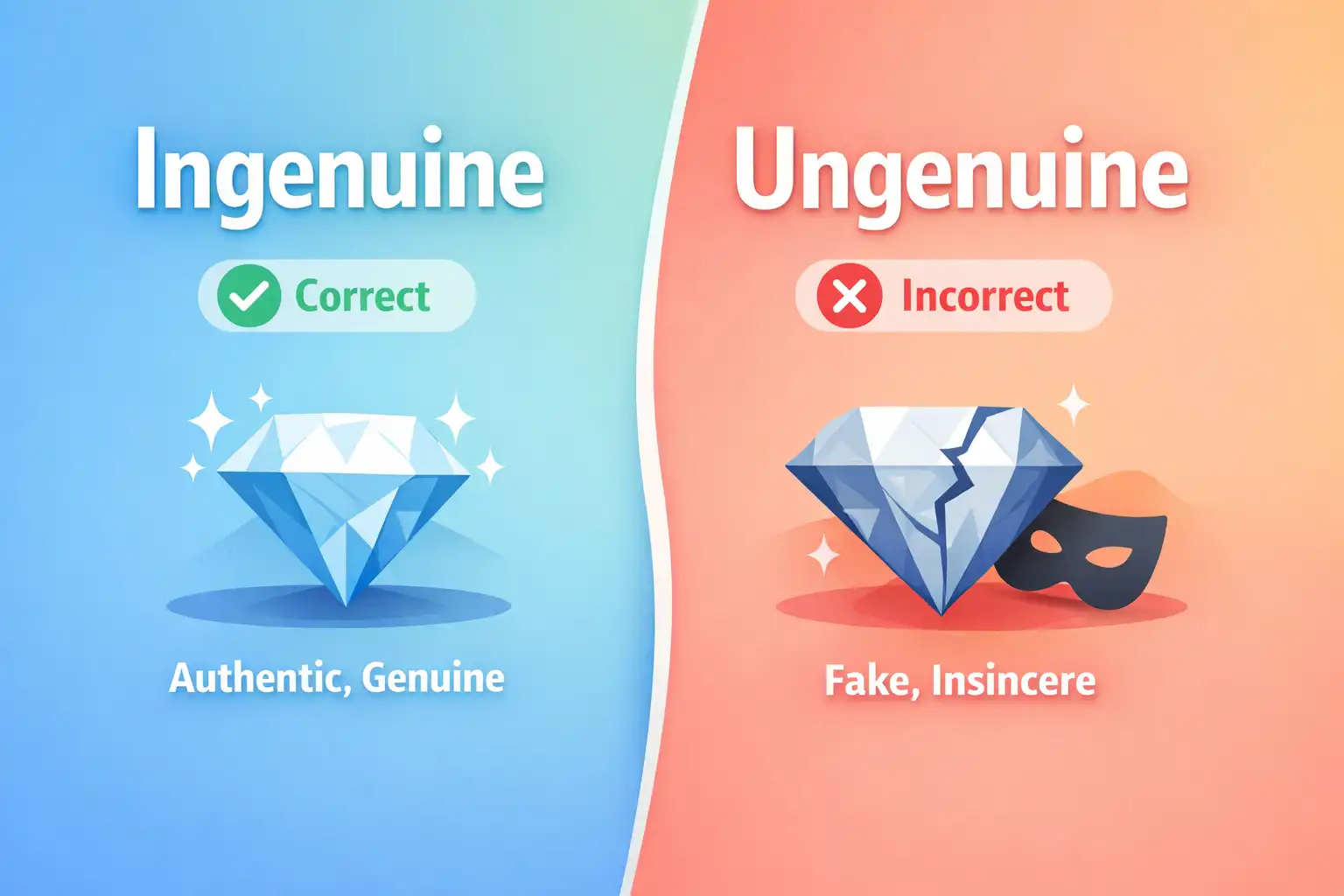
If you’ve ever typed “ingenuine or ungenuine” into Google and stared at the results in confusion — welcome to the club. Thousands of people search for this exact phrase every month because both words look right. Both feel right. And yet, only one of them is accepted in standard English.
But here’s where it gets interesting: the full answer is more nuanced than most websites tell you.
In this guide, you’ll get:
- A clear, fast answer
- The linguistic reason why this confusion exists
- Real-life sentence examples for both words
- The word you should actually be using instead
- Answers to every common question people ask about these words
By the end, you’ll never second-guess yourself again.
Quick Answer — Ingenuine or Ungenuine?
Ungenuine is the correct word. It is recognized by the Merriam-Webster dictionary and used in major English publications.
Ingenuine is not standard English. It does not appear in major dictionaries and is considered incorrect by most grammar authorities.
However — and this is important — neither word is the best choice in professional or formal writing. The word you should actually use in most situations is disingenuous, insincere, fake, or simply not genuine.
Here is a quick summary before we go deeper:
| Word | Status | When to Use |
| Ungenuine | Accepted (informal) | Casual writing only |
| Ingenuine | Not standard | Avoid entirely |
| Disingenuous | Fully correct, formal | Formal and professional writing |
| Not genuine | Safest option | Any context |
Why Do People Confuse Ingenuine and Ungenuine?
This confusion is completely logical, and you are not wrong for being confused. Here is why it happens.
English Has Two “Not” Prefixes
English uses both “un-“ and “in-“ to mean “not.” For example:
- Un-: unhappy, unfair, unrealistic, unreal
- In-: incorrect, incomplete, insincere, inactive
Because both prefixes exist and both mean the same thing, it feels natural to say either ungenuine or ingenuine. The brain follows the pattern it knows.
The problem is that English did not follow consistent rules here. Over time, native speakers settled on ungenuine — not through logic, but through usage. Language is shaped by habit, not math.
The Word “Ingenuous” Creates More Confusion
Here is a twist that most articles skip: the word ingenuous already exists in English. It means honest, innocent, or unsophisticated. So if someone said “ingenuine,” it would sound dangerously close to “ingenuous” — creating real ambiguity in meaning.
This is one reason English speakers historically avoided ingenuine. It could be misheard or misread as a variation of ingenuous, which means nearly the opposite of what you intend.
Historical Pattern
The word “genuine” comes from Latin genuinus, meaning natural or real. When English needed a negative form, it applied the Germanic prefix “un-” rather than the Latinate “in-.” This mirrors how English handles many similar words — ungrateful (not ingrateful), unfair (not infair).
Is Ingenuine a Real Word?
Technically, ingenuine has appeared in older texts and in online usage. But it is not recognized in Merriam-Webster, Oxford, or Cambridge dictionaries as a standard English word.
When a word does not appear in major dictionaries, it is considered non-standard. Using it in professional writing, academic work, or formal emails makes your writing appear unprofessional or error-prone.
Verdict: Avoid ingenuine entirely. There is no situation where it is the best choice.
Is Ungenuine a Real Word?
Yes — but with limits.
Ungenuine is listed in Merriam-Webster dictionary, defined simply as “not genuine.” Major publications like The Verge, Slate, and The Guardian have used it in print.
However, it is still considered informal and somewhat rare. Many grammar experts prefer disingenuous or insincere for formal writing because they are more widely recognized and carry clearer meaning.
Verdict: Ungenuine is acceptable in casual writing. In formal contexts, use a better alternative.
Sentence Examples — Ungenuine vs Ingenuine
Correct Usage (Ungenuine)
- His apology felt ungenuine — like he was saying the words but not meaning them.
- The customer reviews seemed ungenuine and possibly fake.
- She gave an ungenuine smile that didn’t reach her eyes.
- The politician’s concern for voters came across as ungenuine.
- His enthusiasm during the meeting was clearly ungenuine.
Incorrect Usage (Ingenuine — Avoid These)
- ❌ His apology felt ingenuine.
- ❌ The reviews seemed ingenuine.
- ❌ She gave an ingenuine smile.
These examples are wrong not because the meaning is unclear, but because ingenuine is not accepted in standard English. Readers who know this will judge your writing negatively.
What Word Should You Actually Use?
Here is the most important section of this entire article.
Even though ungenuine is technically correct, it is still an unusual word that many readers find awkward. In most situations, there is a better word available.
Use “Disingenuous” in Formal Writing
Disingenuous means not candid or sincere — typically referring to someone who pretends to be honest while hiding real motives. This is the most respected word in this category.
- ✅ His apology was disingenuous — he made the same mistake three days later.
- ✅ The company’s statement was disingenuous, downplaying obvious safety concerns.
- ✅ She was being disingenuous when she claimed she had no idea about the plan.
Use “Insincere” for People and Emotions
Insincere is the clearest, most natural word when describing someone who doesn’t mean what they say.
- ✅ Her compliments always felt insincere.
- ✅ He gave an insincere apology and moved on.
Use “Fake,” “False,” or “Not Genuine” for Objects or Actions
- ✅ The product had fake reviews.
- ✅ The signature looked not genuine.
- ✅ His smile was false and unconvincing.
Quick Reference Guide
| Situation | Best Word to Use |
| Formal writing or academic work | Disingenuous |
| Describing someone’s words or feelings | Insincere |
| Describing an object or product | Fake / Not genuine |
| Casual blog or social media | Ungenuine |
| Never use | Ingenuine |
British English vs American English — Is There a Difference?
No. This is not a British vs American spelling issue.
Both British English and American English recognize ungenuine and reject ingenuine. Unlike colour/color or realise/realize, there is no regional variation here. The rule is universal.
SEO Writing Tip — Which Word Should You Target?
If you are writing content and wondering which version to optimize for, here is the answer:
Target “ingenuine or ungenuine” as your primary keyword phrase because this is what people actually type into Google when they are confused. They are not sure which is correct, so they search both together.
You should also cover:
- “is ingenuine a word”
- “is ungenuine a word”
- “ingenuine meaning”
- “ungenuine meaning”
- “disingenuous meaning”
This covers the full intent of users at different stages of their confusion.
Common Mistakes Writers Make
Mistake 1 — Using Ingenuine in Professional Emails
Many non-native English speakers write something like: “His response seemed ingenuine and I couldn’t trust his words.” This immediately flags the writer as someone not fully fluent in standard English. Always replace this with disingenuous or insincere.
Mistake 2 — Assuming Ungenuine Is Formal
Even though ungenuine is a real word, it is not formal. Do not use it in cover letters, academic essays, or business reports. Save it for blog posts or casual articles.
Mistake 3 — Confusing “Disingenuous” with “Unintelligent”
Some people avoid disingenuous because it sounds complex. But it simply means not honest or sincere in behavior. It does not mean stupid or uneducated. It is a precise, respected word worth adding to your vocabulary.
Frequently Asked Questions
Is ingenuine correct?
No. Ingenuine is not recognized by major English dictionaries and is considered non-standard. Avoid it in all forms of writing.
Is ungenuine a word?
Yes. Ungenuine is listed in Merriam-Webster as meaning “not genuine.” However, it is informal and many writers prefer disingenuous or insincere.
What is the difference between ungenuine and disingenuous?
Ungenuine simply means “not genuine.” Disingenuous is stronger — it implies someone is deliberately pretending to be honest while concealing their real motives. Disingenuous is the more precise and respected choice.
Can I use ungenuine in academic writing?
It is technically acceptable, but not preferred. Academic writing benefits from more precise vocabulary. Use disingenuous, insincere, or inauthentic instead.
What is a synonym for ungenuine?
Fake, insincere, dishonest, false, disingenuous, inauthentic, hollow, artificial.
Why do people write ingenuine instead of ungenuine?
Because English has two negative prefixes — “in-” and “un-” — both meaning “not.” Since words like incorrect and incomplete use “in-“, people assume ingenuine follows the same rule. It does not, because English usage settled on “un-” for this word historically.
Final Verdict
| ❌ Never Use | ⚠️ Use Carefully | ✅ Best Options |
| Ingenuine | Ungenuine (casual only) | Disingenuous (formal) |
| Insincere (people/feelings) | ||
| Fake / Not genuine (objects) |
If you remember only one thing from this article: never write ingenuine, and when in doubt, simply write “not genuine” — it is always correct, always clear, and works in every situation.
Language exists to communicate clearly. Choose words that help your reader — not words that make them pause and question your credibility.
Yahan aapka complete package hai:

Ibrahim Jhon is an English language editor with over ten years of experience working with writers, publishers, and international businesses. He specialises in word choice, grammar accuracy, and the differences between British and American English.